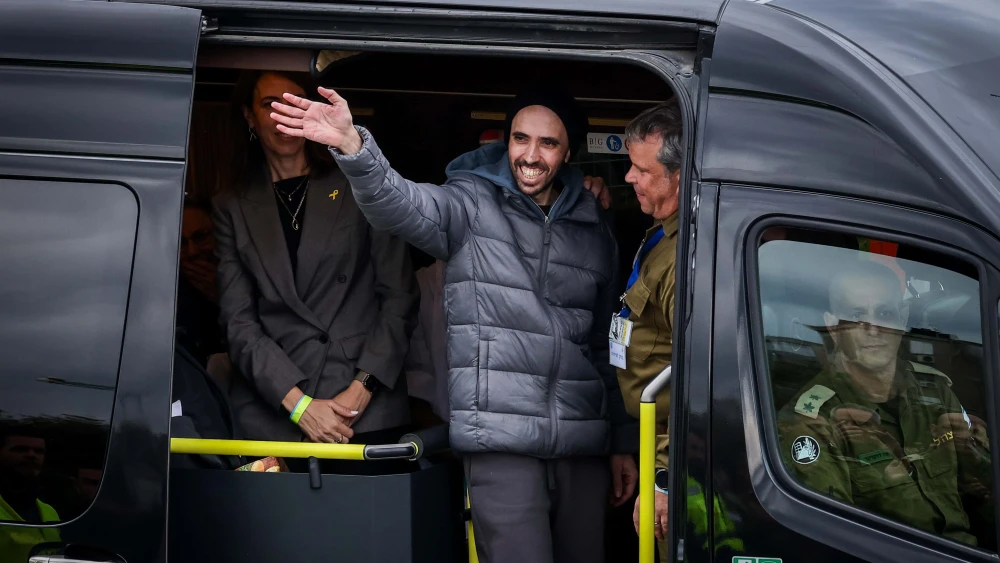
Gaza captivity survivor Tal Shoham told Israel’s Channel 14 on Sunday night that Hamas is deliberately starving the hostages to pressure the Israeli public into backing a ceasefire deal.
“They starved us on purpose, in a sadistic and cruel way,” Shoham told Channel 14‘s “The Patriots” show. According to the former hostage, “it wasn’t about a humanitarian aid shortage. Right beyond the iron door that shut us in, we heard them boasting that they had supplies for the months ahead—supplies they had stolen from their own population.”
“They also admitted that they were starving us so that we would send a message,” Shoham revealed. “They wanted us to come out broken, to shock the Israeli public and pressure the government to reach a deal.”
After the release of emaciated hostages Eli Sharabi and Ohad Ben Ami, the terrorists tasked with guarding Shoham expressed their frustration over the global criticism Hamas received, he claimed. “They admitted their goal was to pressure and shake Israeli society,” Shoham stated.
Shoham described the 505 days in captivity as a “psychological war,” noting that his captors alternated between optimism about the war’s end and deep frustration, but were unequivocal about starving him.
“Down below, in the tunnels, we hardly received any information from the outside, only small anecdotes,” he said. However, “when they spoke about starvation, they were clear: the goal was to make us suffer, just as they claimed their people are suffering,” he added.
Shoham, a dual Israeli–Austrian citizen, was abducted on Oct. 7, 2023, during the Hamas-led attack on Kibbutz Be’eri, alongside his wife Adi and the couple’s two children. Shoham’s in-laws were among the approximately 1,200 people murdered by terrorists that day.
Adi, daughter Yahel, 3, and son Naveh, 8, were released after 50 days in captivity as part of the first ceasefire agreement with the terrorist group.
Tal was only freed from Gaza 455 days later as part of the most recent hostage deal with Hamas on Feb. 22, alongside fellow hostages Eliya Cohen, Avera Mengistu, Hisham al-Sayed and Omer Shem Tov.
Speaking with the Associated Press in April, Shoham revealed that after his wife was freed, an individual identifying himself as a member of Hamas called to warn her not to talk about what she’d been through.
If she did, the terrorist said, her husband would be murdered, Shoham told the Associated Press, noting there are still details of his captivity he cannot discuss due to fear of endangering the remaining hostages.
Fifty-eight hostages are still being held by Hamas in the Gaza Strip after almost 700 days, some 20 of whom are believed by Jerusalem to be alive.