Newsletter
Newsletter Support JNS

Israel, Cyprus, Greece to link power grids via undersea cable

The $9 billion EuroAsia Interconnector will be the world’s longest and deepest underwater power cable, according to Israel’s Energy Ministry.

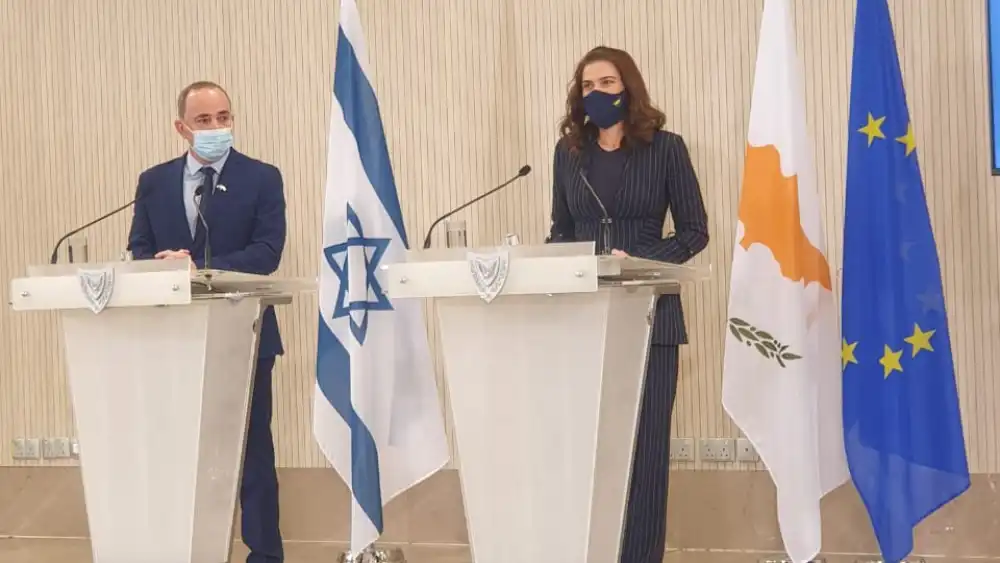
Israeli Energy Minister Yuval Steinitz and Cypriot Energy Minister Natasa Pilides at the signing of a Memorandum of Understanding (MoU) in Nicosia, Cyprus, regarding the construction of an undersea power cable connecting the two countries' power grids, as well as that of Greece, March 8, 2021. Source: Twitter.
Israeli Energy Minister Yuval Steinitz and Cypriot Energy Minister Natasa Pilides at the signing of a Memorandum of Understanding (MoU) in Nicosia, Cyprus, regarding the construction of an undersea power cable connecting the two countries’ power grids, as well as that of Greece, March 8, 2021. Source: Twitter.

Israel, Cyprus and Greece signed a Memorandum of Understanding (MoU) on Monday regarding a project to link their power grids via the construction of the world’s longest and deepest undersea power cable.

The project, called the “EuroAsia Interconnector,” will help Israel build on more options for renewable energy, contribute to energy security and reduce energy prices, said Israeli Energy Minister Yuval Steinitz at the signing ceremony in Nicosia.

Steinitz called the MoU “great news for the citizens of Israel,” according to a ministry statement.

“The Euro-Asia Interconnector underwater power cable will allow us to receive electricity backing from the power grids of the European continent in times of emergency, and more importantly will also support our ability to significantly increase reliance on solar power generation, and help us meet the government’s 2030 solar-energy targets,” he said.

Cypriot Energy Minister Natasa Pilides said that the MoU marked “a decisive step towards ending the island’s energy isolation and, consequently, our dependence on heavy fuels.”

Once completed, the undersea power cable will be the longest and deepest in the world, according to the ministry. The cable, which will be laid at a maximum depth of 2,700 meters (nearly 9,000 feet), will have a capacity of 1,000 to 2,000 megawatts.

According to the ministry, the project is expected to cost a bit more than $9 billion, part of which is to be provided by the European Union, which has recognized the undertaking as a Project of Common Interest.
In a draft report delivered to the U.S. president, the commission also called for improved religious accommodations for U.S. service members.
Salah Salem Sarsour, accused of concealing Israeli military court convictions on immigration forms, argued his detention was part of a Trump admin effort to target the pro-Palestinian movement.
CENTCOM stated that the strikes targeted missile, drone and radar facilities after the Islamic Republic attacked a cargo ship in the Strait of Hormuz, calling the assault a violation of the ceasefire.
Now that the primaries are over, “we hope that everyone will come together and be united,” Christine Quinn, chair of the executive committee of the New York State Democratic Party, told JNS.
An Iranian official warned on Friday that the safety of ships passing through the Strait of Hormuz without Iran’s permission “cannot be guaranteed.”
“We have put the train back on the tracks and going in the right direction,” said Yechiel Leiter, Israeli ambassador in Washington. “Final destination? Peace between our two countries.”
Benny Gantz, JNS editor-in-chief Jonathan S. Tobin, Gilad Erdan, Mosab Hassan Yousef, Nissim Black and leading voices in security, diplomacy, media, law and Jewish communal affairs headline the summit’s third day in Jerusalem.