


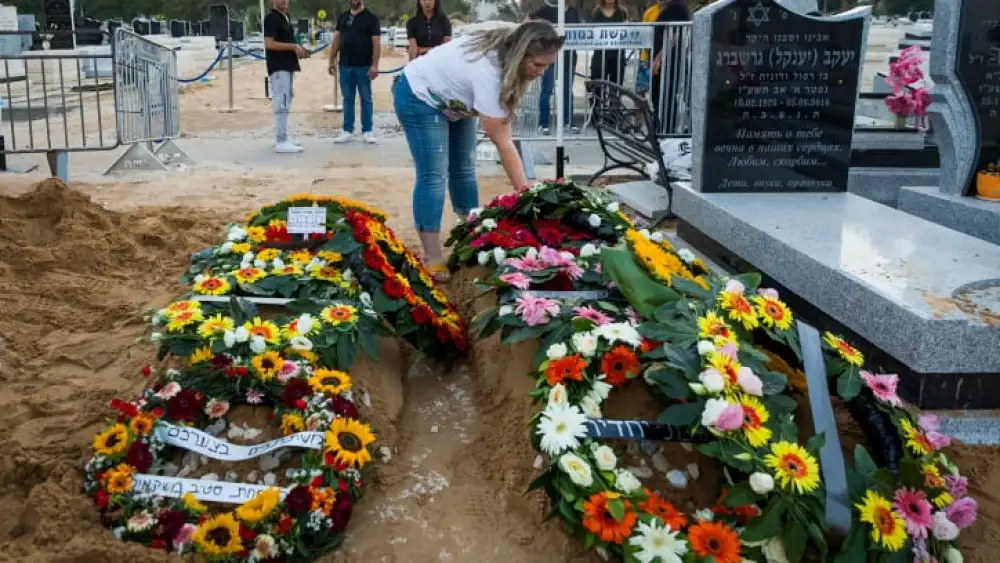
Monday’s murderous terrorist attack on Route 60 in Hebron, in which an Israeli woman was shot dead and a man seriously injured, is just the latest indication of the sad fact that Israel is in the middle of a prolonged security escalation in Judea and Samaria—with no end in sight.
The incident comes two days after an Israeli father and son were shot dead in Huwara, an attack that may have helped “inspire” Monday’s shooting.
So far in 2023, 34 people (33 Israelis and an Italian tourist) were killed in Palestinian terrorism, and almost 200 shooting attacks occurred in Judea and Samaria. In the whole of 2022, terrorists killed 31 people and there were 281 shooting attacks.
These figures attest to the scope of the escalation. The Israel Defense Forces and Israel Security Agency (Shin Bet) are engaged in a non-stop effort to combat terrorism in the area, sending in backup forces and holding assessments daily all the way up to the level of the General Staff, according to an Israeli military source.
Over 20 IDF battalions are active in Judea and Samaria, including the Givati Reconnaissance Battalion that was dispatched on Saturday after the Huwara shootings.
In the end, however, no matter how many backup forces it sends, the IDF still cannot be everywhere at once or preempt every attack.
There are many roads in Judea and Samaria that provide easy targets for terrorists looking to fire on Israeli vehicles, including Route 60 and the Hurawa “corridor,” which Israelis in the area must use to move between north and south—although the decision by the father and son on Saturday to stop at Hurawa for several hours was extremely dangerous.
Other signs of the escalation can be found in the fact that where in the past a single IDF company was sufficient to hold the Huwara area, now an entire battalion is needed, according to the Israeli military source.
The fact that so many IDF battalions have to be deployed to Judea and Samaria is also negatively impacting training.
Last month, work reportedly began to construct a Huwara bypass road, which if completed will significantly ease the pressure on Israeli security forces.
While the current situation is not a full-blown intifada, the figures indicate that it is indeed prolonged escalation, and despite the massive resources and efforts that the IDF and Shin Bet are pouring into Judea and Samaria, terrorists’ motivation remains high.
Furthermore, their ability to carry out attacks is enhanced by the enormous quantities of firearms flooding the area.
The guns are being smuggled in from Jordan, produced in Palestinian workshops and stolen from IDF bases in southern Israel. On Aug. 1, Israel announced that it would build a new security barrier on the border with Jordan, in an attempt to staunch the flow.
The July 5-6 Jenin operation launched by the IDF saw hundreds of weapons seized by security forces, and Israel will continue to launch such operations at various scales, but it will not be enough.
According to the military source, for every successful terrorist attack on average some 10 are foiled by Israel, providing a glimpse into the true extent of the threat.
The instability of the Palestinian Authority, the ability of Hamas to exploit it, and friction between Palestinians and Israelis are all contributing to the strain on the IDF’s efforts.
Israel meanwhile is continuing its policy of allowing some 150,000 Palestinians who have passed security screening to work in Israel, as part of its targeted approach that seeks to differentiate between terrorists and civilians, and to decrease the ability of Hamas to use its murderous incitement to recruit even more attackers.
At the same time, the IDF is under pressure from Israeli civilians to show better results and to bring down the number of attacks.
Israel’s round-the-clock counter-terrorism effort is up against a network of hostile actors involving local gunmen supported by Hamas, Palestinian Islamic Jihad and Iran, with the latter three pouring cash and incitement as fuel onto the fire.
Iran, for its part, is implementing a decision taken around a year ago to transfer its conflict with Israel into Judea and Samaria and the streets of Israel, after its failure to respond to a series of blasts and incidents on Iranian territory that it blamed on Israel.
As such, Iran is strengthening its support for its proxy Hezbollah in Lebanon, while in Judea and Samaria it is working to inject more cash for weapons production and for destabilizing the arena.
Israel’s fight against terrorism in the area is set to be a long-term affair.


