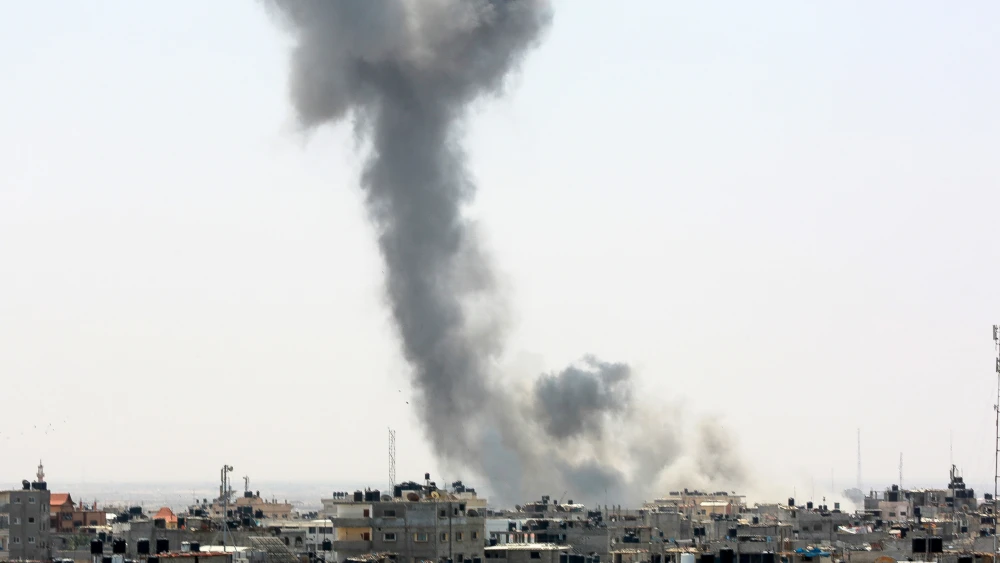
The Israel Defense Forces launched its largest wave of airstrikes in the Gaza Strip since “Operation Protective Edge” in 2014 as more than 100 rockets were fired by the Palestinian terror groups Hamas and Islamic Jihad at southern Israel on Saturday.
According to the IDF, it struck more than 40 terror targets in the Gaza Strip, including two terror tunnels, two large logistic centers and a Hamas Battalion HQ in Beit Lahia in northern Gaza.
The rocket and mortar fire from the Gaza Strip began around 1:30 a.m. local time on Shabbat, giving residents of southern Israel only 15 seconds to run and seek shelter during the middle of the night. The barrage continued throughout the night with some 30 projectiles being launched. The rocket and mortar fire resumed again on Saturday afternoon with a further 100 launched into southern Israel.
Israel’s Magen David Adom said that three Israelis were wounded—a 52-year-old man and two teenage girls, ages 14 and 15—when two rockets hit a home and a synagogue in Sderot.
The rocket barrage from Gaza was in response to an earlier Israeli airstrike on a Hamas terror tunnel and training base. Israel had carried out the strike in response an IDF officer being wounded by a grenade thrown during rioting along the Israel-Gaza border fence on Friday.
“A combination of terror along the security fence, arson terror and rockets are what eventually caused us to retaliate against Hamas,” said Lt. Col. Jonathan Conricus, head of the International and Social Media Branch. “The purpose of the strikes was to stop the terror against Israeli civilians, stop the terror on the fence and to stop the arson terror.”