Newsletter
Newsletter Support JNS

Israel Police chief: ‘Officers cannot become part of a political game’

Responding to two recent confrontations, one violent, between police and Knesset members, Israel Police Commissioner Yaakov Shabtai says such incidents will not be tolerated.

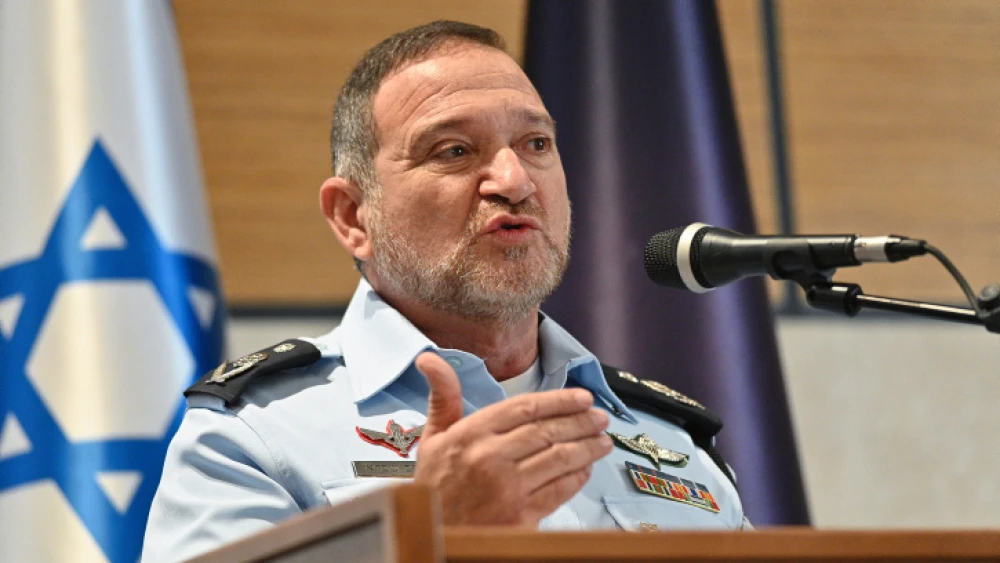
Israel Police Chief Yaakov Shabtai speaks during a ceremony after the largest-ever police operation against illegal gun dealers in the northern Israeli city of Nazareth, Nov. 9, 2021. Photo by Michael Giladi/Flash90.

Israel Police Commissioner Yaakov Shabtai has condemned the violent exchanges that took place between Arab Knesset members and police officers last week.

“I will not abide an agenda of blatantly and forcefully harming police officers who are doing their job on behalf of the state and for its citizens,” said Shabtai at a Knesset event on Tuesday honoring Israeli security forces. “Certainly not by someone who is supposed to serve as an example and model of law-abiding behavior for their constituents,” he said. He refrained from naming the lawmakers in question.

On May 13, Joint Arab List MK Ofer Cassif was filmed confronting and striking a police officer who blocked his way to a protest in the southern Hebron Hills region. In a separate incident, MK Ahmad Tibi was documented interfering with police work at a protest in Jerusalem.

“The police and officers cannot become part of a political game and a target for provocations,” said Shabtai on Tuesday.

Earlier this week, the police asked the attorney general for authorization to launch a criminal investigation into the two incidents.

This article first appeared in Israel Hayom.

“We’re suing to keep these assets in Cincinnati where they belong,” the state prosecutor’s office said of the school’s shuttering Cincinnati campus.
“It’s a lot less threatening when you are sitting around drinking coffee and having a one-on-one conversation,” Alyssa Sadoff, of Yad Vashem USA Foundation, told JNS.
The social media platform is “being used as a key tool to bring smaller extremist profiles out of obscurity and into more people’s feeds,” Alex Friedfeld, of the ADL, told JNS.
To “disproportionately demonize AIPAC as a distinctively harmful dark-money entity crosses the line into antisemitic tropes about sinister Jewish political influence,” the URJ stated.
“These changes reinforce that transparency and accountability can be powerful motivators,” Shira Goodman, of the Anti-Defamation League, told JNS.
“There have been continuing conversations with Harvard about compliance concerns,” Kenneth Marcus, of the Brandeis Center, stated.