


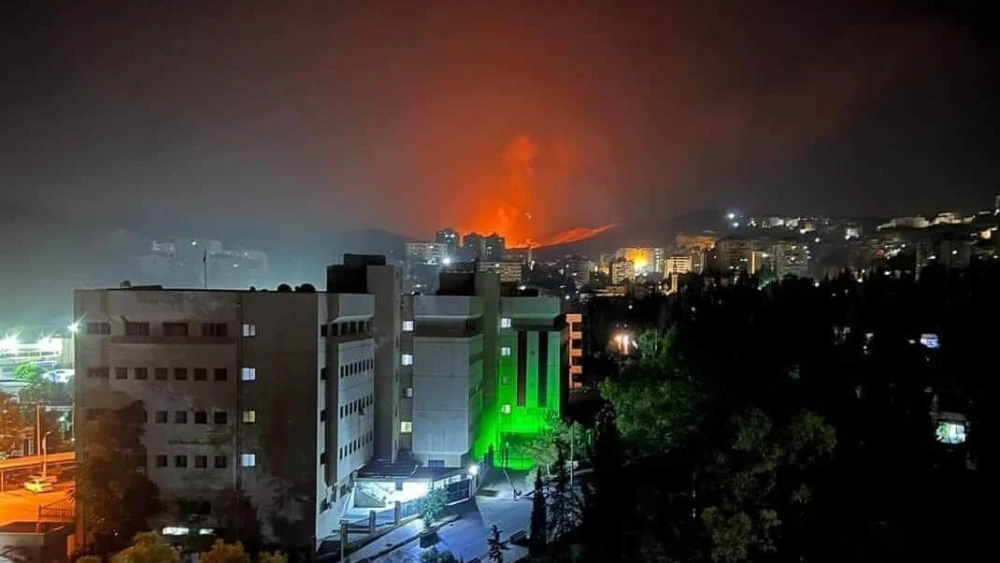
Israeli airstrikes caused “material damage” to targets near Damascus early on Friday, according to Syrian state media.
“At around 2:25 a.m., the Israeli enemy carried out an aerial attack from the direction of the occupied Syrian Golan, targeting a number of points in the surroundings of Damascus,” SANA reported, citing a military source.
The source did not provide details on the targets, but claimed that Syrian air defenses shot down most of the Israeli missiles.
Military analysts have repeatedly cast doubt on Syria’s stated ability to thwart Israeli strikes.
The Britain-based Syrian Observatory for Human Rights said Friday’s strikes hit sites belonging to the Iranian-backed Hezbollah terror group.
Last Saturday, Israeli Air Force jets struck terrorist infrastructure in Syria in response to projectiles launched towards the Israeli Golan Heights several hours earlier.
Two days earlier, the IDF struck assets in Syria belonging to the group responsible for launching a drone that hit a school in Eilat.
“The Syrian regime is fully responsible for all terror activity that is carried out from Syrian territory. The IDF will respond severely to any attempt to attack the territory of the State of Israel,” according to a military statement last week.
On Sunday, the United States struck two Iranian-linked sites in Syria in response to recent attacks on American forces.
This was the third time in less than three weeks that the U.S. military has targeted locations in Syria it said were tied to Iran, whose terror proxies have wounded dozens of American troops in a series of attacks in the Middle East since the outbreak of the Israel-Hamas war on Oct. 7.
U.S. Defense Secretary Lloyd Austin stressed in late October that Washington “does not seek conflict and has no intention nor desire to engage in further hostilities, but these Iranian-backed attacks against U.S. forces are unacceptable and must stop.”
He went on to state that “Iran wants to hide its hand and deny its role in these attacks against our forces. We will not let them. If attacks by Iran’s proxies against U.S. forces continue, we will not hesitate to take further necessary measures to protect our people.”


