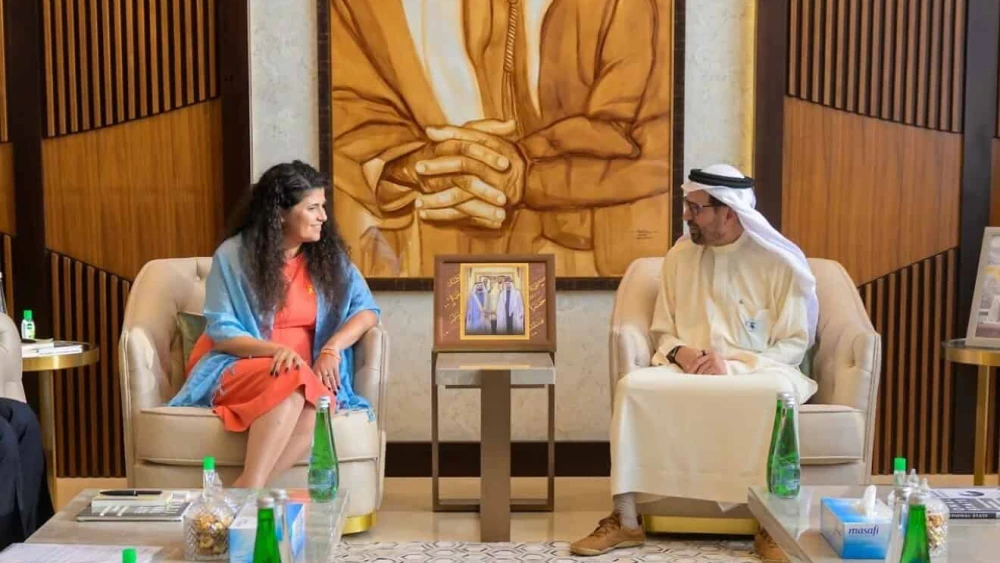
Israeli Deputy Foreign Minister Sharren Haskel said on Wednesday that the landmark Abraham Accords will be expanded in the coming years with additional Muslim countries reaching peace agreements with the Jewish state, amid growing ties with Gulf countries.
The remarks, coming on the five-year anniversary of Israel’s relations with the United Arab Emirates, the first of four Muslim countries to make peace with Israel as part of the historic 2020 accords during the first Trump administration, reflect a growing diplomatic consensus over a major geostrategic shakeup on the horizon after nearly two years of turbulence triggered by the Oct. 7, 2023 Hamas-led attack on southern Israel.
“We understand that in the next years the Abraham Accords will be expanded,” Haskel told JNS from the Emirati capital of Abu Dhabi at the culmination of a three-day visit marking the inauguration of ties five years ago.
She noted that the peace accord had withstood the test of time by overcoming the tensions due to the nearly two-year old war against Hamas in Gaza.
“The fact that the Abraham Accords held on is a type of insurance policy towards the furthering of this relationship and the building of trust between the two sides,” she said. “The Emirates have demonstrated a steadfast commitment to peace with Israel and opened the door for other nations to choose peace as well.”
During her visit, Israel’s second highest diplomat met with senior Emirati government officials, including Ali Rashid al-Nuaimi, chairman of the Federal National Council’s Foreign Affairs and Defense Committee; Foreign Minister Noor al-Kaabi; and Minister of State for International Cooperation and Emirati-Israeli relations Reem al-Hashemi. She also was the keynote speaker at a conference sponsored by the European Leadership Network (ELNET), an NGO dedicated to strengthening Europe-Israel relations, where she praised the UAE for unequivocally condemning Monday’s deadly shooting attack in Jerusalem.
Trade increases last year by 11%
Despite the regional turbulence, trade between the two countries rose last year to $3.2 billion, an 11% increase compared to 2023, excluding government to government agreements, according to figures from the Israeli Foreign Ministry. At the same time, the first half of this year saw trade reaching $1.4 billion, a decrease of 14% compared to the previous year.
Notably, after Greece the UAE remained the second most visited country by Israelis during the first half of the year, with Fly Dubai leading among international carriers in flying nearly uninterrupted throughout the war and currently offering a whopping 10 daily flights between the two countries.
Wartime tensions and a warning over sovereignty push
Haskel conceded that international media coverage of the war in Gaza had created “tensions and not a few challenges” in the bilateral relationship, and cautioned against “burying one’s head in the sand” to the adverse effects of the PR war which Israel has conceded it is losing.
Last week, the UAE issued a rare public warning against Israeli annexation of the biblical heartland amid reports that Israel was considering such a move in the wake of various European countries’ upcoming recognition of a Palestinian state. The sovereignty declaration had previously been deliberated in 2020 as part of a Trump peace plan but was subsequently shelved in favor of the Abraham Accords amid similar opposition by the Gulf country which was the driving force behind the agreement.
The Hamas-led attack on Israel nearly two years ago which triggered the war in Gaza was seen as a move intended to stymie the expansion of the Abraham Accords.