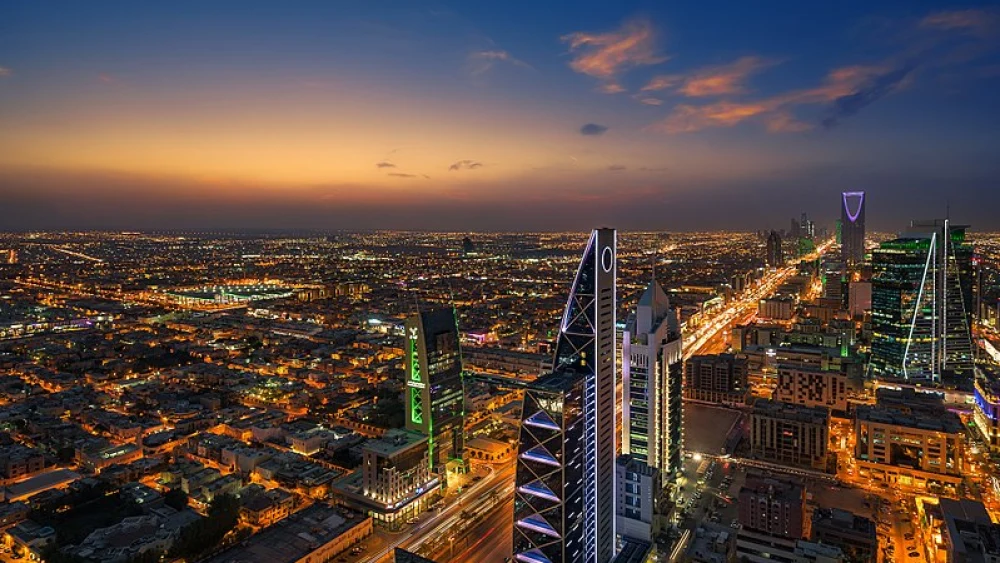
A team of Israelis arrived in Saudi Arabia on Friday to participate in a global video game competition.
Three gamers, their coach and manager entered the Gulf state via the United Arab Emirates using their Israeli passports, according to Hebrew-language media reports.
The tournament runs from July 16-19.
Team manager Zvika Kosman told Israel’s public broadcaster that he worked in conjunction with FIFA, which hosts the event, to ensure the Saudis allowed the team to participate.
He said that there was no direct contact between Jerusalem and Riyadh during the negotiation process, adding that the team had agreed not express their Israeli identity outwardly in public.
However, the team will display the Israeli flag as Hatikvah, Israel’s national anthem, plays at the opening ceremony, in accordance with FIFA regulations, according to the reports.
The Israelis will be guarded by local authorities and a private security firm.
The annual FIFAe World Cup sees entrants compete in the latest version of the immensely popular soccer video game.
The Israeli team is ranked second in the world.
בהמשך לדיווח שלנו אתמול, תמונות ראשונות של שחקני נבחרת הפיפ"א הישראלית בריאד, בירת סעודיה, עם חולצות כחול לבן. נורמליזציה או לא זה בהחלט דבר שלא רואים כל יום https://t.co/KeDuMxLfWT pic.twitter.com/cP9xIDNKtU
— roi kais • روعي كايس • רועי קייס (@kaisos1987) July 8, 2023
Last month, Israeli National Security Adviser Tzachi Hanegbi told JNS that the United States believes that a landmark diplomatic deal normalizing relations between Israel and Saudi Arabia is achievable.
The remarks come as the Biden administration has embarked on an intense diplomatic push to reach such an agreement, which Israeli Prime Minister Benjamin Netanyahu has said could pave the way to ending the Arab-Israeli conflict.
“There is an increased American involvement on the issue,” Hanegbi told JNS in an interview in Cyprus. “They believe that there is a possibility [to reach an agreement].”
Hanegbi said that the Americans had not yet updated the Israeli government on the contours of such an agreement or what their vision is, and said that the situation remains murky.
“There is more hidden than known,” he said, using a popular Hebrew saying.
At the same time, Hanegbi said that “generally speaking” he was “optimistic” that it was possible to enlarge the circle of Arab countries that have normalized relations with Israel since the historic Abraham Accords were signed under President Trump in 2020.
He noted, however, that in the case of Saudi Arabia the ball was not in Israel’s court.
“It’s up to them,” Hanegbi said. “We want normalization and peace, but they have their own demands of the Americans.”
Earlier this month, U.S. Secretary of State Antony Blinken met with Crown Prince Mohammed bin Salman in Saudi Arabia.
In return for normalization with Israel, Riyadh reportedly wants American support for its civilian nuclear program, something Washington has long opposed, as well as a strong security pact with the United States.
Netanyahu has called a deal with the Saudis a “quantum leap” for regional peace.
Israel has normalized ties with the United Arab Emirates, Bahrain, Morocco and Sudan as part of the Abraham Accords.