Newsletter
Newsletter Support JNS

Israel’s high court blocked eviction of Palestinians in Jerusalem, for now

Sheikh Jarrah has been a focal point of tension, and Hamas used the issue as a pretext for violence against Israel, which eventually led to the 11-day war with Israel last year.

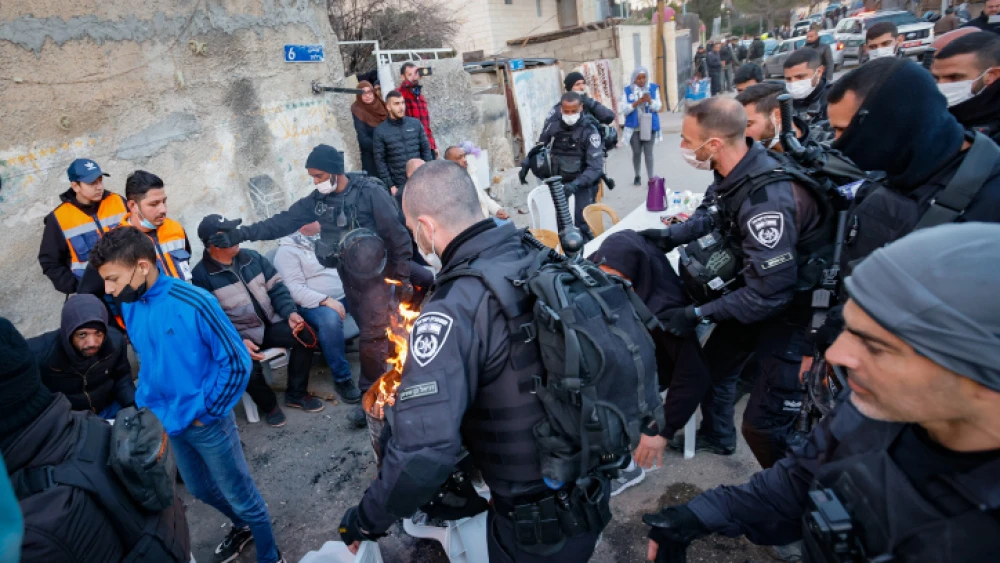
Palestinian protesters in Jerusalem's Sheikh Jarrah neighborhood, Feb. 14, 2022. Photo by Yossi Zamir/Flash90.
Palestinian protesters in Jerusalem’s Sheikh Jarrah neighborhood, Feb. 14, 2022. Photo by Yossi Zamir/Flash90.

Israel’s Supreme Court ruled on Tuesday that families in the eastern Jerusalem Sheikh Jarrah neighborhood would not be evicted at the moment.

Israeli courts had ruled that Jews owned the land before 1948 and were subsequently occupied by Palestinians when Jordan controlled Jerusalem. However, the Supreme Court ruled that the families could stay in their homes for now.

Sheikh Jarrah has been a focal point of tension, and Hamas used the issue as a pretext for violence against Israel, which eventually led to the 11-day war with Israel last year.

In February, a senior member of Palestinian Islamic Jihad (PIJ) warned that it was prepared for a fresh round of fighting with Israel.

Khaled al-Batsh, who sits on the organization’s politburo in the Gaza Strip, told Palestinian radio, “What happened in the past was the starting point for ‘The Sword of Jerusalem,’ and we are ready to fight round two.” Batsh referred to PIJ and Hamas’s name of their military campaign during the war last year, which Israel called “Operation Guardian of the Walls.”

If Ismael Jimenez were suspended, it would be “an encouraging sign of the much-needed systemic change for the district,” Mika Hackner, of the North American Values Institute, told JNS.
Prayer notes calling for peace have been sent from Arab countries to the holy site in Jerusalem, and some even from Iran.
Iraq’s Interior Ministry stated that it is using “precise intelligence information” to locate Shelly Kittleson, a U.S. freelance journalist who reports extensively from Iraq, Syria and Afghanistan.
The Israeli prime minister said strikes on steel production facilities weaken the Islamic Revolutionary Guard Corps as the operation against Iran progresses “beyond the halfway point.”
Adm. Brad Cooper, commander of the U.S. Central Command, and Lt. Gen. Eyal Zamir, chief of staff of the Israel Defense Forces, also discussed ongoing efforts to curb Iran’s reach.
“Organizations and individuals tied to terrorism have no place operating under the protection of Canadian law,” the Centre for Israel and Jewish Affairs wrote.