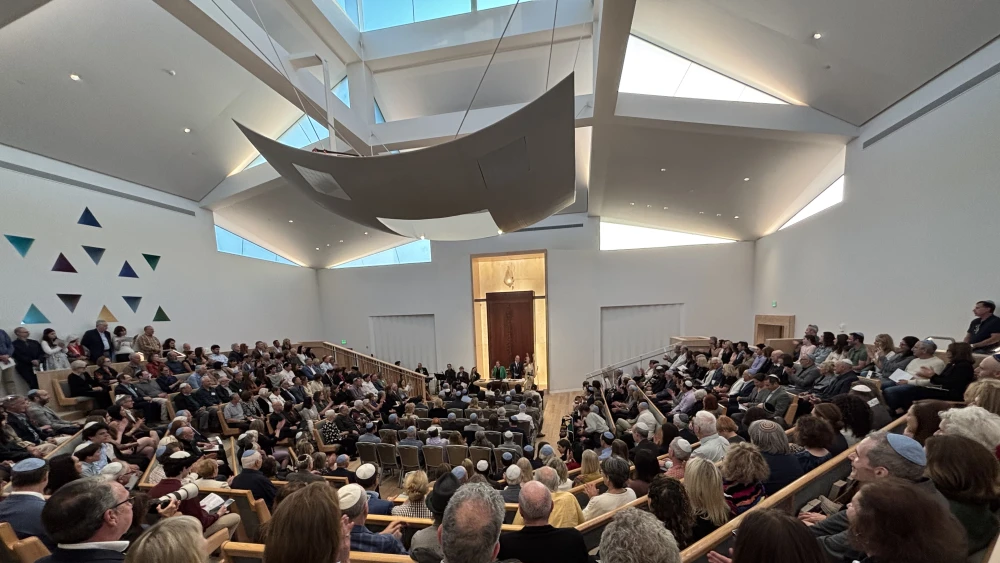
Singing at Kehillat Israel on Friday for the first time since the Los Angeles-area Reconstructionist synagogue was damaged in the January 2025 Palisades Fire felt “surreal” to Chayim Frenkel, the cantor.
“I’m numb,” Frenkel told JNS at the reopening event, during which he and his wife, Marsi, were honored for their 40 years at the synagogue.
“I last sang in this room 18 months ago, and it’s a whole brand new sound system, brand new room, but it’s still my KI,” he said. “It’s still my sanctuary. We didn’t change the footprint, but I’m blown away by this place.”
After the synagogue suffered smoke damage, forcing the congregation to use temporary spaces, the building has been remodeled, Daniel Sher, associate rabbi of the synagogue, told JNS.
“We’ve learned very quickly to be without a centralized place, and actually, these last few weeks moving back toward that centralized place again, there’s been a really profound kind of emotion about how fast we jumped into ‘go’ mode to care for our community and having a chance to reflect as we move back into it,” he said.
The energy among the 750 attendees for the Shabbat services that evening was “very loving, very moving, and it was a lot of mixed emotions,” Frenkel told JNS.
“They were just in shock,” he said. “Like, we’re back, but oh my God, what do we do, and how do we handle this? And how do we deal with this new ark and this new room, and yet our town has burnt down, and we have to still go out and rebuild our home?”
“But they have their community back, and I think it’s a huge step,” he said.
Some 220 congregants completely lost their homes, and more than 250 were displaced, about half the community, according to Frenkel. Both he and Sher lost their homes in the fire.
Sher told JNS that “a stark majority” of the synagogue’s congregants will be moving back into rebuilt homes in the community and that many who are not moving back into their homes plan to remain congregants at the synagogue.
The community’s mindset right now is “we’ve got this, it’s just really hard, but we’ve got this,” Sher told JNS.
JNS asked Frenkel and Sher whether the community has been frustrated with how the state, county or city has handled the fires and the aftermath.
Frenkel said, “Oh yeah,” but that there wasn’t time to delve into the “iterations of conversations we’ve had.”
“Those conversations still are happening in the commonplace,” he told JNS. “We have members who are very, very involved in trying to make positive, meaningful change.”
David and Deborah Fried, who are married and work in financial services, are longtime congregants at the synagogue, where David Fried was one of the first congregants.
The Frieds have been living in Beverly Hills after their home suffered smoke damage from the fire, and they have been fighting with their insurance company. They’re also frustrated with the ways that political leaders have handled the fires, they told JNS.
“We have a fire hydrant in front of our house that was empty,” Deborah Fried said. “Our local government let us down, and I think Karen Bass,” the mayor of Los Angeles, “should be held accountable for 12 to 33 deaths.”
“I think she should go to jail,” Deborah Fried told JNS.
Greg Sinaiko, 54, a businessman who has been a congregant at the synagogue his entire life, plans to move back into his house in the next couple of months after it sustained smoke and lead damage from the fire.
His parents lost their home in the fire and will not be moving back, and he has been frustrated with the insurance companies, he told JNS.
“It’s just been a lot more money out than money coming back in from the insurance company,” he said.
Political leaders displayed a “lack of preparedness when everyone knew that the strong winds were going to be here,” he told JNS. “We sat there at my parents’ house on the balcony, and we watched the fire for 45 minutes before we evacuated, and it was just not enough happening.”