Newsletter
Newsletter Support JNS

Knesset members Smotrich, Ariel battle to lead National Union Party

The religious-Zionist National Union faction planning another joint run with Habayit Hayehudi • Instead of party-wide primaries, a limited forum of 128 central committee members will elect a new party leader and decide on its list for the April election.

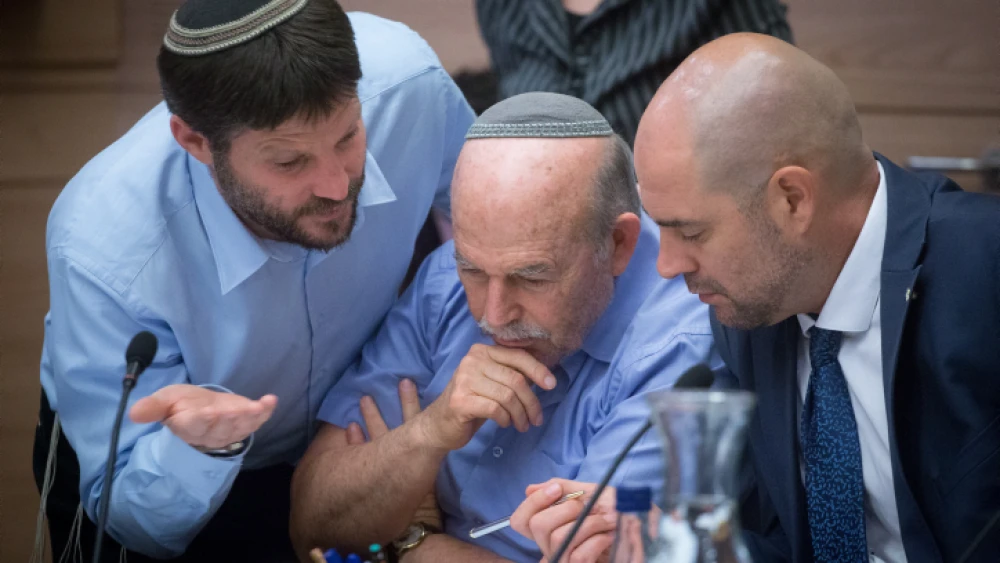
Interim Justice Minister Amir Ohana (right) with Jewish Home parliament members Nissan Slomiansky (center) and Bezalel Smotrich at the joint Knesset and Constitution Committee meeting discussing the proposed National Law at the Knesset, July 16, 2018. Photo by Miriam Alster/Flash90.

The sudden departure of Education Minister Naftali Bennett and Justice Minister Ayelet Shaked from Habayit Hayehudi to set up their own party continues to make waves in the right-wing camp.

The religious-Zionist National Union faction, which ran with Habayit Hayehudi under the latter’s name in the 2015 Knesset election, was scheduled to hold a snap primary on Monday evening.

Because of time constraints, primary voting will not be open to all party members. Instead, 128 members of the National Union central committee will elect the next party leader as well as lock in the party’s Knesset list, with results expected to be announced soon after the vote.

Former Habayit Hayehudi Knesset member Bezalel Smotrich and Agriculture Minister Uri Ariel will be facing off for the leadership of the National Union faction, which will again be running with Habayit Hayehudi in the general election on April 9.

The coalition agreements of the 2015 election allocated the National Union faction two top 10 spots on the joint party list. The faction is now seeking five.

Each party running for the Knesset compiles a list of 120 potential Knesset members. The number of representatives from each party who actually wind up serving in the Knesset is based on the percentage of the vote the party gets in a Knesset election.

The minimum electoral threshold required to enter the Knesset is 3.25 percent of the vote, meaning that the fewest MKs a given party can have in the Knesset is four. The rules for determining Knesset lists vary from party to party, but most of the major parties allow leaders to reserve spots for specific representatives or representatives of specific sectors (women, minorities, immigrants).

Gideon Sa’ar said that Israel and the United States pushed back an immediate Iranian nuclear threat and called Hezbollah a violator of Lebanon’s sovereignty, urging disarmament.
“We are strengthening a path already built on trust, dialogue and sharing,” said Somaliland President Abdirahman Mohamed Abdullahi.
Officials, watchdogs and victims’ advocates say the Palestinian Authority continues paying stipends to convicted terrorists and their families, and criticize loopholes in international donor funding and oversight mechanisms.
The U.S. vice president said that the memorandum of understanding mandates uranium stockpile destruction and verification, with no benefits if Tehran fails to comply.
Hussam Abu Safiya, a Hamas terrorist who ran the Kamal Adwan Hospital in the Strip, has been in custody since late 2024.
The Iranian foreign minister warned that any Israel Defense Forces actions in the country would be considered a violation of the MoU.