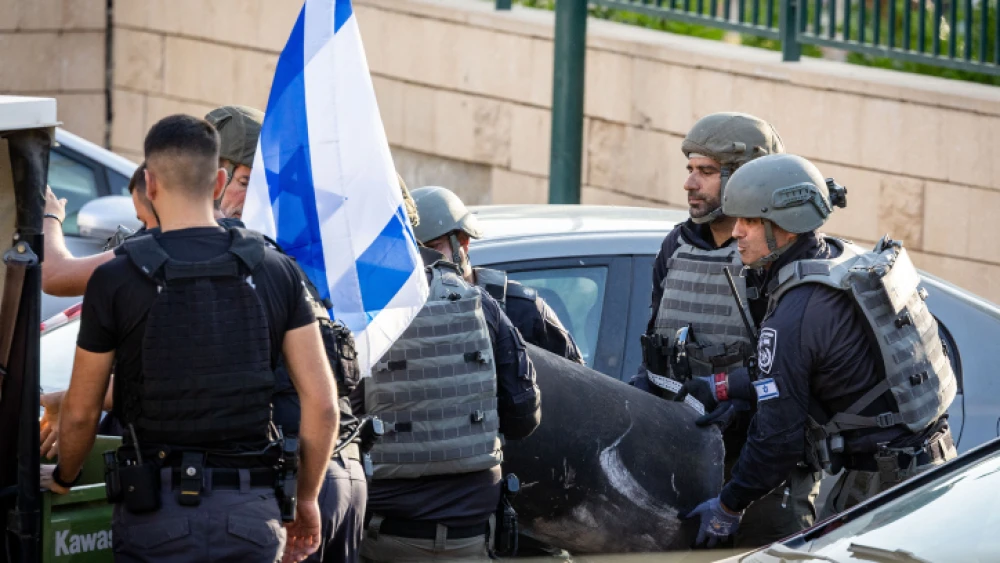
As the truce between Israel and Palestinian Islamic Jihad entered its third day on Tuesday, Israeli police were busy clearing out the dangerous rocket remnants that remain scattered around the southern part of the country.
Supt. Raz Manur, commander of the Explosive Ordnance Disposal Team at the Negev police sub-district, told JNS on Tuesday that such fragments had been identified at more than 100 sites so far.
The fragments comprise parts of PIJ rockets and Iron Dome interceptors, as well as duds, some of which are dangerous, he said.
“We are still removing all of these dangers. Certainly, there are more remnants out there, and we are scanning for them,” he added.
Alongside searches, police are looking to southern residents, particularly farmers heading out to fields and greenhouses, for information regarding additional rocket debris, he said.
However, he emphasized that members of the public were not to attempt to clear such debris on their own.
“We call on civilians who see rocket parts and other weapons on the ground to not approach them, but rather, to call 100 instead, and an EOD officer will arrive to safely deal with it,” he said.
The police’s Negev sub-district came under heavy fire during the five-day escalation between May 9 and 13, with some 500 projectiles fired at the area by PIJ, out of around 1,470 fired at Israel in total (of which some 1,140 crossed into Israel, with the remainder falling inside the Gaza Strip).
Police identified around 300 potential sites in the south where rockets may have come down, open areas that Israel’s Iron Dome air defense system is programmed not to protect, focusing instead on intercepting threats to inhabited areas.
Iron Dome intercepted more than 95% of rockets headed for built-up areas during the conflict, according to the Israeli military. Two civilians—an Israeli woman in Rehovot and a Gazan worker in the western Negev, were killed by PIJ rocket fire.
Manur recalled arriving at several impact zones during the escalation, including a dud rocket that fell near Kibbutz Kerem Shalom. The EOD team arrived on the scene with bomb-disposal robots and destroyed the rocket in a controlled explosion, he said.
His team of 24 explosive experts was active throughout the escalation, in Ofakim, Netivot and Beersheva, working around the clock to ensure that no warheads and projectiles were left behind.
“We do this under fire, during sirens, deploying with ceramic vests and helmets to the impact zone. Now we are clearing the area,” he said.
Manur, a resident of Ashkelon, described how he and his team needed to leave families at home while sirens were sounding and head out to impact zones, knowing rocket attacks were occurring in real time.
“It’s challenging. But as southern residents, we have, unfortunately, gotten used to it,” he said.
Master Sgt. Dean Elsdunne, the Israel Police’s international spokesperson, said hundreds of rockets rained down in the south, “sending women and children running into bomb shelters.”
Speaking at Ofakim police station, Elsdunne pointed to a pile of rockets EOD officers had retrieved from parks and streets.
According to Elsdunne, the risk rockets and rocket debris pose isn’t just that they could explode.
“These materials have cancer-causing substances on them. That’s why we tell the public to call 100, to call for the EOD specialists,” he stated.