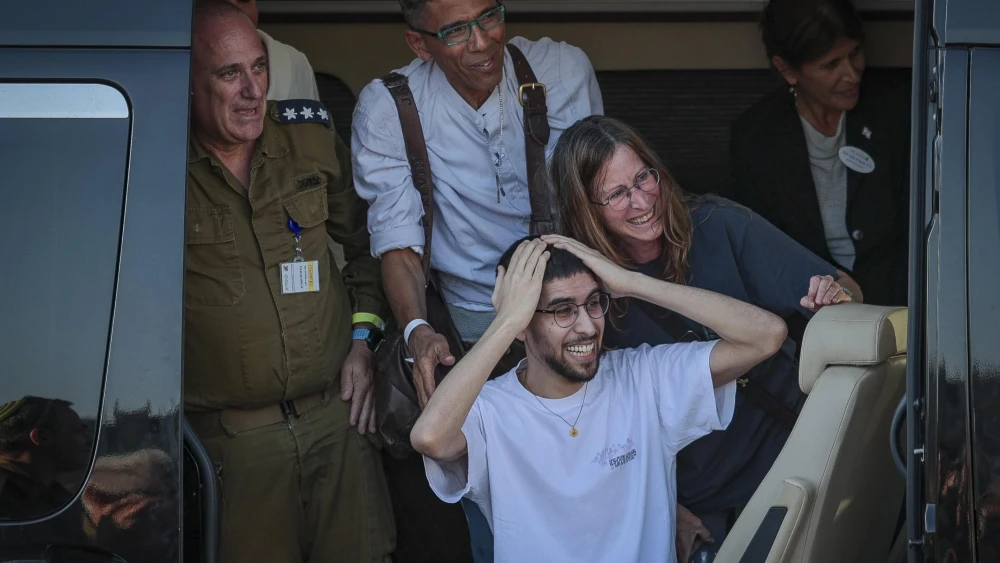
The head of the Israel Defense Forces’ Hostages and Missing Persons Command on Monday hailed the return of all 20 living Israeli captives from the Gaza Strip, emphasizing the ongoing coordination between troops on the ground and international mediators to ensure the full implementation of the agreement.
“On the night between Oct. 7 and 8, 2023, this command post began operating amid the chaos of thousands of people who had lost all contact,” said Maj. Gen. (res.) Nitzan Alon, head of the Hostages and Missing Persons Command. “Through thorough, systematic work, you labored day and night to assess the situation of each hostage—to understand and define the mission of protecting their lives.”
On Monday morning, Israel redeemed the living hostages, two years after their kidnapping by Hamas during the Palestinian terrorist group’s massacre on Oct. 7, 2023. Their return is part of the first phase of U.S. President Donald Trump‘s plan to end the war in the Gaza Strip.
The IDF also announced on Monday the return of four deceased hostages to Israel: the bodies have since been forensically identified. The Hostages and Missing Families Forum noted that Hamas’s failure to return all 28 of the deceased was a “blatant breach” of the ceasefire agreement.
“It pains us deeply for every life we could not save,” said Alon. “Many here are scarred and wounded in their souls, carrying with them a sense of responsibility and, at times, guilt. But I think it is important to view this all in a balanced way. Within the intensity of battle and the chaos of war, there is reason to be proud of the good work that was done.”
Since its establishment, dozens of teams and hundreds of IDF reservists have served within the Hostages and Missing Persons Command to build the most accurate possible intelligence picture of the hostages’ condition and whereabouts. The unit has also provided ongoing support to their families, ensuring the delivery of verified information with accuracy and sensitivity.
At the same time, the command worked to safeguard the lives of the captives, guiding operational activity amid the fighting in Gaza.
“The return of the hostages is only the first cornerstone in processes that go far beyond this room,” said Alon. “It marks the beginning of healing, rehabilitation and the renewal of Israeli society. I hope that what we have done over these past two years—together with the troops in the field, their commanders, and the heavy price that was paid—will truly allow this progress to take place.”