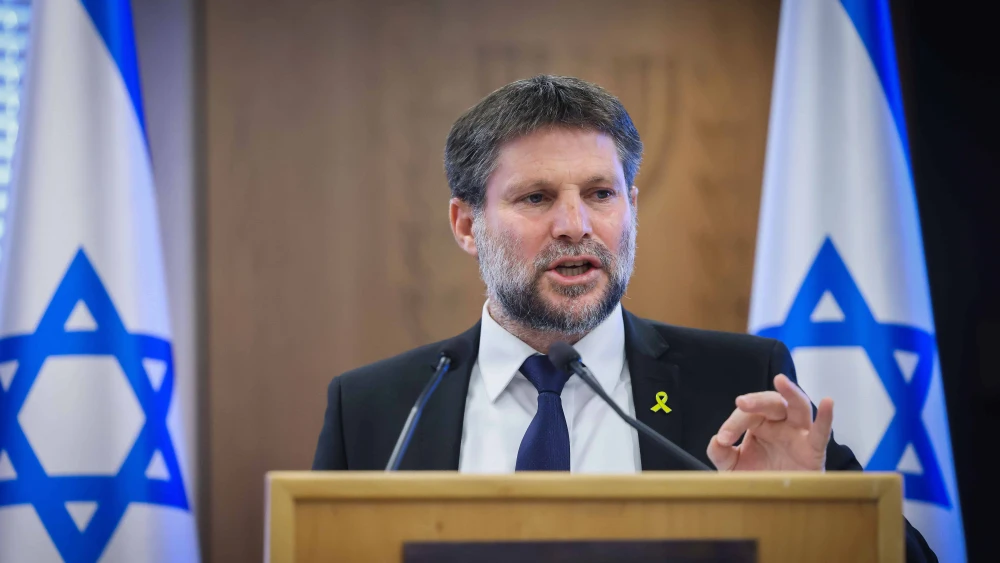
Israeli Finance Minister Bezalel Smotrich said on Tuesday that the Israel Defense Forces’ chief of staff supports the idea of annexing parts of the Gaza Strip for security purposes, Israel National News reported.
Speaking at a Knesset conference titled “The Riviera in Gaza—From Vision to Reality,” Smotrich revealed details of a recent conversation he held with IDF chief Lt. Gen. Eyal Zamir.
“I had a conversation with the chief of staff last week, and he told me that there is a need for a security annexation,” Smotrich said. “I genuinely believe we have an enormous opportunity here.”
Smotrich further elaborated that he envisions Israel beginning this process in the northern Gaza border region, where he suggested establishing three Israeli communities.
“We’ve been talking about this already; starting in the northern perimeter and setting up three settlements,” he said.
The minister framed the move not merely as a territorial expansion, but as a strategic necessity for Israel’s long-term security following the war against Hamas.
“Some people call it a ‘security annexation,’ but the bottom line is the same, ensuring Israel’s safety by maintaining a permanent presence,” Smotrich remarked.
The proposal echoes long-held views on the Israeli right advocating for reestablishing settlements in Gaza, which Israel unilaterally evacuated in 2005, despite dire warnings about what would likely occur if it abandoned the Strip.
While Smotrich did not specify whether Zamir endorsed civilian resettlement, he emphasized that military control and sovereignty would be essential for security.
The Israel Defense Forces’ Spokesperson’s Unit refused to comment on Zamir’s alleged remarks when asked by JNS on Wednesday morning.
Tuesday’s Knesset conference was attended by MKs, ministers, mayors from Israel’s south, members of the security forces, representatives of hostage families and researchers, according to the Israel Hayom daily.
A plan presented at the conference calls for building 850,000 housing units, an international airport, public transportation and a new port connecting the enclave to the land route between India and Europe.
“We will work for Jewish settlement throughout the Gaza Strip,” stated Limor Son Har-Melech (Otzma Yehudit), one of the summit’s initiators.
“Like the founding fathers of the nation, we too are building a future—a future of settlement in Gaza. Even today, there already are plans, there is infrastructure, there are settlement cores, architects looking at the map and saying: here we will build! No more isolated villages like Netzarim, but large, fortified cities throughout the entire Gaza Strip,” she added.
Yossi Dagan, head of the Samaria Regional Council, addressed the conference via a pre-recorded statement from Washington, D.C., where he is holding meetings to rally support for Israeli sovereignty.
“I call on the Israeli government to reestablish the communities of Gush Katif [in Gaza] and northern Samaria,” said Dagan. “We will restore the settlement and thus restore justice and security to the State of Israel.”
In March, Israeli Defense Minister Israel Katz threatened to annex parts of Gaza unless Hamas releases all of the hostages.
“If the Hamas terror organization continues to refuse to release the captives, I instructed the IDF to capture additional areas, evacuate the population and expand the security zone around Gaza for the protection of Israeli communities through a permanent hold of the area,” said Katz.
“As long as Hamas continues its refusal, it will lose more and more land to Israel,” he added.
A majority of Israelis want Gaza to remain under Israeli military rule after the current war ends, according to a survey published last week by the Jerusalem Center for Security and Foreign Affairs (JCFA).
The poll found that 52% support an Israeli takeover of Gaza with a temporary military administration—if all hostages are first released.