Newsletter
Newsletter Support JNS

State Department designates Hamas leader Ismail Haniyeh as ‘global terrorist’

The U.S. State Department has listed Hamas leader Ismail Haniyeh and two Egyptian terrorists—Liwa al Thawra and Harakat Sawa’d Misr—as “specially designated global terrorists.”

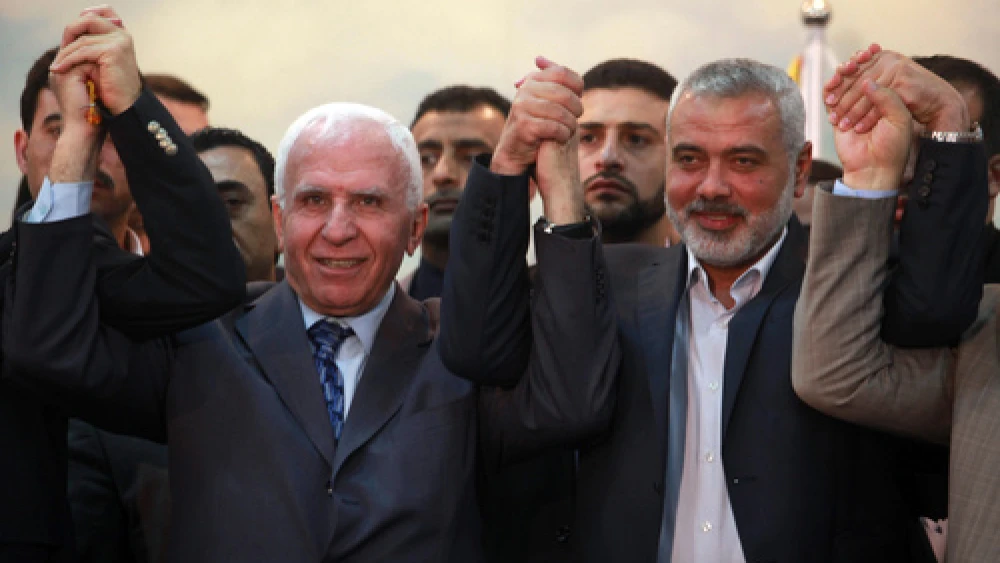
Senior Fatah official Azzam al-Ahmed (left) and Hamas leader Ismail Haniyeh announce a reconciliation agreement between the terrorist factions in Gaza City, April 23, 2014. Photo by Abed Rahim Khatib/Flash90.

The U.S. State Department has listed Hamas leader Ismail Haniyeh and two Egyptian terrorists—Liwa al Thawra and Harakat Sawa’d Misr—as “specially designated global terrorists.”

In announcing the move, Secretary of State Rex Tillerson emphasized that “these designations target key terrorist groups and leaders—including two sponsored and directed by Iran—who are threatening the stability of the Middle East, undermining the peace process, and attacking our allies Egypt and Israel. Today’s actions are an important step in denying them the resources they need to plan and carry out their terrorist activities.”

According to the State Department, Haniyeh, who serves as president of Hamas’s “political bureau,” has “close links with Hamas’ military wing and has been a proponent of armed struggle, including against civilians.”

“He has reportedly been involved in terrorist attacks against Israeli citizens. Hamas has been responsible for an estimated 17 American lives killed in terrorist attacks,” the State Department said.

The designation by the State Department seeks to prevent these individuals from obtaining the resources they need to plan or carry out terror attacks. As such, all their property and interests subject to U.S. jurisdiction are blocked, and U.S. citizens are prohibited from engaging in transactions with them.

Hamas called the U.S. move “a failed attempt to put pressure on the resistance,” adding, “This step won’t deter us from continuing on our path and striving to expel the occupation.”
“Before the war, the public was divided,” the premier said. “I think that has changed.”
Prosecutors say defendants linked to the IRGC planned assassinations and arson against the Federal Republic’s top Jewish leader, a pro-Israel activist and Jewish businesses.
A change in Austrian law could allow survivors who remained in the country after World War II while searching for relatives or awaiting visas to receive long-denied benefits.
The facility, mainly used by budget airlines, had been shut for four months due to reduced traffic during the war with Iran.
“Peace is tied to freeing Lebanon from the de facto Iranian occupation,” said Gideon Sa’ar.
Jerusalem and Beirut recognized “that they are not at war w/ each other but with terror group Hezbollah,” the U.S. ambassador said.
Benny Gantz, JNS editor-in-chief Jonathan S. Tobin, Gilad Erdan, Mosab Hassan Yousef, Nissim Black and leading voices in security, diplomacy, media, law and Jewish communal affairs headline the summit’s third day in Jerusalem.