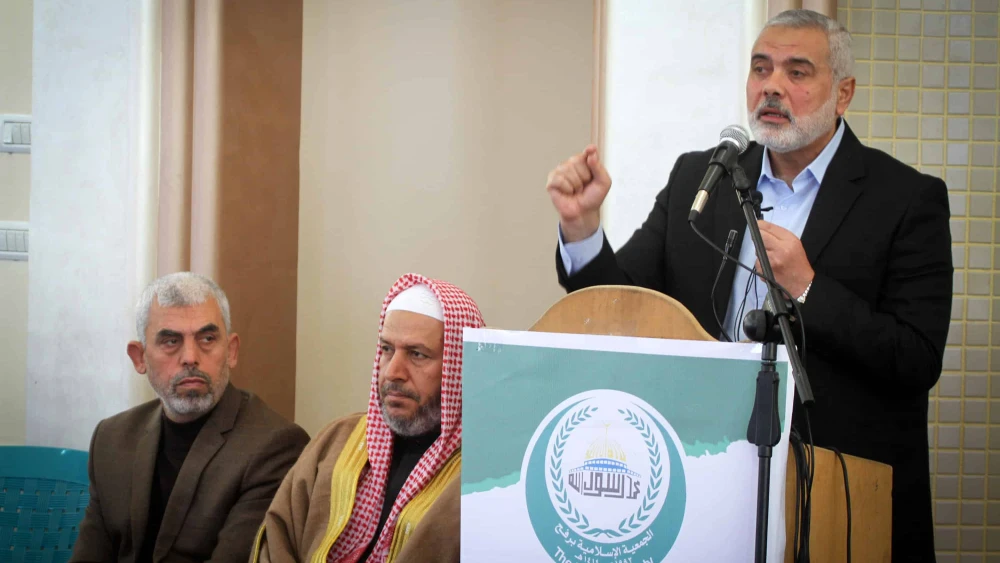
The death of top Hamas leader and key strategist Ismail Haniyeh in Tehran early on Wednesday dealt a significant blow to the terror group and could potentially alter the course of the ongoing conflict in Gaza.
Haniyeh, who had been living in exile, played a pivotal role in orchestrating Hamas’s Oct. 7 assault on Israel and was seen celebrating the attack from Turkey.
Haniyeh’s journey began in 1962 in Gaza’s Shati refugee camp. In his early years, he worked in construction in the Israeli city of Ashkelon, while three of his sisters settled in the Negev region.
He began his political career as a disciple of Hamas founder Ahmed Yassin, with involvement at Gaza’s Islamic University, where he earned a degree in Arabic literature. The First Intifada saw him serve a three-year prison sentence.
In 1992, Haniyeh was among hundreds of Hamas activists exiled to Lebanon, where he forged connections with Hezbollah. Following Israel’s botched 1997 assassination attempt on Hamas’s then-politburo chief Khaled Mashal, Sheikh Ahmed Yassin was released from Israeli prison and Haniyeh became his chief of staff.
During the Second Intifada, Haniyeh narrowly escaped an assassination attempt that targeted several Hamas leaders.
After Israel’s targeted killings decimated Hamas’s upper echelons, Haniyeh rose to lead the group in Gaza. He spearheaded Hamas’s victorious slate in the 2006 Palestinian parliamentary elections, defeating Fatah and forming a government that Israel refused to recognize.
His tenure was marked by a Fatah-led assassination attempt and a short-lived unity government. In 2007, Palestinian Authority chief Mahmoud Abbas dismissed Haniyeh, but Hamas swiftly seized control of Gaza. Haniyeh’s subsequent focus was on cementing Hamas’s grip on the coastal enclave.
Haniyeh chalked up a major win in 2011 with the Shalit prisoner exchange. Six years on, Yahya Sinwar, one of the deal’s released prisoners, succeeded him as Hamas’s Gaza chief.
Haniyeh then clinched the top spot in Hamas’s political bureau through internal elections, taking over from Khaled Mashal and relocating to Qatar.
Originally published by Israel Hayom.