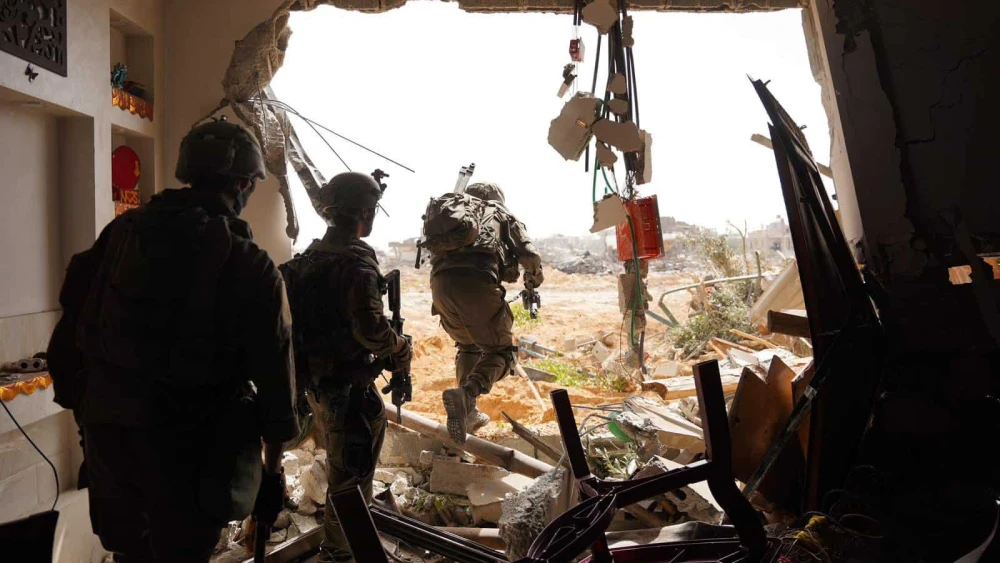
The Israel Defense Forces is pursuing a phased approach in its ongoing offensive against Hamas’s last stronghold in Rafah, Gaza. By dividing Rafah into sub-areas and deploying a single division—the 162nd—rather than two, the IDF and the Israeli Cabinet have taken a slower path, but one that has avoided another crisis with the United States.
According to Israeli military assessments, Hamas’s final functioning brigade will be dismantled in Rafah within weeks. Its defeat will mark a major milestone in the war that began on Oct. 7 with Hamas’s mass invasion of southern Israel. Meanwhile, Hamas has lost its ability to smuggle weapons and contraband from Egypt’s Sinai into Gaza via the cross-border tunnels. This will severely harm Hamas’s ability to rebuild its terror army—assuming that Israel does not relinquish its control of the Gaza-Egypt border.
According to an IDF source, of Hamas’s four Rafah battalions, only two are currently functional.
The IDF has eliminated over 500 terrorists in Rafah, and has also discovered extensive tunnel networks under the city, and under the Philadelphi Corridor along the Gaza-Egypt border. Two of the tunnels destroyed by Israeli forces exceeded a kilometer in length.
IDF ground and air units are dismantling significant portions of Hamas’s terrorist infrastructure in the area. Much of this work is slow and extremely difficult, as Hamas employs asymmetric warfare tactics and stays out of sight until it strikes.
The Israeli Air Force has played a crucial role in these operations. IAF fighter jets and aircraft have been striking numerous targets across Gaza, and providing close air support for the 162nd Division in Rafah. The Israeli Navy has also been striking enemy targets from the sea.
On June 20, the IDF reported that the Nahal infantry brigade, operating under the 162nd Division, had discovered large quantities of hidden weapons and tunnel shafts within and under civilian residences in Rafah.
The IDF has learned an enormous amount about complex, large-scale urban warfare in recent months, and is applying those lessons effectively in Rafah.
All of this has led to considerable, steady progress in the systematic erosion of the Rafah Brigade’s capabilities.
The phased approach allowed for the safe evacuation of over a million civilians; the evacuations have continued at the local level.
This has been crucial in avoiding civilian casualties as much as possible and avoiding a crisis with the U.S. Biden administration. However, this approach also gave Hamas the option of fleeing Rafah under the cover of the evacuations, possibly taking hostages with them.
International media has reported that the IDF has accelerated the pace of the Rafah operation in recent days. Reuters reported on June 21 that the IDF had taken control of the eastern, southern and central parts of the city and was now focusing on the northern and western sections. The intensified activity has led to a new wave of evacuations, with Gazans moving northward, according to the report. Reuters cited U.N. estimates that there are now fewer than 100,000 civilians left in Rafah, compared with over a million before the IDF ground maneuver.
Despite the slower pace, the IDF’s strategy appears to have proven effective.
Meanwhile, the IDF’s destruction of Rafah’s massive tunnels network is crucial in cutting off supply lines and operational routes, significantly weakening Hamas’s overall capabilities.
Parallel to this effort in Rafah is the ongoing IDF effort to eliminate senior Hamas and Palestinian Islamic Jihad terrorists, harming the terrorist groups’ command and control capabilities. On June 22, the Israeli Air Force attempted to eliminate Hamas’s head of operations, Raed Sa’ad, in a strike in Gaza City. At time of publication, it remained unclear whether the attempt was successful.