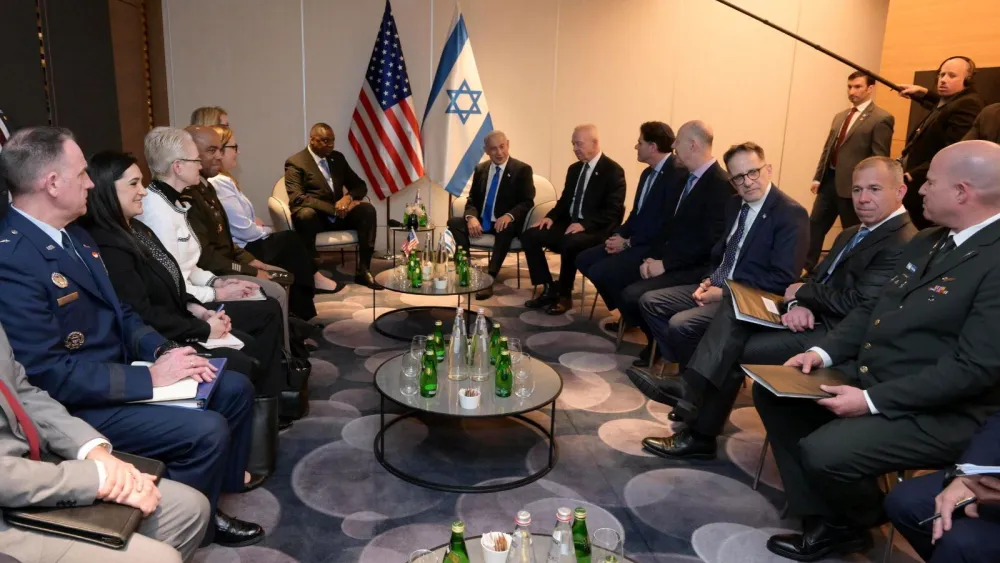
Prime Minister Benjamin Netanyahu met U.S. Defense Secretary Lloyd Austin on Thursday in Israel, primarily to discuss the Iranian nuclear threat and strengthening the Abraham Accords.
“We have a common agenda to prevent Iran from acquiring nuclear weapons and preventing Iran’s aggression, maintaining the security and prosperity of this region and seeking to expand the circle of peace,” Netanyahu said at the start of the meeting.
“You’re right, we do have a lot to talk about today, and you’ve heard us say over and over again that we are absolutely committed to the security of Israel,” Austin told the prime minister in response.
Austin arrived in Israel for a one-day visit from Egypt as part of a Mideast tour that began in Jordan and also included an unannounced visit to Iraq.
It marks his second diplomatic trip to the region as defense secretary. During his first visit, in April 2021, he met with then-Israeli Defense Minister Benny Gantz and other senior officials.
The visit comes after Israel’s Strategic Affairs Minister Ron Dermer and National Security Advisor Tzachi Hanegbi met in Washington on Monday with U.S. Secretary of State Antony Blinken, amid growing concern in Jerusalem over Iran’s nuclear progress.
Blinken reiterated the Biden administration’s commitment to preventing Tehran from developing nuclear weapons, according to State Department spokesman Ned Price.
U.S. National Security Advisor Jake Sullivan also hosted a meeting of the U.S.-Israel Strategic Consultative Group, which included Hanegbi and Dermer, as well as “a senior Israeli interagency delegation,” according to a joint statement.
Both sides “pledged to enhance coordination on measures to prevent Iran from acquiring a nuclear weapon and to further deter Iran’s hostile regional activities.” Israeli and U.S. officials reviewed joint U.S. military and Israel Defense Forces exercises.
The high-level meetings come after the International Atomic Energy Agency last month found uranium enriched to 83.7% in the Islamic Republic.
IAEA chief Rafael Grossi was in Tehran for two days of meetings this weekend that “addressed the importance of taking steps in order to facilitate enhanced cooperation, to expedite as appropriate the resolution of outstanding safeguards issues,” according to a statement released by the parties on Saturday.
Grossi said that Tehran will allow the IAEA to reinstall some monitoring equipment that was removed last year amid stalled talks to revive the moribund 2015 nuclear deal. However, Atomic Energy Organization of Iran spokesman Behrouz Kamalvandi said that inspectors would not be given access to several sensitive sites regarding which the IAEA is seeking clarifications of past nuclear work.
Grossi said that follow-up talks in Iran aimed at hammering out the details of the informal agreement would take place “very, very soon.”
The IAEA has confirmed in a report that its inspectors found enriched uranium to 83.7 percent at Iran’s underground nuclear site in Fordow, just below the 90% enrichment level considered “military grade.”
Netanyahu on Sunday criticized as “unworthy” Grossi’s statement a day earlier that any attack on Iran’s nuclear program would be illegal.
“Against which law?” said Netanyahu at the weekly Cabinet meeting. “Is Iran, which openly calls for our destruction, permitted to defend the destructive weapons that would slaughter us? Are we permitted to defend ourselves? It is clear that we are, and it is clear that we will do so.”
Grossi, he said, was “a worthy gentleman who said something unworthy.”
Referencing Tuesday’s Purim holiday, the Israeli premier said, “2,500 years ago an enemy arose in Persia who sought to destroy the Jews. They did not succeed then, neither will they succeed today.”
Earlier this month, U.S. Under Secretary of Defense for Policy Colin Kahl warned that Tehran could produce enough fissile material for a nuclear bomb in less than two weeks, comments that echoed those made in a recent interview by CIA chief William Burns.
Netanyahu has warned that in the absence of a credible military threat or actual military action, Iran will become a nuclear power.
“The longer you wait, the harder that becomes [to prevent]. We’ve waited very long. I can tell you that I will do everything in my power to prevent Iran from acquiring nuclear weapons. That is not merely an Israeli interest; it’s an American interest; it’s in the interest of the entire world,” he said.