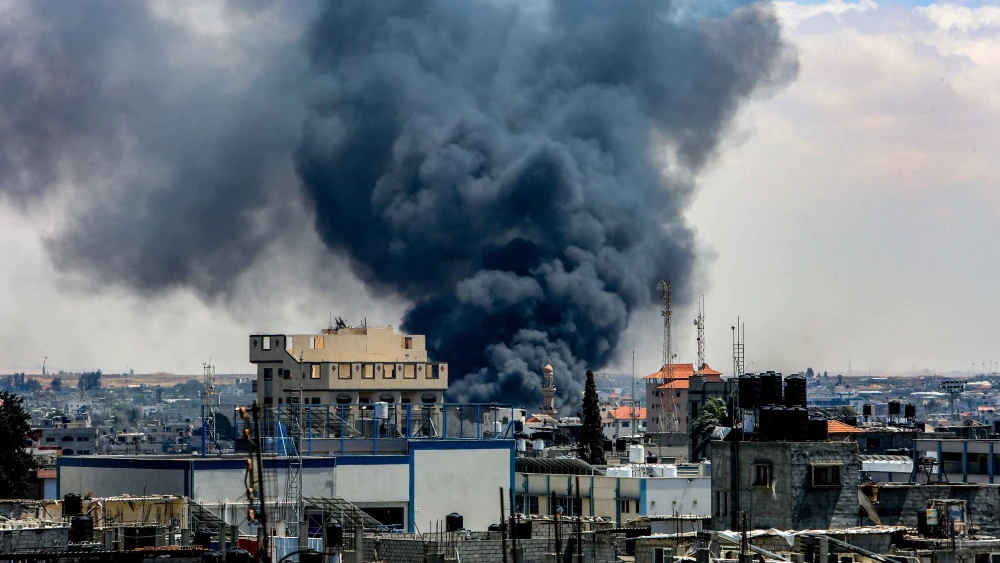
Two senior Hamas terrorists were killed on Sunday night in an Israeli airstrike on a Hamas compound in the area of Tel Sultan in northwestern Rafah, according to the Israel Defense Forces.
The IDF was investigating Palestinian media reports that dozens of noncombatants were killed and wounded in the strike.
🔴Eliminated in the precise airstrike in northwest Rafah: Hamas Chief of Staff in Judea and Samaria and an additional senior Hamas official.
— Israel Defense Forces (@IDF) May 26, 2024
Terrorist #1: Yassin Rabia
Rabia managed the entirety of Hamas' terrorist activity in Judea and Samaria, transferred funds to terrorist… https://t.co/iaGrw8WJ4f
The targets of the strike were named as Yassin Rabia, the head of Hamas’s Judea and Samaria headquarters, and Khaled Nagar, a senior official in the terror group’s Judea and Samaria wing.
Rabia and Nagar carried out terrorist attacks in the early 2000s in Judea and Samaria that killed and wounded Israeli soldiers and civilians, the military said. They also transferred funds for terrorist activities in Judea and Samaria and planned and directed attacks there.
According to the IDF spokesperson, the strike was carried out in accordance with international law, was based on intelligence and executed using precision weaponry. However, the spokesperson continued, “The claim is known that as a result of the attack and a fire that broke out in the area, a number of non-involved people were injured. The incident is under investigation.”
The Palestinian Red Crescent said the strikes were carried out over “displaced persons’ tents near the United Nations headquarters northwest of Rafah,” in an area designated by Israel as a humanitarian zone.
Hamas called the incident a “massacre” and called on Palestinians to “rise up and march” in response.
The Palestinian Authority also called the strike a “massacre,” accusing Israel of deliberately targeting a displaced persons camp.
A U.S. National Security Council spokesperson said that the White House was “aware of the incident in Rafah and ... gathering more information.”
The airstrike came hours after Hamas fired a barrage of eight rockets from Rafah at Tel Aviv and central Israel, with the IDF later Sunday saying that it had destroyed the rocket launcher used in the attack, which was located near two mosques.
מוקדם יותר היום בוצעו שמונה שיגורים מאזור רפיח לעבר שטח הארץ. זמן קצר לאחר זיהוי מקור הירי, מטוסי קרב של חיל האוויר בשיתוף כוחות אוגדה 162 תקפו והשמידו את המשגר אשר מוקם בסמוך לשני מסגדים>> pic.twitter.com/Abp4ox7l9P
— צבא ההגנה לישראל (@idfonline) May 26, 2024
Also on Sunday, the military announced that two Israeli soldiers had died of wounds sustained during combat in the northern Gaza Strip. Their deaths bring the total number of troops slain in Gaza since the start of the IDF’s ground incursion on Oct. 27 to 282 and to 636 on all fronts since Oct. 7.
The IDF will continue to press its offensive in Rafah in the southern Strip in order to free the hostages held by Hamas and destroy the terrorist group, Defense Minister Yoav Gallant said on Sunday.
Tel Sultan, the site of the Sunday night strike, is where one of the four Hamas battalions in Rafah is located, with the others being in Yabna (south), Shaboura (north) and east Rafah, all areas where the IDF has been active in recent weeks.