Newsletter
Newsletter Support JNS

Israeli defense minister calls for ‘Plan B’ if Iran nuclear deal not signed

Tehran has amassed 50 kilograms of 60% enriched uranium, Israeli Defense Minister Benny Gantz tells foreign ambassadors.

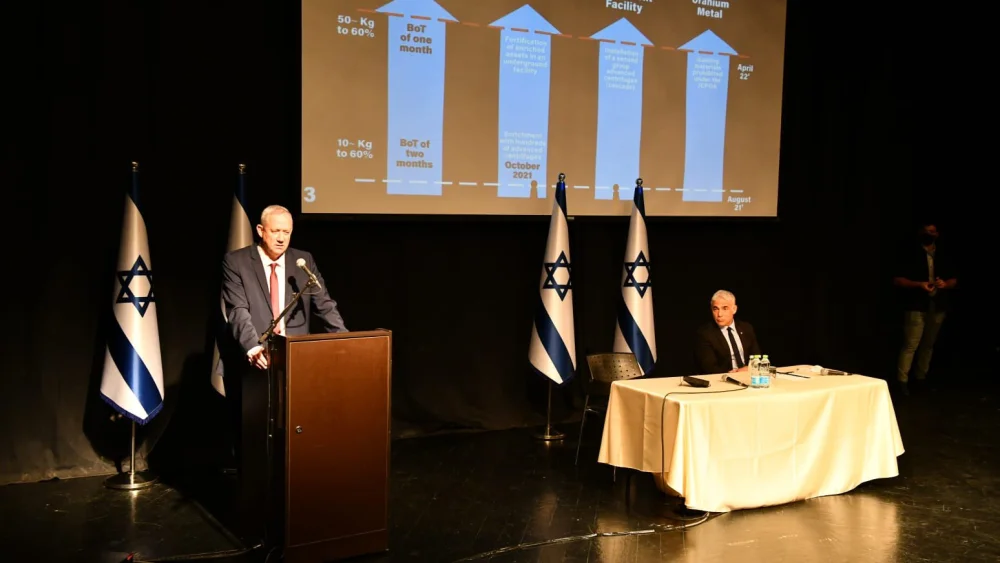
Israeli Defense Minister Benny Gantz and Foreign Minister Yair Lapid deliver a policy and security briefing to a group of 80 foreign ambassadors stationed in Israel, on April 6, 2022. Credit: Ariel Hermoni/Israeli Defense Ministry.

Israeli Defense Minister Benny Gantz said on Wednesday that if a new nuclear deal is not signed with Iran, then other measures must be taken.

“If needed, we can move forward with economic pressure, intel, diplomatic pressure, power projection and regional counterterrorism efforts,” said Gantz, according to a defense ministry spokesperson.

Gantz made the remarks during a policy and security briefing for the 80 foreign ambassadors stationed in Israel, together with Israeli Foreign Minister Yair Lapid.

He also presented the diplomats with information on the rapid advance of Iran’s nuclear program.

“Since August 2021, Iran has raced forward. Iran has increased its enriched uranium stockpile to 50 kilograms at [at an enrichment level of] 60%. We are running against [the clock]. The international community must insist on a solid agreement,” he said.

Regarding the recent wave of terrorist attacks in the country, Gantz said that Israel was taking all necessary measures, including preemptive operations, to prevent further attacks.

Gantz concluded his remarks by presenting confidence-building measures undertaken with the Palestinian Authority since “Operation Guardian of the Walls” last May. He also called on the international community to invest in the P.A.

Lapid presented the ambassadors with an overview of last month’s Negev Summit and spoke of the importance of regional cooperation in the fields of security and the economy.

In addition, Lapid provided the ambassadors with information about the humanitarian aid Israel is providing to Ukraine and reiterated Israel’s condemnation of the Russian invasion.

Both Gantz and Lapid emphasized Israel’s condemnation of the invasion and its humanitarian efforts, as well as Israeli Prime Minister Naftali Bennett’s mediation efforts.

It’s “absurd and tragic that there are U.N. experts who are supposed to care about the rights of women, especially to combat sexual violence, and she’s one of the world’s major deniers of sexual violence against Israeli women,” Hillel Neuer told JNS.
“We’re going to keep pushing, and we’ll get there,” Rabbi Josh Joseph told JNS. “We’ll get to the $1 billion that we need.”
“We don’t need it. We need to teach real, honest history,” Sonja Shaw, school board president of Chino Valley Unified School District, told JNS.
The Israeli ambassador accused Vanessa Frazier, the U.N. special representative for children and armed conflict, of amplifying antisemitic content and unverified claims about Israel, and called for a review of her continued suitability for office.
A federal judge found that efforts to remove Hassan Suleiman Khalaf to Gaza or an Arab village in Judea and Samaria via Israel remain viable.
Speaking to local authority leaders, the Israeli premier said bold military decisions changed the regional balance of power and averted existential threats.
Benny Gantz, JNS editor-in-chief Jonathan S. Tobin, Gilad Erdan, Mosab Hassan Yousef, Nissim Black and leading voices in security, diplomacy, media, law and Jewish communal affairs headline the summit’s third day in Jerusalem.