Newsletter
Newsletter Support JNS

Israel’s High Court to review decision to close Temple Mount on Jerusalem Day

For the first time in 30 years, the national holiday marking the reunification of Jerusalem after the Six Day War falls during the final days of Ramadan, when the Temple Mount is usually closed to Jews.

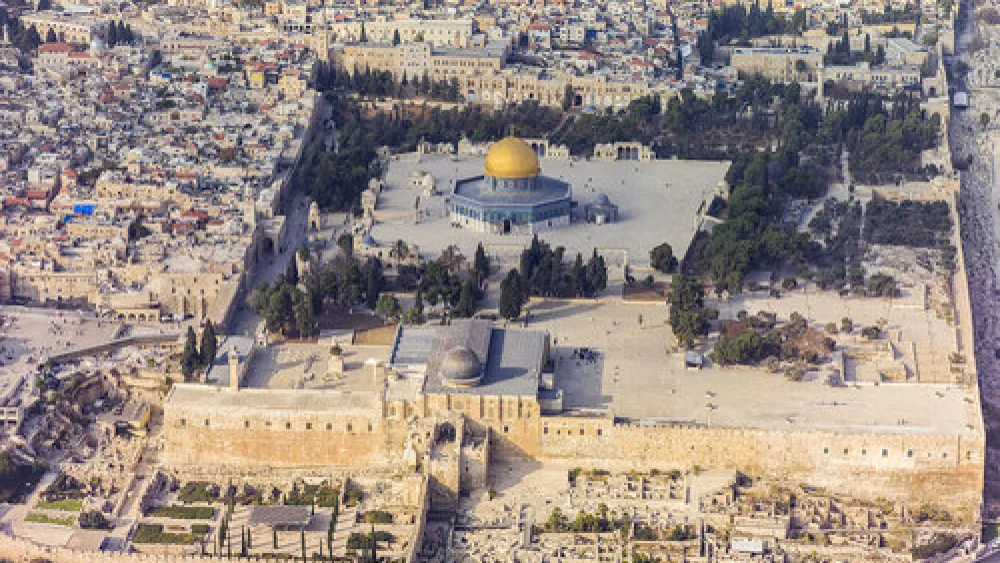
An aerial view of the Temple Mount in the Old City of Jerusalem. Credit: Wikimedia Commons.

Israel’s High Court of Justice is scheduled to discuss on Thursday a petition against a decision this week by Jerusalem District Police commander Maj. Gen. Doron Yedid to close the Temple Mount to Jews on Jerusalem Day for the first time in 30 years.

Most years, the police not only allow Jewish visitors into the Temple Mount compound on Jerusalem Day, they expand visiting hours to accommodate the thousands of extra visitors who come to celebrate the annual holiday marking the reunification of Jerusalem after the 1967 Six Day War.

This year, however, Jerusalem Day takes place on June 2, which falls during the Muslim holy month of Ramadan.

It is standard practice for the Jerusalem police to shut the Temple Mount to Jews for the last few days of Ramadan, when hundreds of thousands of Muslim worshippers traditionally visit the site.

On Monday, the various Temple Mount activist groups were infuriated after they were notified that this year, the Mount would be off-limits to Jews on Jerusalem Day because of the conflict with Ramadan.

Students for the Temple Mount and the Temple Mount Heritage Foundation said in a joint response: “We will not accept more discrimination against Jews at this holy place, and certainly not on the day [marking] the precious site’s liberation.”

The court could decide to instruct the police to open the Temple Mount to Jews on June 2, but restrict the hours. No matter how it rules, the decision will likely have ramifications for years to come.

This article first appeared on Israel Hayom.
In a draft report delivered to the U.S. president, the commission also called for improved religious accommodations for U.S. service members.
Salah Salem Sarsour, accused of concealing Israeli military court convictions on immigration forms, argued his detention was part of a Trump admin effort to target the pro-Palestinian movement.
CENTCOM stated that the strikes targeted missile, drone and radar facilities after the Islamic Republic attacked a cargo ship in the Strait of Hormuz, calling the assault a violation of the ceasefire.
Now that the primaries are over, “we hope that everyone will come together and be united,” Christine Quinn, chair of the executive committee of the New York State Democratic Party, told JNS.
An Iranian official warned on Friday that the safety of ships passing through the Strait of Hormuz without Iran’s permission “cannot be guaranteed.”
“We have put the train back on the tracks and going in the right direction,” said Yechiel Leiter, Israeli ambassador in Washington. “Final destination? Peace between our two countries.”
Benny Gantz, JNS editor-in-chief Jonathan S. Tobin, Gilad Erdan, Mosab Hassan Yousef, Nissim Black and leading voices in security, diplomacy, media, law and Jewish communal affairs headline the summit’s third day in Jerusalem.