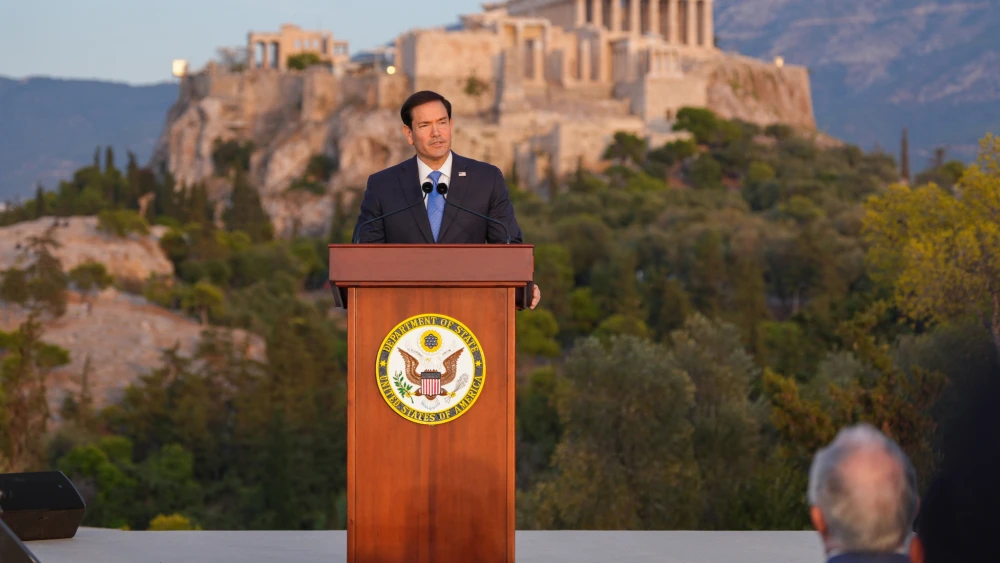

Marco Rubio, the U.S. secretary of state, has rightly drawn much praise for the speech he made last week in Athens.
Extolling ancient Greece, he said that the thumos—the Greeks’ term for strength, courage and pride—lay at the heart of civilizational greatness.
But the West, he noted, had come to feel ashamed of its achievements. Nationalism had become a dirty word. Condemning its own past, the West had outsourced its industry and its sovereignty, allowing its militaries to wither and decay and the ensuing vacuum to be filled by its enemies.
Now it was facing a choice—to maintain its place at the head of the world or to resign itself to a future of servitude and decline.
This was a remarkable speech. It’s the first time a senior politician has addressed the burning issue of the age—that the West is in deep civilizational trouble.
Having eroded its core values and historic identity, it has opened the way to conquest by predatory Islamism. Although Britain and Europe have led the way on this, America, unless it’s very careful, could follow suit.
However, Rubio’s speech had one glaring flaw. He claimed that ancient Greece had been responsible for the greatness of the West.
But that’s wrong. Certainly, ancient Greece contributed much of huge value to Western civilization. But it was also a cruel, barbaric, hierarchical society that eventually destroyed itself.
The glaring hole in Rubio’s speech was Judaism, the basic source of the West’s moral greatness and the key to its scientific, political and cultural achievements. Rubio didn’t even mention it.
“The Greeks did not just shape history; the Greeks gave us history itself,” he said. But it was the Jews who invented history. The idea that events build upon themselves over the ages was made possible by the revolutionary idea in the Torah that time was linear, not circular.
Rubio said the ancient Greeks gave us the idea that “there is a rational order to the cosmos, governed by certain fundamental laws, laws that men can observe and the mind can come to understand.”
But it was Genesis that came up with its further revolutionary idea that the universe was governed by natural laws, upon which the scientists of the Renaissance explicitly drew to launch the unstoppable rise of Western science.
Even more strangely, Rubio claimed that Greece was the “foundation of the riches of Christian theology.” Certainly, both Christian and Jewish medieval thinkers drew upon ancient Greece. But Greece didn’t create Christianity, and the foundation of Christianity’s riches was Judaism.
While, of course, Christianity developed into a religion that diverged sharply from Judaism, Jesus himself was a Jew who promulgated Jewish principles.
It was the moral principles of the Torah that constituted the core precepts of Western civilization—equal respect for every human being because humanity was fashioned in the image of God; the driving importance of justice and compassion; putting the welfare of others above our own, which is the basis of community, and more.
Furthermore, it was the particular principles of the Hebrew Bible upon which the founders of America and Western democratic government explicitly drew.
As I wrote in my book The Builder’s Stone: How Jews and Christians Built the West and Why Only They Can Save It, the Mosaic laws weren’t enforced by despotic authority but were adopted voluntarily through individual self-discipline. This gave the world the concept of equal individual accountability. Mosaic justice therefore embodied fairness for all and gave rise to a reverence for the rule of law.
The ancient Greeks held that the state was a good in itself. By contrast, the Hebrew Bible held that no power could be absolute.
No earthly ruler could enjoy ultimate sovereignty. That belonged to God alone. And the power of the king was circumscribed by judges and prophets, the inspiration for limited government in Britain and America.
The thinkers and jurists who created England’s foundational representative democracy explicitly drew upon the Hebrew Bible. In Leviathan, Thomas Hobbes wrote approvingly that the authority of Moses was grounded in the consent of the people and their promise to obey the law, as they did at Sinai no fewer than three times.
The Christian commonwealth, wrote Hobbes, should model itself on the Hebrew republic. Under Oliver Cromwell, some thinkers advocated turning Parliament into a “Sanhedrin or Supreme Council” patterned on the biblical high court of the kingdom of Judea.
The key constitutional thinker, John Selden, undertook lengthy investigations into ancient Israelite and rabbinic legal history, and gave Hebrew biblical precepts the place of honor in his blueprint for an ideal of governance.
The founding fathers of the United States also consciously tapped into this Hebrew precedent. The opening pages of “Common Sense,” the 1776 pamphlet by Thomas Paine, which made a decisive impact on the American Revolution, were based on citations from the Hebrew Bible.
As his design for the Great Seal of America, Benjamin Franklin drew a picture of the Egyptians (i.e., the English) drowning in the Red Sea (i.e., the Atlantic) with the caption: “Rebellion to tyrants is obedience to God.” Thomas Jefferson recommended the sentence to be used on the Great Seal of Virginia and later incorporated it in his personal seal.
But Rubio’s speech left out Judaism altogether. American ideas of law, virtue, citizenship and republican government, he said, were shaped in the Greek city-states.
Philadelphia, the city where the U.S. Constitution was born, was itself a Greek name. In fact, the Liberty Bell that sits in Philadelphia’s Independence Hall is engraved with an inscription from Leviticus: “Proclaim liberty throughout all the land unto all the inhabitants thereof.”
Rubio knows all this. In September 2025, he attended the unveiling of the fully exposed Pilgrimage Road in Jerusalem’s City of David. Archaeologists say that this street served as the ancient city’s main thoroughfare for pilgrims during the Second Temple period.
On that occasion, Rubio said: “The Pilgrimage Road is an enduring cultural and historical bond between the United States and Israel. It’s a powerful reminder of the Judeo-Christian values that inspired America’s Founding Fathers.”
He went on to note that America was founded on the principle that the rights of mankind come from their Creator. This was an idea “deeply rooted in the traditions, in the teachings of ancient words thousands and thousands of years that find its genesis here literally on the very spot on which I stand.”
Indeed. And that genesis was not in Greece but in ancient Israel.
So why did Rubio excise all reference to Judaism from his speech in Athens?
In The Wall Street Journal, William Galston wrote that the speech reflected the thinking of Rubio’s principal speechwriter, Nate Hochman.
In 2022, Hochman wrote in The New York Times that religion was disappearing from the right. A new coalition was emerging on that side of politics based on “social conservatism rather than a religious one, revolving around race relations, identity politics, immigration and the teaching of American history.”
More significant may have been a strategic impulse to butter up the Greeks, who are now an important ally for the West.
Whatever the reason, the omission is unfortunate because of the current global onslaught on Israel and the Jewish people. The insanity of the West’s reaction to the Hamas-led atrocities in southern Israel on Oct. 7, 2023, and the ensuing Gaza war can only be understood in the context of the West’s decades-long onslaught against the core principles of its own culture and historic identity, at the root of which sit Judaism and Christianity.
From all he has previously said and done, Rubio’s sympathy for both Israel and the Jewish people is not in doubt. He is outstanding precisely because he understands better than most the symbiotic connection between the defense of the West and the survival of Israel and the Jewish people.
Now he needs to make an even more magnificent speech about the central role of Judaism in creating the greatness of the West and the Christianity on which it stands.