Newsletter
Newsletter Support JNS

Arabs clash with police on Temple Mount during Tisha B’Av

Following a security assessment, Israeli Prime Minister Naftali Bennett allows Jews to continue to visit the site to mark the fast day.

Israeli riot police clash with Muslim worshippers at the al-Aqsa Mosque compound in Jerusalem's Old City on June 18, 2021. Photo by Jamal Awad/Flash90.
Israeli riot police clash with Muslim worshippers at the al-Aqsa Mosque compound in Jerusalem’s Old City on June 18, 2021. Photo by Jamal Awad/Flash90.

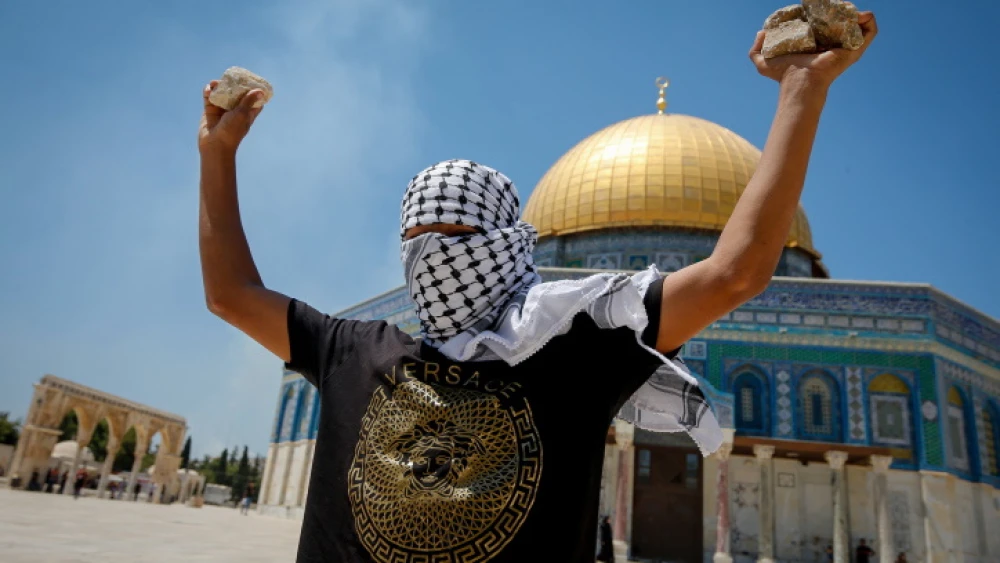
Arabs hurled stones at Israeli security forces and shouted nationalist slogans on the Temple Mount on Sunday, hours before Jews began to visit the site to mark the fast day of Tisha B’Av.

The burst of violence, which according to Israel’s s Channel 12 began at around 5 a.m., was quickly dispersed by Border Police.

Israeli Prime Minister Naftali Bennett held an assessment of the situation on Sunday together with top security officials, following which he instructed that Jewish visits to the Temple Mount be allowed to continue.

“The prime minister is receiving timely updates and will hold additional assessments in the coming hours,” his office said in a statement.

Tisha B’Av, the Ninth of Av, is the date on which both the First and Second Temples were destroyed and is regarded as one of the most solemn days on the Jewish calendar.

“It looks as if the Genocide Caucus in Congress will continue to grow,” Dan Schnur, a political science lecturer, told JNS.
Ahead of the JNS Summit, the Bosnian Serb leader explains her strong support for the Jewish state and warns of Iranian influence in the Balkans.
A coalition of Jewish groups called the law “an important step forward, giving law enforcement and prosecutors additional tools to protect targeted communities and hold offenders accountable.”
The participation of campus-affiliated groups like CUNY for Palestine “openly encouraging and providing support for terrorism and extremist ideologies,” Jayne Zirkle of EndJewHatred told JNS, “represents a serious challenge that universities can no longer ignore.”
After 35 years working across the continent, entrepreneur Haim Taib tells JNS he sees it as the next frontier for Abraham Accords cooperation.
The Islamic Republic is seeking to recover economically and militarily through the memorandum of understanding with the U.S., while avoiding any relinquishment of long-term strategic assets.