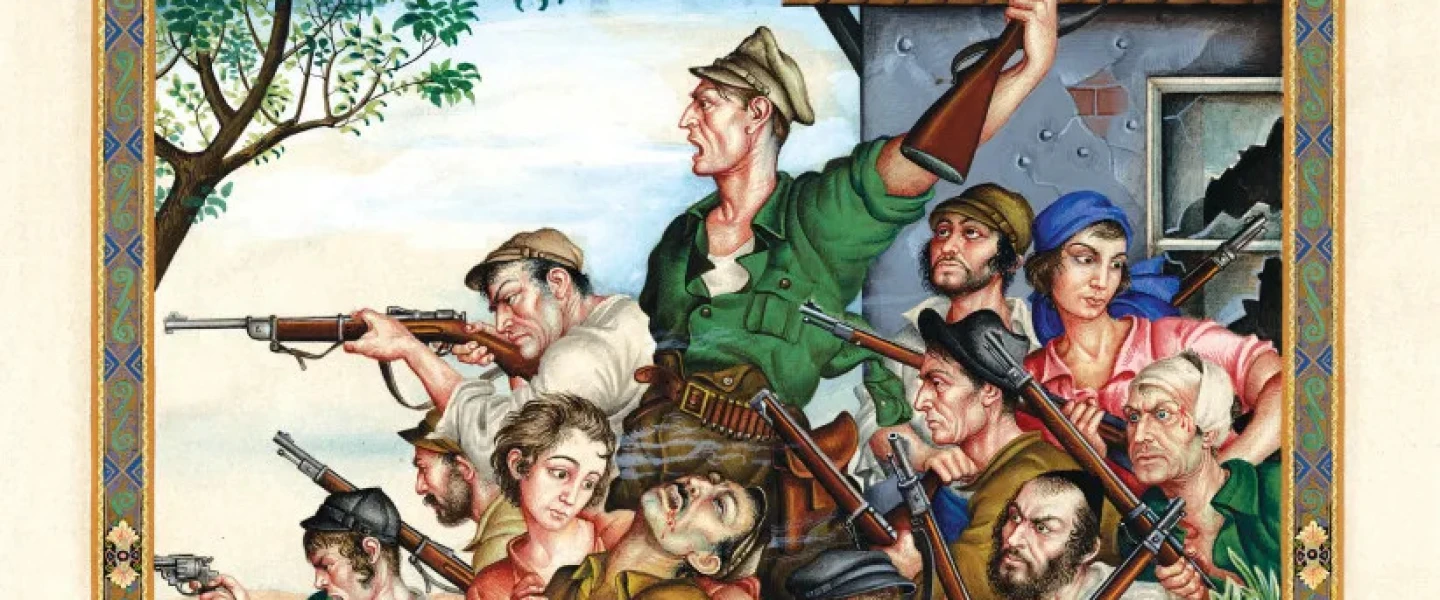
Irvin Ungar’s journey with Jewish American artist Arthur Szyk (pronounced “Shick”) began almost by accident in a Manhattan bookstore.
Speaking in conversation with Menachem Begin Heritage Center senior fellow Paul Gross in Jerusalem after the launch of his new book on Szyk on Sunday, Ungar recounted how a chance encounter with The Szyk Haggadah set him on a decades-long mission to rescue the Polish-born artist from obscurity.
Fresh out of rabbinical school, newly appointed to a pulpit and preparing for his wedding, Ungar walked into Bloch’s Bookstore looking for gifts for members of his wedding party. In one corner, he found boxed copies of the illustrated Haggadah.
“When the colors leaped out at me,” Ungar recalled, “that was my first encounter with Szyk’s art.”
He bought several copies. Then, for more than a decade, life moved on.

Today, some 50 years later, Ungar, 77, a former pulpit rabbi turned antiquarian bookseller, curator and scholar who lives in California, has published Reviving the Artist Who Fought Hitler: My Life with Arthur Szyk, released on June 2 by University of Texas Press.
The book tells not only Szyk’s story but Ungar’s own: how a rabbi with no formal business training and little money began collecting, researching, exhibiting and publishing the work of a once-famous Jewish artist who had largely disappeared from public memory.
‘A soldier in art’
Born in Lodz, Poland, in 1894, Szyk became one of the best-known political artists of World War II. He moved to the United States in 1940 after spending several years in London, where his Haggadah was published and where he worked closely with the Polish government-in-exile.

Szyk’s anti-Nazi art appeared in newspapers, magazines, exhibitions, posters and public campaigns. In America, Ungar said, his work was everywhere—from the covers of major magazines to billboards in Times Square and exhibitions at leading galleries.
“He went on to become the leading anti-Nazi artist in America during World War II,” Ungar said. “At the same time, he was also the leading artist for the rescue of European Jews in America.”
Szyk worked closely with Peter Bergson, Hillel Kook, Ben Hecht and others who challenged the Roosevelt administration and the American Jewish establishment to do more to rescue European Jewry. Ungar described Szyk as “their one-man art department.”
“He was a soldier in art,” Ungar said. “That’s how Szyk saw himself.”
For Ungar, the connection was not only aesthetic. It was moral and Jewish.
He was drawn to Szyk because the artist combined Jewish tradition, Zionism and universal justice. Szyk illustrated Jewish holidays and biblical themes but also attacked Nazism, racism and oppression.
“His art visually articulated what my value system was through words, through writing and through speaking,” Ungar said.

Zionism and the Jewish people
Szyk was deeply committed to Zionism and was close to Revisionist Zionist circles. He knew Ze’ev Jabotinsky personally and illustrated works connected to him. Menachem Begin visited Szyk at his home in New Canaan, Conn., before Israel’s founding.
In 1948, after the establishment of the State of Israel, Szyk created his celebrated illuminated version of Israel’s Declaration of Independence. According to a memoir written by his wife, Julia, Szyk cried only twice in his life: when he learned that his mother and brother had been taken from the Lodz Ghetto, and when Israel declared independence.
“She said that Arthur Szyk saw those who fought for the creation of the State of Israel as if they were his own children,” Ungar said.
After Szyk’s death in 1951 at the age of 57, his name faded. His son died shortly afterward, dealers were dismissed, the family sold much of his art, and the art world moved toward abstract modernism. Szyk’s detailed illuminated style seemed out of step with the times.
He also paid a price for his political views. He had criticized Britain over Palestine, the American Jewish establishment over rescue efforts and postwar America over racism. In Israel, his Revisionist connections placed him outside the cultural mainstream dominated by the Labor movement.
“He was forgotten,” Ungar said. “He wasn’t written about. I have books on World War II political art—and he’s missing.”

Mission to restore Szyk’s legacy
Ungar set out to change that.
He mortgaged his family home, borrowed money, acquired reference collections and original works, and began building exhibitions. His goal was to bring Szyk into museums and serious scholarship, not merely the market for Judaica.
Over the years, Szyk exhibitions appeared at major institutions, including the Library of Congress, the U.S. Holocaust Memorial Museum and the German Historical Museum in Berlin. Ungar also produced new editions of Szyk’s Haggadah and helped place his work before new audiences.
Among the more unexpected chapters in Ungar’s journey was bringing a luxury edition of The Szyk Haggadah to the Vatican. During a visit there, he presented Vatican officials with Szyk’s Visual History of Israel and later wrote about the encounter.
“There I am in the heart of the Vatican,” he recalled, “advocating for Israel.”
Ungar emphasized Szyk’s universal moral message. In a 1945 visual history of the United States, Szyk placed a Black American and a Native American alongside white soldiers and sailors, giving them equal space in the fabric of the country at a time when the U.S. military was still segregated.
“This is Arthur Szyk in 1945,” Ungar said. “He was an immigrant, a Polish Jew, and he had great sensitivity to the idea that they had the same entitlement to be part of America.”
For Ungar, that is what makes Szyk not only a Jewish artist but an artist for humanity.
“He was an artist who built bridges between peoples and nations,” Ungar said. “He used the best of his tradition to make the world a better place.”
Why Szyk still matters
One of Szyk’s most powerful Holocaust works, “De Profundis,” created in 1943, depicts murdered and dying Jews, with Jesus among them, holding the Ten Commandments. Reproduced full-page in the Chicago Sun by a Protestant group, the image was used to call Christians to account for the antisemitism taught in their own traditions.
Ungar considers it one of the most important works of Holocaust art created during the war because it did not merely document tragedy—it demanded responsibility.
“By adding the verse, ‘Cain, where is Abel thy brother?’ Szyk is talking about responsibility,” Ungar said. “Who is going to be held accountable for this?”
That sense of accountability also explains Ungar’s own mission.
When he began, there were almost no books about Szyk and little accessible information. Today, after decades of collecting, publishing, exhibiting and lecturing, Ungar believes Szyk’s disappearance from memory will not happen again.
“Behind the great art and the great messages stands the great man,” Ungar said. “This man was heroic.”
For Ungar, reviving Szyk was never only about rescuing an artist from obscurity. It was about restoring a Jewish voice that spoke with courage, pride and moral clarity at a time of catastrophe.
“He loved the Jewish people,” Ungar said. “His art was always used to elevate the prestige of the Jew in the world.”