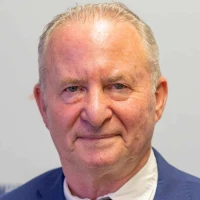
Zeljka Cvijanovic, the Serb member of the three-person Presidency of Bosnia and Herzegovina, says her support for Israel is based on a shared history of suffering, a commitment to historical truth and what she describes as Israel’s unquestionable right to defend itself after the Hamas massacre of Oct. 7, 2023.
In a wide-ranging interview with JNS ahead of her appearance at the JNS International Policy Summit in Jerusalem, Cvijanovic discussed her upcoming visit to Israel, the threat posed by Iran and its proxies and her opposition to the International Criminal Court’s arrest warrant against Israeli Prime Minister Benjamin Netanyahu.
Cvijanovic, 59, is serving her first term as the Serb member of the Presidency of Bosnia and Herzegovina after previously serving as president of Republika Srpska, the Serb-majority entity that comprises almost half of Bosnia and Herzegovina’s territory.
Returning to Israel
Cvijanovic said she was looking forward to returning to Israel for the first time since 2021.
“In Republika Srpska, we regard Israel as a friendly state,” she told JNS. “For the benefit of your readers, Republika Srpska is one of the two equal entities within Bosnia and Herzegovina, which makes up 49 percent of the country’s territory and it is the entity I represent within the three-member Presidency of Bosnia and Herzegovina.”
During her visit, Cvijanovic plans to meet senior Israeli officials, attend the MUNIEXPO conference in Tel Aviv and revisit Yad Vashem.
“As is natural, I also plan to visit Yad Vashem once again, with the intention of paying tribute to your history and honoring the victims of the Holocaust,” she said.
Cvijanovic has long cultivated ties with Israel, including meetings with Israeli leaders and public expressions of support during the war against Hamas. In April, she sent Independence Day greetings to Israeli President Isaac Herzog, reaffirming what she described as the friendship between the Serbian and Jewish peoples.

Shared history and support for Israel
Asked what motivates her strong support for Israel, Cvijanovic pointed to the historical experiences of Serbs and Jews during World War II.
“Our support for Israel stems from a shared history, mutual understanding and the sincere friendship that Serbs and Jews forged during the most difficult period in the history of both peoples,” she said.
Cvijanovic specifically referenced the Ustasha-run Jasenovac concentration camp and the nearby Donja Gradina execution site, where large numbers of Serbs, Jews and Roma were murdered during the Holocaust. She highlighted her recent meeting with U.S. Special Envoy to Monitor and Combat Antisemitism Rabbi Yehuda Kaplun at Donja Gradina, the largest execution site at Jasenovac, emphasizing shared Serbian and Jewish suffering during World War II.
“We know that the State of Israel was founded to ensure that such evil would never again be inflicted upon the Jewish people, and that is why we unequivocally support its right to self-defense,” she said.
While expressing sympathy for all civilian victims, Cvijanovic stressed the importance of recognizing how the current war in the region began.
“As we all know, the conflict in Gaza began on Oct. 7, 2023, with the horrific massacre of innocent civilians carried out by Hamas,” she said. “We unequivocally support [Israel’s] right to self-defense.”
Opposition to ICC warrant
Cvijanovic was equally direct when discussing the ICC’s decision to issue an arrest warrant for Netanyahu.
“Absolutely,” she said when asked whether she opposed the move.
“I stated very clearly that the decision was evidently being used as a means of political pressure against Prime Minister Netanyahu and that, as such, it constituted an abuse of international law for political purposes.”
She said the decision gave the impression of an attempt to deny Israel its right to self-defense.
“It was particularly hypocritical to issue such a decision at a time when Israel was doing everything in its power to secure the return of the hostages taken by Hamas on Oct. 7, 2023,” she said.
Cvijanovic stressed that Republika Srpska would not participate in the implementation of the warrant within the framework of its constitutional authorities.
Iran and the Muslim Brotherhood
One of the more controversial issues raised during the interview concerned her recent effort to designate both Iran’s Islamic Revolutionary Guard Corps and the Muslim Brotherhood as terrorist organizations.
Cvijanovic noted that fellow Presidency members Denis Becirovic and Zeljko Komsic blocked her proposal from even reaching the agenda.
“I would say that they opposed it partly because of their personal convictions, but also because of their concern about how such a decision would be received by the Sarajevo public,” she said.
She cited longstanding ties between Iran and Bosniak political and military leaders dating back to the Bosnian war, as well as reports of ongoing Iranian influence in Bosnia and Herzegovina.
“The CIA stated in its report last year that the Islamic Revolutionary Guard Corps operates in Bosnia and Herzegovina,” she said.
Cvijanovic argued that opposition to her proposal illustrates the deep political divisions that continue to characterize Bosnia and Herzegovina more than three decades after the end of the Bosnian war.

Hope for regional stability
Discussing Iran and the broader Middle East, Cvijanovic said many countries in the region view Tehran as a source of instability.
“It has become clear that the countries of the region regard Iran as the principal source of regional instability,” she said.
At the same time, she expressed hope that diplomatic efforts led by U.S. President Donald Trump could help reduce tensions.
“What is encouraging in this context is the engagement, commitment and determination demonstrated by President Trump, which resulted in the recent peace agreement with Iran,” she said.
“As someone who has, unfortunately, experienced war and who considers peace to be an invaluable good, I sincerely hope that the agreement reached will lead to a sustainable peace, that Israel will be safe and secure, and that the entire Middle East will become more peaceful and stable.”
Looking ahead, Cvijanovic said she hopes the region can move beyond cycles of conflict.
“The most important thing is for this region to undergo a transformation and become a place of stability rather than one of permanent instability,” she said.
For Cvijanovic, that message is consistent with the one she plans to bring to Jerusalem.
“My fundamental message always includes words such as peace, dialogue, understanding and cooperation,” she said. “We are here to talk, to resolve issues and to deepen mutual understanding.”