


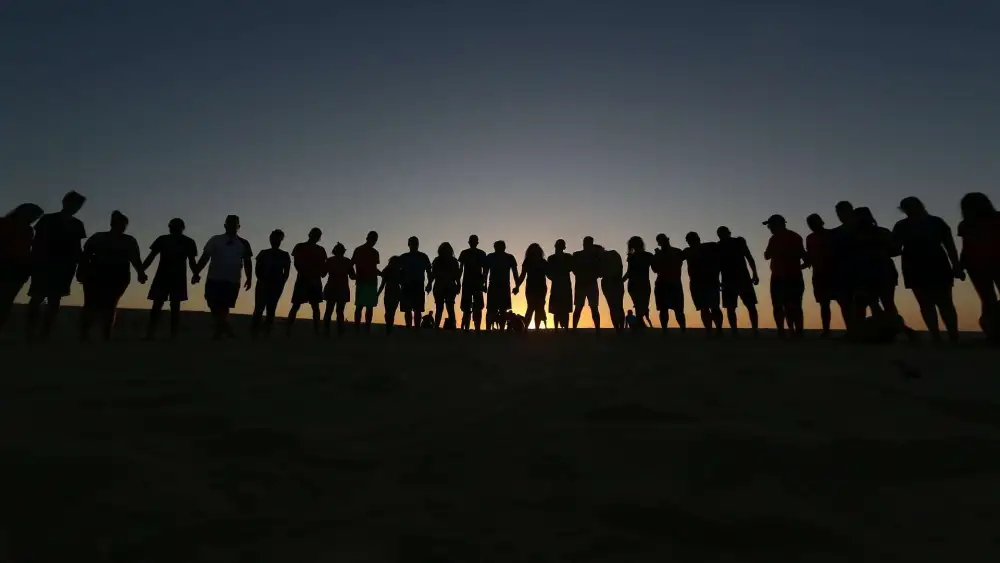

South Florida doesn’t struggle with diversity—it struggles with what to do with it. That’s why we need to elevate programming that brings together our community by focusing on what we have in common as opposed to our differences.
In Broward County alone, more than 2 million people live side by side, representing a striking mix of backgrounds. Hispanics make up roughly a third of the population, black residents more than a quarter and non-Hispanic white residents just over 30%—a rare balance where no single group defines the whole. In fact, by some measures, Broward ranks among the most diverse counties in Florida, with an “A+” rating for diversity.
But diversity, by itself, is not the same as connection.
We often celebrate South Florida’s multicultural identity as a point of pride (which it is). Yet many of us still live parallel lives, shaped by different institutions, houses of worship, schools and social circles. We share geography more than we share experience. And in a time when national conversations increasingly reward division, that gap matters.
That’s where initiatives like The Overlap come in. Not as symbolic gestures, but as necessary civic work.
Led by the David Posnack Jewish Community Center, The Overlap reflects something important that often gets misunderstood: Yes, the JCC is proudly rooted in Jewish values and identity, but its doors are open to the entire community. That’s not a contradiction; it’s the point. A strong sense of identity can be a bridge, not a barrier, when it’s paired with an invitation outward.
The Overlap builds on that idea by focusing not on what separates us, but on what we share.
That may sound simple, even obvious. It isn’t.
Much of today’s public discourse emphasizes difference—what makes us distinct, what divides us, what puts us at odds. This program takes a different approach: It creates spaces where people can discover common ground through shared experiences. That is applicable whether playing soccer, cooking a meal, listening to music or engaging in honest conversation.
And those shared experiences matter more than we often admit.
It’s one thing to talk abstractly about coexistence. It’s another to watch young people from different faiths build teamwork and trust on a soccer field. Programs like interfaith youth sports don’t just teach cooperation but make it real. They replace assumptions with relationships.
The same is true around a table. Food-centered programs don’t require participants to agree on everything; they simply ask them to sit together, taste each other’s traditions and listen. That act alone can shift perspective from “otherness” to familiarity.
The arts, too, play a critical role. Music, storytelling and performance allow people to engage with difficult histories—like the Holocaust or experiences of discrimination—in ways that statistics alone cannot. They create emotional understanding, not just intellectual awareness.
This is especially urgent right now. Across the country, incidents of religious intolerance are rising. Social media amplifies outrage but rarely fosters nuance. It’s easier than ever to form opinions about people we’ve never actually met.
And that makes real-world interaction and face-to-face experiences even more essential.
The Overlap doesn’t pretend that differences don’t exist. It doesn’t ask participants to abandon their identities or beliefs. Instead, it starts from a different premise: that beneath those differences, there is enough shared humanity to build trust.
And that trust is what turns diversity into strength.
Because the alternative is fragmentation. A region where communities coexist but don’t connect is more vulnerable to misunderstanding, fear and conflict. A region where people actively engage across lines of difference is more resilient, more empathetic, and ultimately, more unified.
South Florida already has the raw ingredients. The question is whether we’re willing to do the work.
In a place as diverse as Broward, building connections isn’t optional. It’s essential.
And sometimes, the most powerful place to start isn’t by focusing on what makes us different, but by discovering, together, where we overlap.



