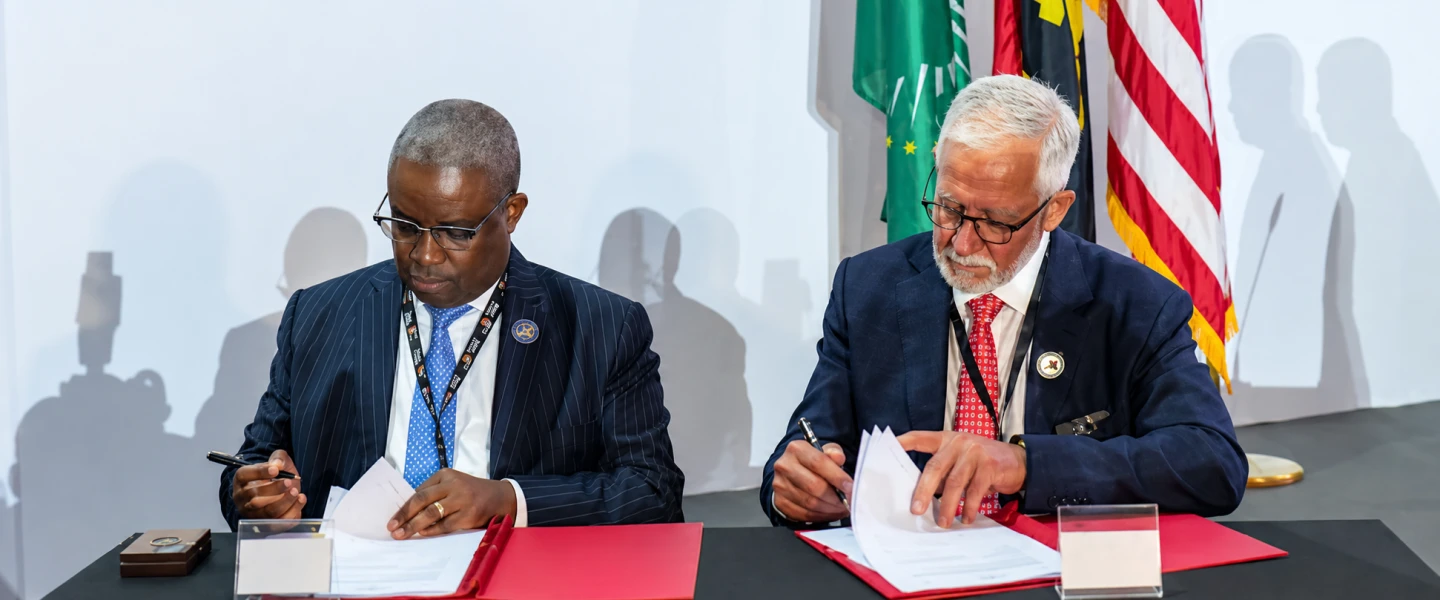
When Israeli entrepreneur and philanthropist Haim Taib first arrived in Angola three and a half decades ago, the Central African nation was mired in a deadly civil war. Yet he saw opportunity where others saw only turmoil.
Taib, who went on to become a business magnate responsible for more than 100 national-scale development projects across Africa, now believes Israel has a historic opportunity to expand the landmark Abraham Accords to the continent in partnership with the United States and allied Gulf states.
“We are at a historic moment for Israel in the development of Africa,” Taib told JNS in an interview at his offices in Herzliya. “The time to act is now.”

Humble beginnings
The grandson of a Holocaust survivor from Tunisia, Taib, 66, was born in Jerusalem and raised on Moshav Olesh in central Israel after his father received a plot of land there.
“There was not a lot of comfort at home, but there was a lot of love, shared responsibility and Zionist values,” he recalled.
One of seven siblings, Taib remembers watching his father struggle in agriculture while working three jobs and his mother holding two jobs to help put food on the table. He also recalls wearing hand-me-down shoes from his older brothers.
After serving in the Israeli military during the 1982 Lebanon War, Taib moved to Portugal in an unsuccessful effort to market eggs with an Israeli poultry company.
While there, he connected with former Israeli fighter pilot-turned-entrepreneur Eytan Stibbe, who was pursuing business opportunities in Angola. The two eventually became partners.
Taib first arrived in Angola in 1991 and was struck by the contrast between the resource-rich country—with its vast petroleum and diamond reserves—and the poverty of its people.
Recognizing the determination of young Angolans to build a better future despite the country’s decades-long civil war, he forged relationships with local leaders that would deepen over the next 35 years.
Following the end of the civil war in 2002, Taib’s companies became involved in large-scale infrastructure projects throughout Angola and elsewhere in Africa, spanning housing, energy, water, agriculture, education and healthcare.
“I didn’t need to reinvent the wheel,” he said. “I simply adapted projects that had succeeded in Israel and applied lessons I learned growing up on the moshav.”

Abraham Accords Africa
Having quietly leveraged his extensive network of African contacts to help advance Israel’s recent diplomatic outreach on the continent, Taib believes a new window of opportunity has opened.
“Many people look at Africa and see risk. I see potential, and the results speak for themselves,” he said.
Home to 1.6 billion people, Africa is the world’s second-largest continent, with approximately 60% of its population under the age of 25.
“There is a tremendous historic opportunity for Israel, together with the United States and its Abraham Accords partners in the Gulf, to help develop Africa,” Taib said. “The next chapter of the Abraham Accords can—and should—extend to Africa.”
While much of the West remains focused on immediate global crises, he noted, China has been investing heavily across Africa with a long-term strategic vision.
“China is looking 30 years ahead,” he said.

‘A win-win for everyone’
Israel has also been expanding its faith-based diplomatic outreach on the continent, where some 600 million Christians live. A significant portion belong to evangelical communities that are broadly supportive of Israel.
Taib described Africa’s evangelical population, which is estimated at roughly 20% of the continent’s population, as a natural partner in promoting joint development initiatives.
“It’s a win-win for everyone,” he said.
Looking back on a career that has spanned more than three decades across Africa, Taib sees a personal and historical connection between his upbringing and his life’s work.
“I took the values with which I was raised and realized them in Africa,” he said.