


Tova Hartman and Charlie Buckholtz in “Are You Not a Man of God?” have taken two stories from the bible, two from the Talmud, and one from Greek literature, stories that we all know—or that we think we know—and shown us how to read them in a fresh and radical way.
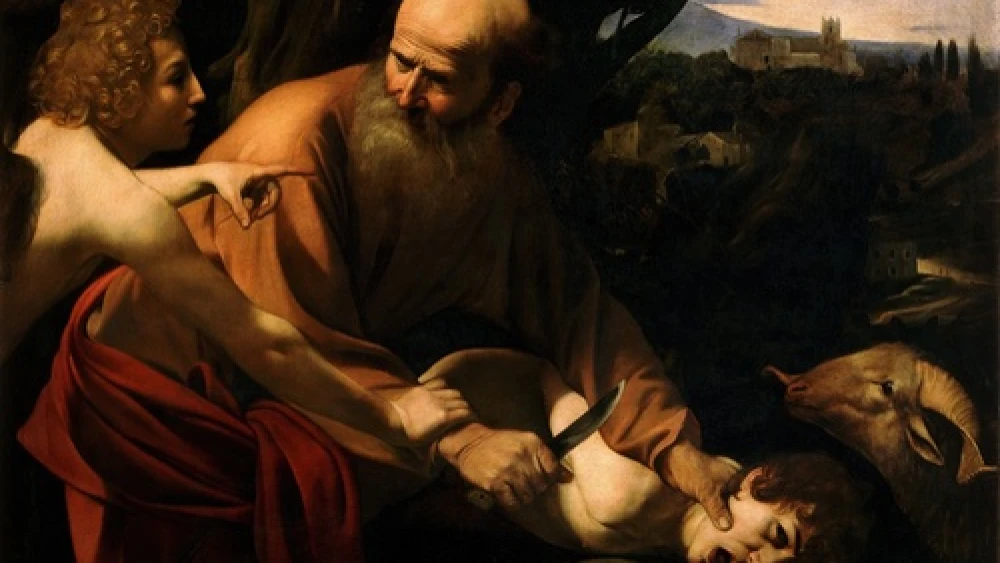
The authors begin their recently released book with two stories that seem to mirror each other—the story of Iphigenia by the Greek tragedian Euripides and the story of the Binding of Isaac (which is detailed in the Torah portion of the second day of Rosh Hashanah). The two stories raise the same moral issue, an issue that parents encounter in every generation: What do you do when you are caught between what the Supreme Authority commands of you and what your love for your own flesh and blood commands?
Not only every zealot who sends his child out to die as a martyr, but every parent who sends his child off to war for his country, knows this tension. On the surface, the child in both stories—Iphigenia and Isaac—seems to accept the command of the father and go along with it passively. But commentators on both stories discover what the authors of this book call “devotional resistance” hidden inside the narratives. They claim that the “supporting actors” challenge the fathers by reminding them of the covenant of love, which they say is as sacred as the covenant with the Supreme Authority. Neither Iphigenia nor Isaac can explicitly refuse to obey their fathers because that would put the children outside the boundaries of their culture. But they undermine their fathers’ authority in subtle ways that are easy to overlook in these stories—unless you read them very carefully.
When Iphigenia fails to persuade her father to change his mind, she gives in but instructs her mother not to mourn for her, and not even to bury her, because she is an instrument of the nation and not a daughter. By saying this, she turns her father’s whole argument upside down. She says: You want me to be an instrument of the state and not a daughter? I’ll show you what it means to be an instrument and not a daughter. I’ll show you what happens when you make the covenant of love less sacred than the covenant with society. It is never quite said in words, but the point of the play may be to undermine the values of the society for the sake of the values of the family.
The same hidden agenda can be found if you carefully read the story of the Binding of Isaac. On the surface, Isaac obeys his father without question. There are a host of midrashim that describe Isaac as taking such steps as asking his father to tie him up in order to make sure that he does not spoil the sacrifice by moving. The Talmud, the Danish philosopher Søren Kierkegaard, and Rabbi Joseph B. Soloveitchik all agree in calling Abraham a great hero because he does not let concern for his child stop him from carrying out the will of God. And Isaac is praised by them too, for going to be sacrificed without protest and without hesitation. It is for this total and almost inhuman devotion to God that Abraham is rewarded. It is this that we are to remember when we hear the shofar on Rosh Hashanah. It is this that we mean when we speak of “zechut avot”—the merit of the patriarchs—which accrues to the benefit of their descendants.
But then, just when you think that the readiness to sacrifice what is most precious to you for the sake of God is the lesson of the story, there is a line in a midrash in which Isaac says, “I am ready to die, but I grieve for my mother.” Then one can find another midrash in which Isaac tells his father, “Please do not tell mother while she is standing over a pit or on a rooftop, lest she throw herself down and kill herself.” In yet another midrash Isaac says, “Father, who will take care of you in your old age without me?” Most surprising of all, Isaac says, “If God has chosen, then… .”
How can Isaac say “if” when Abraham has already told him what God has said? Here, Hartman and Buckholtz present a counter-version of the story, one in which concern for family outweighs even the word of God. In this version, Isaac is not docile and not passive, but raises the same questions that we raise when we think about this story.
The book’s chapters about other biblical figures, such as the prophetess Hannah, the female sage Beruriah, and the Stove of Achnai, are just as full of surprises as the sections on Isaac and Iphigenia. This book is not easy reading, but it is well worth the effort. Hartman and Buckholtz reveal how many different ways there are of reading the same stories, and how each reader can find new understanding by reading the old from the perspective of today.
“Are You Not a Man of God?” by Tova Hartman and Charlie Buckholtz, Oxford University Press, Oxford and New York, 2014, 208 pages.



