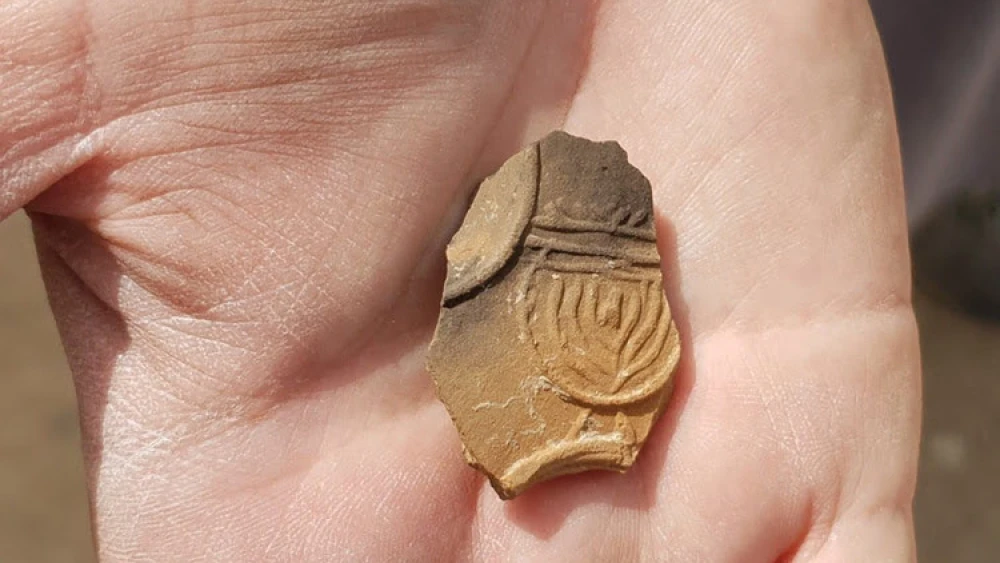
The remains of a Jewish settlement of the Second Temple period, including the sherd of a rare oil lamp depicting a menorah with nine branches, have been discovered in Beersheva for the first time, revealing proof of Jewish day-to-day life there, announced the Israel Antiquities Authority on Thursday.
Along with the menorah, limestone vessels used by Jews for reasons of ritual purity and a watchtower were uncovered.
The site, dated from the first century C.E. until the Bar-Kochba Revolt in 135 C.E., also appears to contain underground hidden passageways used by the Jewish rebels.
“Remains of the settlement cover an area … and include several structures and installations, such as the foundations of a large watchtower, baking facilities, ancient trash pits and an underground system that was probably used as a Jewish ritual bath [mikvah],” said Peter Fabian of the Ben-Gurion University in the Negev and Dr. Daniel Varga of the Israel Antiquities Authority. “Signs of a conflagration discovered in some of the structures evince a crisis that the settlement experienced, probably that of the First Jewish Revolt in circa 70 C.E.”
The site is located along the southern border of the ancient kingdom of Judah next to a road that led from Tel Beersheva to the southern coastal plain.
Finally, dozens of bronze coins discovered at the site belong to the period of Roman provincial rule. Some were minted in Ashkelon and others were minted in cities from throughout the Roman Empire.