


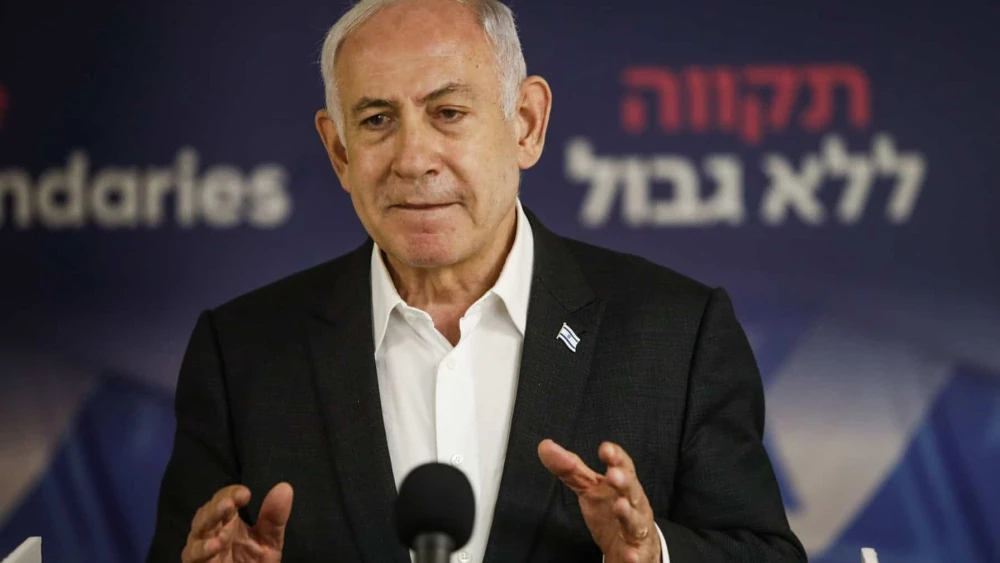
Israeli Prime Minister Benjamin Netanyahu’s office on Sunday night outlined Jerusalem’s red lines in the ongoing ceasefire negotiations with the Hamas terrorist organization in the Gaza Strip.
“The plan that has been agreed to by Israel and which has been welcomed by President Biden will allow Israel to return hostages without infringing on the other objectives of the war,” according to the PMO.
The statement also credited Netanyahu with pressuring Hamas into returning to the negotiating table.
“The prime minister’s steadfast position against the attempt to halt the Israel Defense Forces’ action in Rafah is what has led Hamas to enter negotiations,” it continued.
Israel’s red lines for a ceasefire are the ability to resume fighting until all war goals have been met; an end to arms smuggling into Gaza through Egypt; no return of “thousands” of terrorists to Gaza’s north; and maximizing the number of living hostages released, according to the PMO.
Mossad Director David Barnea traveled to Doha, Qatar, over the weekend to jump-start talks. Upon his return, Netanyahu’s office said that a team would be dispatched this week to continue the negotiations.
However, the PMO cautioned on Saturday however that “it should be emphasized that there are still gaps between the sides.”
A source with knowledge of the talks told Israel’s Kan News on Sunday that Barnea, CIA Director William Burns, Egyptian intelligence chief Maj. Gen. Abbas Kamel and Qatari Prime Minister Mohammed bin Abdulrahman Al Thani are set to hold an additional meeting in Doha on Wednesday.
Meanwhile, Israel Security Agency chief Ronen Bar departed with an Israeli delegation for Cairo on Monday to continue hostage deal talks, Israeli media reported. Bar and his team are also expected to discuss future control of the Rafah border crossing between Gaza and Egypt.
Israeli forces took over the Gaza side of the crossing during the start of the Rafah military operation in early May, later securing the entire Philadelphi Corridor running along the Gaza-Sinai border. Jerusalem insists that Israeli security control is vital to preventing Hamas smuggling efforts via its terror tunnels.
According to Hebrew reports, Bar is also expected to discuss the construction of an underground barrier between Gaza and Egypt as part of efforts to prevent smuggling.
Bar is then expected to fly to Doha on Wednesday to join the hostage negotiations there, holding “working meetings” with senior officials in the Qatari capital.
Mediators are working to revive the phased ceasefire outline presented by U.S. President Joe Biden in May, which calls in its first stage for a “full and complete” six-week truce during which dozens of Israeli hostages—women, the elderly and the sick—would be exchanged for hundreds of Palestinian terrorists.
Meanwhile, Jerusalem and Hamas would negotiate the terms of the second phase, in which the remaining male hostages would be freed in return for Israel releasing additional Palestinian terrorists from jail.
In the third phase, the bodies of dead Israeli civilians and soldiers would be returned for burial, and the reconstruction of Gaza would begin.
Hamas has dropped its key demand that Jerusalem commit upfront to ending the war as part of any deal, the Associated Press reported on Saturday, citing anonymous Egyptian and Hamas terrorist officials.
However, it is still demanding written guarantees from mediators that the Jewish state will continue to negotiate a permanent ceasefire deal once the first phase of the agreement goes into effect, the officials noted.
The Hamas official said the move came after it received “verbal commitments and guarantees” from mediators that the war won’t be resumed and that talks will continue until a permanent truce is reached.
Israeli President Isaac Herzog on Sunday marked nine months since the beginning of the war on Oct. 7 by calling for the immediate return of all 120 hostages still being held in Gaza.
“Our hearts are with the bereaved families, the physically and mentally wounded, the abductees and their families who have been working for months to return their loved ones home,” he said. “The entire nation wants their return, and an absolute majority supports a hostage deal.”
Jonathan Dekel-Chen, whose son Sagui, 35, was kidnapped by Hamas on Oct. 7, told JNS on Sunday, “Unfortunately, we’ve been here before, this is not the first time certain parties have expressed optimism about the possibility of getting a deal done. Speaking for myself, I’ll save the optimism until a deal is actually done and the hostages are home.”
Of the 120 hostages remaining in the Strip, 116 were abducted on Oct. 7 (the other four were captured earlier). The figure includes both living and deceased men, women and children.
At least dozens of the remaining hostages are believed to be alive, a senior Israeli official involved in the negotiations told AFP last month.
The official told the agency that Israel cannot commit to ending the war as a precondition for a deal because Hamas could “breach their commitment ... and drag out the negotiations for 10 years” or more.


