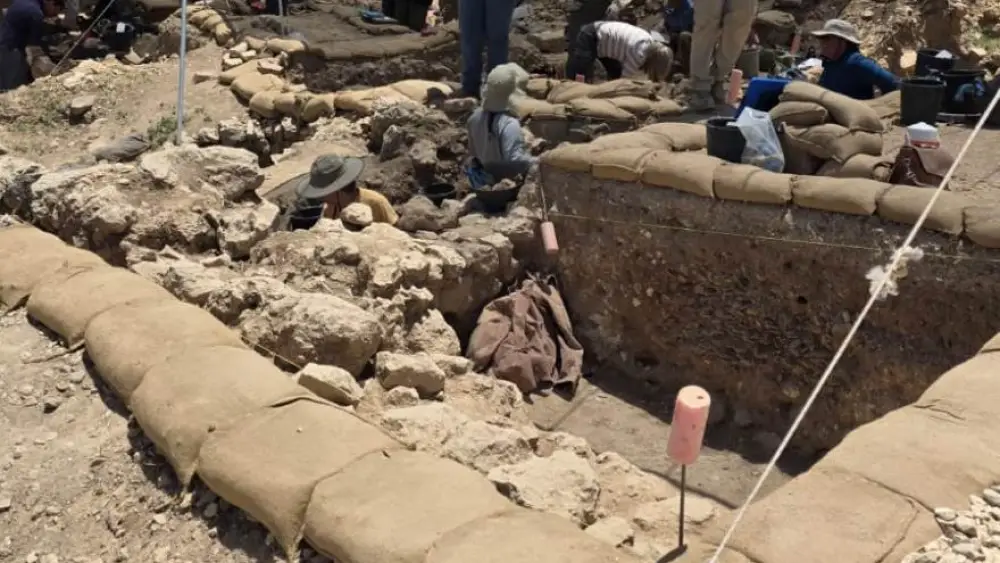
Three remarkably well-preserved storage jars dating back thousands of years to the Middle Bronze Age have been unearthed near the site traditionally identified with the biblical Tabernacle during this year’s archaeological excavations at Ancient Shiloh, in the Binyamin region of Samaria.
Researchers are examining whether the vessels were used to store agricultural products, including grapes, wine and olive oil. The announcement by the Mishkan Shiloh Foundation came days before the annual Ancient Shiloh Wine Festival on June 12.
The discovery was made as part of an annual excavation season led by the Ancient Shiloh site and the Mishkan Shiloh Foundation, in cooperation with the archaeology staff officer of the Ministry of Heritage.
Over the past several years, the excavations have become one of Israel’s most significant archaeological research projects, drawing archaeologists, students and volunteers from around the world. The expedition is led by Dr. Scott Stripling, one of the leading figures in biblical archaeology. This year, despite the ongoing war, dozens of participants from the United States and other countries traveled to Shiloh to take part in uncovering the site’s ancient history.
Buried beneath later civilizations
The jars were discovered during deep excavation work in an area where archaeologists had previously uncovered approximately 10,000 animal bones, numerous Late Bronze Age pottery vessels and offerings made of gold and silver.
The purpose of the excavation was to reach bedrock and complete the site’s stratigraphic sequence. During the process, the three jars were found in a particularly ancient layer from the Middle Bronze Age, beneath Late Bronze Age remains and below Iron Age strata.
The jars will undergo careful excavation and scientific analysis to determine their precise age and original use. Initial assessments suggest they served as storage vessels for agricultural products, including grapes, wine, olive oil and other commodities that formed part of daily life in the region thousands of years ago.
“This is an especially exciting discovery,” said Stripling, director of the excavation expedition. “We set out to investigate the earliest layers of the site in order to better understand the history of Shiloh, and along the way, we uncovered three impressive storage jars that have remained preserved for thousands of years.
“We now have the opportunity to examine what they contained and perhaps learn new details about the daily lives of the people who lived here long ago. Every year we come here with researchers and volunteers from around the world to uncover another chapter in the story of Shiloh, and this year people chose to come despite the war because they understand the significance of this remarkable place.”
‘The earth itself continues to speak’
Heritage Minister Amichai Eliyahu said the latest discovery underscores the Jewish people’s ancient connection to the land.
“Anyone who wants to understand who this land belongs to need only get down on their knees and dig,” he said. “Every layer of soil in Shiloh tells a story that cannot be denied: The Jewish people lived here, worked here and produced wine and oil here thousands of years before anyone ever dreamed of inventing a Palestinian people.”
Yisrael Ganz, governor of Binyamin and chairman of the Yesha Council, described Ancient Shiloh as “one of the strongest testimonies to the deep roots of the Jewish people in this land.”
He said, “While there are those who seek to distort, deny or erase our history, the earth itself continues to speak. Time and again, discoveries emerge here that tell the story of our ancestors, who lived, worked, prayed and built their lives in this place thousands of years ago.”
Beni Har-Even, head of the Civil Administration’s Archaeology Unit for Judea and Samaria, said the excavation is part of a broader effort to uncover and preserve heritage sites throughout the region.
“Shiloh, where the Tabernacle stood for centuries, is one of the most important sites in biblical archaeology,” he said. “The jars uncovered this week provide yet another reminder that the archaeological sites of Judea and Samaria are of global significance and that the work here is far from complete.”
Ancient wine and modern vineyards
The discovery was announced ahead of Friday’s Ancient Shiloh Wine Festival, which features dozens of wineries, workshops and tastings.
One of the festival’s highlights is a lecture by Professor Shivi Drori, one of Israel’s leading wine researchers, who will discuss the connection between the archaeology of the Land of Israel and the modern wine industry.
In recent years, Drori has led groundbreaking research identifying and reviving ancient grape varieties through genetic analysis of archaeological remains, some of which have since been used to produce local wines. Several of these varieties are currently used by wineries in the region, including the Gvaot Winery in Binyamin.
“There is something especially moving about the fact that just days before the Ancient Shiloh Wine Festival, jars thousands of years old, likely used to store grapes and wine, have been uncovered here,” said Kobi Mamo, CEO of the Mishkan Shiloh Foundation.
“The discovery is unrelated to the festival and emerged as part of the annual excavation. Yet it beautifully illustrates Shiloh’s unique historical continuity, from the vineyards and wines of ancient times to the leading wineries operating here today.”