


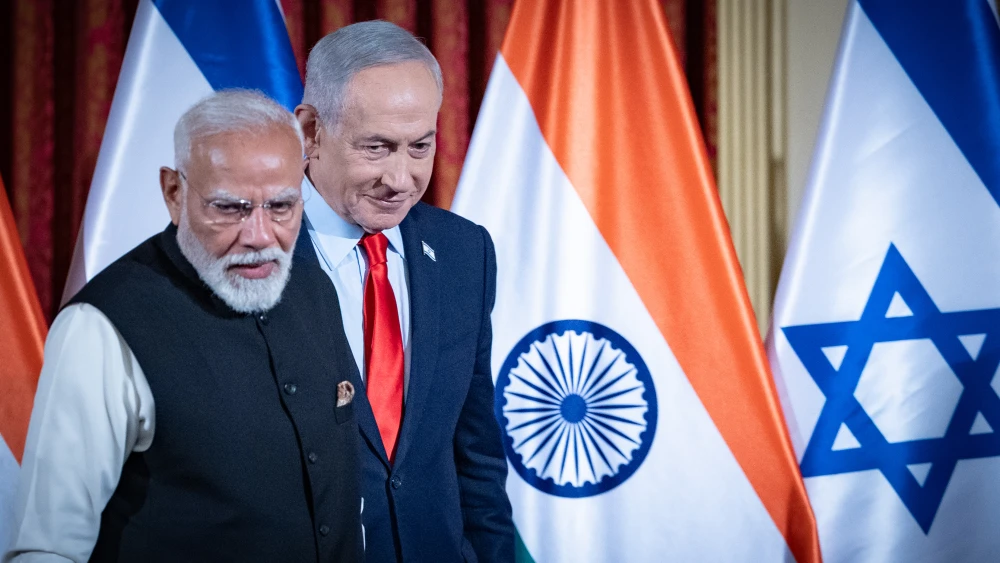
The evolution of the India-Israel relationship from a trading partnership to a “special strategic partnership” was the central topic of a panel at the Monday evening plenary, “Israel on the Global Stage: Foreign Affairs & Diplomacy,” at the 2026 JNS International Policy Summit, held at the Waldorf Astoria in Jerusalem.
The panel, “The Impact of the Israel-India Relationship,” highlighted the strategic importance of India to Israel, which has seen significant advancements in economic and defense cooperation.
The relationship has enormous potential for growth through recent multilateral initiatives, such as the India–Middle East–Europe Economic Corridor (IMEC) and I2U2, a partnership between the United States, Israel, India and the United Arab Emirates. (It’s named after the first letters of its four member countries.)
“What started a little more than 30 years ago as basic relations of seller and buyer has evolved dramatically to the highest level,” said Ron Malka, former Israeli ambassador to India, who participated on the panel.
Malka spoke of the new status bestowed on the relationship, a “Special Strategic Partnership for Peace, Innovation and Prosperity,” during Indian Prime Minister Narendra Modi’s two-day state visit to Israel in February. (During Modi’s first trip to Israel in 2017, the relationship had been elevated to “Strategic Partnership.”)
“As far as I know, only two other countries in the world were defined this way, as special strategic partners of India. It was Russia and Japan. And this really reflects what happened between Israel and India in the last 30 years. It’s a very strong, deep relationship that is based on trust and respect,” Malka said.
Steadily expanding India-Israel ties are entering a new phase, he said, shifting from “co-production to co-development.” The two countries complement one another, with Israel contributing technological prowess to India’s large-scale manufacturing.
India brings the production capacity, Israel the technological edge. Together, there is a synergy, Malka said.
‘Pivot to the east’
Israel’s Foreign Ministry’s strategy is to “pivot to the east,” which holds still untapped potential, said Aviv Ezra, head of Pacific and Asian affairs at the Israel Ministry of Foreign Affairs. The “crown jewel” of that strategy is India. “India is definitely a critical and a crucial component of Israel’s national strategy,” he said.
Israel and India have already been working together in the fields of agriculture, water management and defense. During Modi’s visit in February, the countries committed to integrating Indian and Israeli advancements in AI, cybersecurity, semiconductors, quantum computing, biotechnology and space exploration.
“We are going to be building centers of excellence in cyber in India very soon. And I would say the potential is really endless. The foreign ministry will be focusing on it through our embassy there and our consulate, both in Mumbai and Bangalore,” Ezra said.
Multilateral initiatives offer untold economic potential. IMEC would take advantage of Israel’s strategic location to connect the Far East, the Middle East and Europe. India has already invested in this corridor. A consortium led by India’s Adani Group purchased Haifa Port for $1.2 billion in 2022. The corridor would connect trade, communications, energy and more, from India through the UAE, Saudi Arabia, possibly Jordan, Israel, and on to Europe.
“Imagine if we have the ability to bypass the Strait of Hormuz,” Ezra said.
I2U2, which first convened virtually in July 2022, aims to strengthen supply chains and technological independence among U.S. allies. It seeks to counterbalance China’s expanding influence in the Middle East and Indian Ocean.
Malka and Ezra both expressed optimism for the relationship as private sector ties are encouraged. Since the Oct. 2023 Hamas war, between 20,000 and 25,000 Indian workers have arrived in Israel, filling critical vacancies left by Palestinian workers.
“So many, both from India, from Israel, reach out to me and ask me to bridge the gap and to try to evolve and to help to facilitate more and more businesses, more and more engagements,” Malka said. “I think these relations are going to grow, and to serve both countries and the region.”


