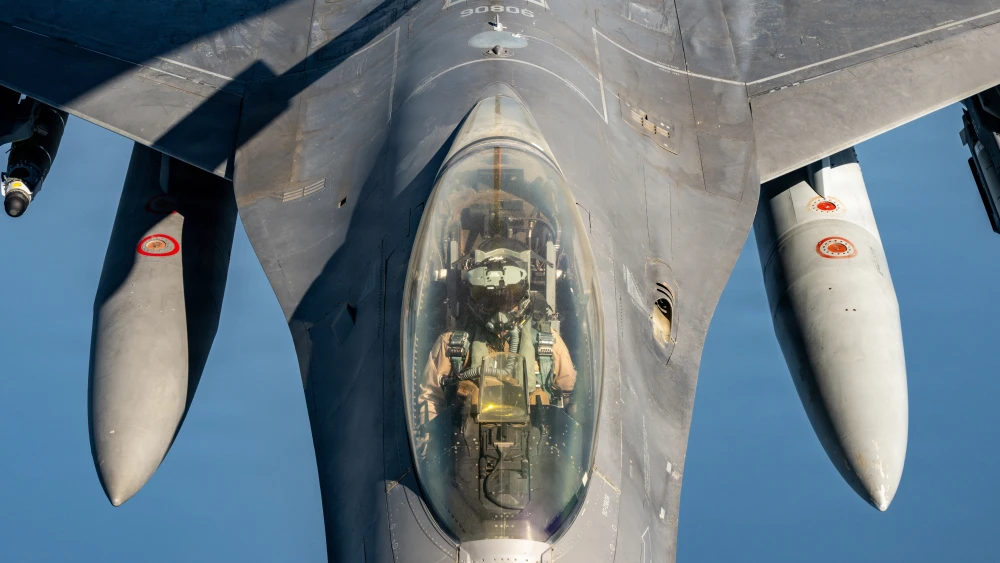
U.S. Central Command completed its 13th consecutive night of strikes against Iran on Thursday night, targeting military command centers, drone storage facilities, communications networks, coastal surveillance sites and maritime capabilities.
The strikes were aimed at further reducing Iran’s ability to threaten civilian mariners and commercial shipping transiting the Strait of Hormuz, CENTCOM said in a statement released early Friday.
“The international waterway remains open for transit despite recent attacks from Iran’s Islamic Revolutionary Guard Corps,” the command said. “Commercial vessels continue to freely navigate the strait with U.S. military support.”
CENTCOM added that more than 50,000 U.S. service members are currently operating across the Middle East.
The latest operation follows nearly two weeks of sustained U.S. military action against Iranian targets after Tehran escalated attacks on commercial shipping in the strategic waterway.
Israeli Defense Minister Israel Katz warned on Thursday that Iran would suffer a “crushing blow” if it attacks the Jewish state, following a high-level security assessment with the country’s top military leadership.
“We are preparing for every possibility. If Iran attacks Israel, it will absorb a crushing blow,” Katz said, according to a statement from his office.
The meeting included IDF Chief of Staff Lt. Gen. Eyal Zamir, Defense Ministry Director General Maj. Gen. (res.) Amir Baram, Israeli Air Force commander Maj. Gen. Tomer Bar, the heads of the IDF Operations Directorate, Intelligence Directorate and Planning Directorate, Home Front Command chief Maj. Gen. Rafi Milo and other senior defense officials.
On Thursday, CENTCOM said its forces had completed a 12th consecutive night of strikes, targeting maritime capabilities, missile and drone storage facilities, coastal surveillance sites and air-defense assets.
“The strikes further degrade Iran’s ability to attack civilian mariners and commercial vessels,” the U.S. military said.
Earlier this month, the United States said it had struck dozens of Iranian military sites and resumed a naval blockade of the Islamic Republic, redirecting commercial vessels and preventing others from entering or departing Iranian ports.
The Islamic Revolutionary Guard Corps subsequently claimed it had prevented three oil tankers from transiting the Strait of Hormuz, asserting that the strategic chokepoint was under its control.
U.S. President Donald Trump said on Wednesday that Iran was “getting hit so hard” and would soon be ready to negotiate with Washington.
“They want to make a deal,” Trump said at a rally in Georgia. “But I say they’re not ready to make a deal because every time they make a deal, they want to change it.”
Trump warned that the United States would strike critical Iranian infrastructure if Tehran continued attacking vessels in the Strait of Hormuz.
“From this point forward, any time the Islamic Republic of Iran shoots at a ship in the Strait of Hormuz, whether it be by missile, rocket, drone or another device or weapon, the United States will bomb and destroy one bridge or power plant, including those located next to, or in, the capital city of Tehran,” he wrote on Truth Social.