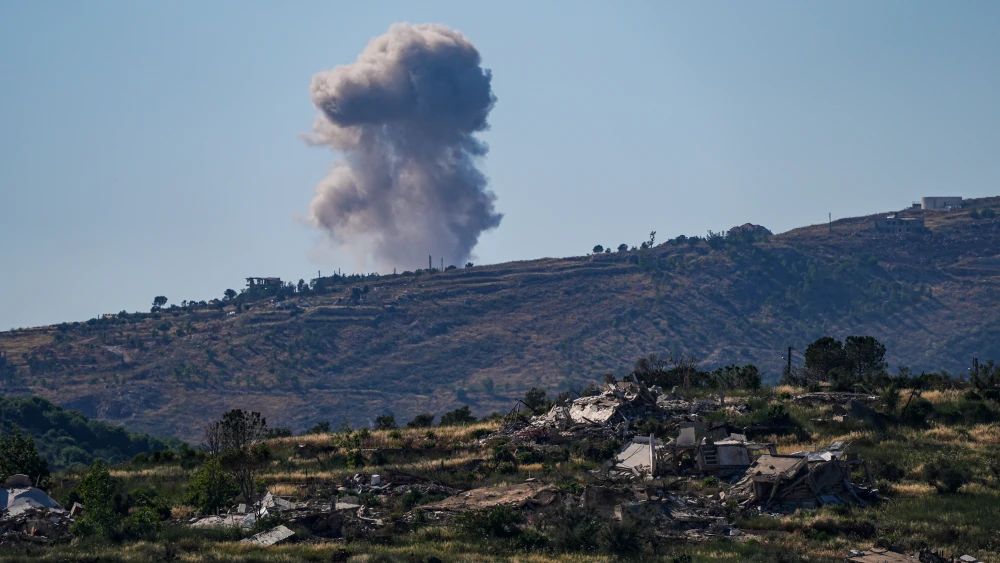
The Israel Defense Forces on Sunday attacked three Hezbollah command centers in Southern Lebanon in response to the Iranian proxy’s violation of the truce agreement, the military said on Monday.
“In response to Hezbollah’s violations of the ceasefire agreement in the form of continued attacks on IDF soldiers in the security zone, the IDF struck three Hezbollah command centers in the areas of Nabatieh and Mayfadoun in Southern Lebanon,” the army said in a statement.
Also on Sunday, IDF soldiers struck a launch pad “that Hezbollah continued using to direct attacks at them,” it stated.
“The IDF will continue to operate to remove any threat posed to IDF soldiers and will not allow the Hezbollah terrorist organization to harm Israeli civilians and IDF soldiers,” the statement added.
לאור הפרת ההסכם ופגיעה בכוחות צה״ל במרחב הביטחוני: צה"ל תקף שלוש מפקדות של ארגון הטרור חיזבאללה בדרום לבנון
— צבא ההגנה לישראל (@idfonline) June 29, 2026
חיל האוויר תקף אמש שלוש מפקדות של ארגון הטרור חיזבאללה במרחבים נבטיה ומייפדון שבדרום לבנון.
התקיפות בוצעו בתגובה להמשך הפגיעה בכוחותינו הפועלים במרחב הביטחוני על ידי… pic.twitter.com/zkaY1vjPLN
In a separate operation on Sunday, the IDF destroyed an underground Hezbollah complex in southwestern Lebanon containing hundreds of weapons and several rocket silos.
The operation in the Majdal Zoun area, some five miles north of the border with Israel inside the IDF-controlled security zone, was carried out after Jerusalem informed the United States, according to the Prime Minister’s Office.
Hezbollah renewed its rocket and drone attacks from Southern Lebanon on Israel on March 2, following the targeted killing in Tehran of Iranian Supreme Leader Ali Khamenei on the first day of “Operation Roaring Lion” on Feb. 28.
In response, Jerusalem launched a broad aerial campaign against Hezbollah targets and expanded military operations in Lebanon aimed at preventing cross-border attacks on Israeli communities.
Israeli and Lebanese officials subsequently held five rounds of direct talks at the U.S. State Department in Washington, resulting in the framework of understandings that was reached on Friday and is conditioned on Hezbollah being removed from the south.