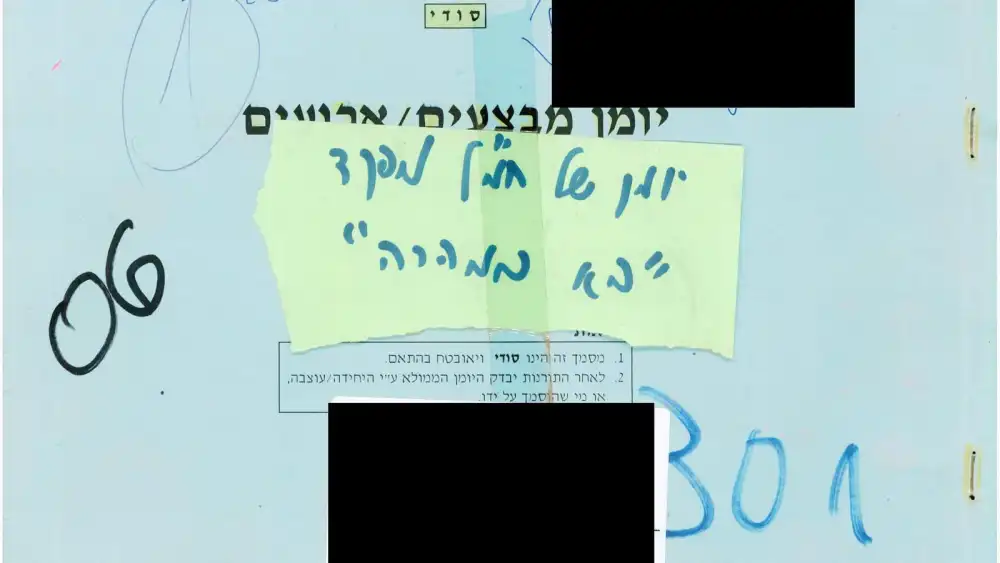
Israel’s Ministry of Defense published on Thursday the operational logs of the Israel Defense Forces Archives from 20 years ago that documented the day of Hamas’s kidnapping of soldier Gilad Shalit into Gaza.
On the morning of June 25, 2006, a terrorist cell infiltrated Israeli territory from the Gaza Strip through a tunnel and attacked a tank crew of the 71st Battalion operating in the area of Kibbutz Kerem Shalom adjacent to the border.
During the battle, two IDF soldiers were killed and several others were wounded, while then-Cpl. Shalit, 19, was abducted.
The first entry in the operational log appears at 5:13 a.m. It notes numerous explosions heard in the Kerem Shalom area, initially believed to be caused by incoming projectiles.
A minute later, at 5:14 a.m., the words, “There are casualties,” appear in the log.
Numerous subsequent entries report the deployment of additional forces and the identification of terrorists who had infiltrated the area.
Almost 90 minutes after the attack began, at 6:40 a.m., the first report stated that “a soldier is missing from the tank.” Four minutes later, the operational log recorded the code word “Hannibal,” referring to an IDF directive intended to prevent the capture of soldiers by all means necessary. The directive’s practical implementation, however, has long been the subject of debate, and it was officially revoked in 2016.
At 7:12 a.m., a report is received that an army vest and helmet have been found by the border fence.
At 8:00 a.m., the soldier is officially identified: “Name of the abducted soldier: Gilad Shalit.”
The defense ministry released the handwritten logs, written in Hebrew, which captured the uncertainty of those early hours and the operational effort undertaken in real time to determine what had happened on the ground.

Shalit, who was held hostage for over five years in the Gaza Strip, was released on Oct. 18, 2011, after 1,941 days in Hamas captivity, in exchange for 1,027 Palestinian security prisoners, including Yahya Sinwar, who would go on to become the terror group’s commander in Gaza and a key mastermind of the Oct. 7, 2023, massacre. Sinwar was killed by Israeli forces in southern Gaza on Oct. 16, 2024.
Today, Shalit lives a private life in central Israel with his wife, Nitzan. He has largely stayed out of the public eye since his release, making only occasional appearances, particularly to support the families of Israelis held hostage by Hamas.