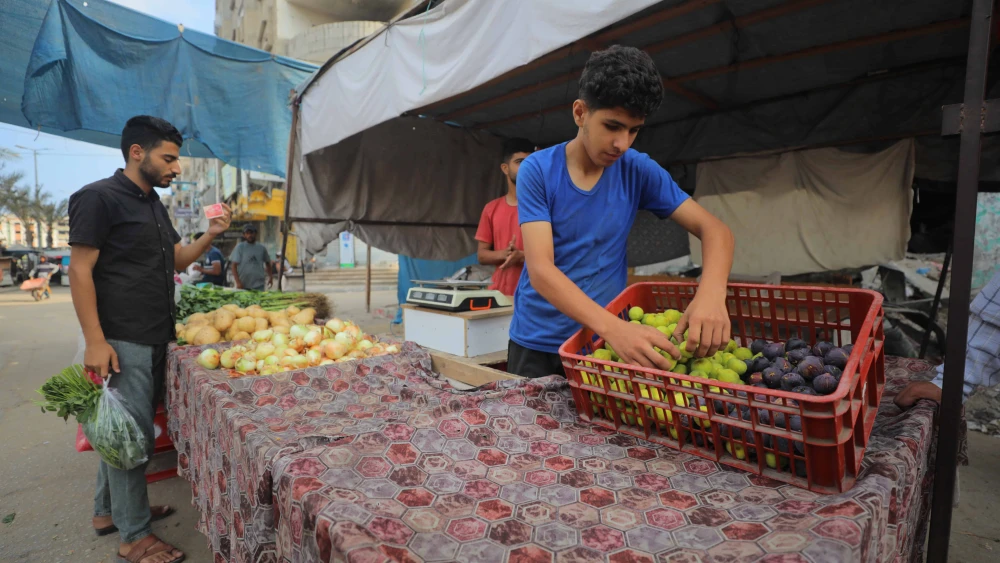
Victory Supermarket Chain Ltd., a popular discount grocery retailer in Israel, released its first-quarter 2026 financial results a month ago. The Israel Securities Authority demanded it issue a supplemental report to explain a greater-than-expected jump in earnings, and the supplemental revealed that 99 million shekels ($33 million) came from sales to the Gaza Strip.
Victory hadn’t hidden the fact that it sold goods to Gaza in its first report. It listed Gaza sales as one of the three reasons for its first-quarter growth, along with the introduction of an electronic appliances category, which started in Dec. 2025, and a 23% increase in same-store sales.
However, the Israel Securities Authority wasn’t satisfied with the initial report and requested a supplemental report detailing the extent to which Gaza sales impacted its first-quarter results, Ynet reported. It turned out that 65% of its 152 million shekel ($50 million) first-quarter year-over-year growth came from Gaza, according to the supplemental released on June 14.
Victory had rolled its Gaza sales into its same-store sales in the first report. Separating out Gaza sales, its same-store sales only rose 5.95%, not the 23% previously reported, according to Israeli business news site Globes.
While Victory insists it has done nothing wrong, with CEO and Founder Eyal Ravid saying his company was “the first to report about sales activity to Gaza,” the episode has raised questions about whether Israeli companies should be selling to the Strip at all in the wake of the Oct. 7, 2023, massacre.
“As a general rule I believe that Israel, and all Israeli shops should be completely cut off from Gaza. Israel should stop providing the Gazans anything and everything, including water and electricity,” Maurice Hirsch, director of the Palestinian Authority Accountability Initiative at the Jerusalem Center for Security and Foreign Affairs (JCFA), told JNS.
“No Gazan should be let into Israel, no matter the reason, including to receive health care. Anything and everything, including the passage of people, going into or out of Gaza should go through Egypt, subject of course to Israel security supervision,” he said.
Israeli merchants are allowed to sell to the Gaza Strip under a mechanism approved by the government in August 2025 and run by COGAT, the Israeli Defense Ministry department in charge of civilian policy in the Gaza Strip.
The Customs Directorate in the Israel Tax Authority keeps a list of the approved companies, which it keeps private for reasons of confidentiality, Globes reported.
Most companies are not eager to advertise their sales to Gaza. Only one, Mehadrin, a fruits and vegetables exporter, voluntarily provides its Gaza sales figures, according to Globes. Mehadrin reported 60 million shekels ($20 million) in sales to Gaza in the last quarter.
Some companies that are eligible to sell refuse to do so, such as the Rami Levy and King Store chains. The latter caters to the Arab Israeli sector. Another retail food chain, Yochananof and Sons, went further than Rami Levy and King Store, never applying for a Gaza sales license despite being eligible to do so. “We are an Israeli chain that serves the Israeli public and that does not wish to supply to Gaza in the light of the war and the events of Oct. 7,” the company told Globes.
The rationale for COGAT’s program is to reduce Gazan dependence for basic goods on anti-Israel, Hamas-infiltrated international organizations, such as the United Nations Relief and Works Agency for Palestine Refugees in the Near East, or UNRWA.
David Bedein, director of the Nahum Bedein Center for Near East Policy Research, told JNS that the result is the opposite. Israeli goods end up strengthening international groups and Hamas. UNRWA benefits and the companies benefit, he said.
“There’s too many people making too much money, too much profit. That’s what’s going on. It’s not complicated,” he told JNS.
In a March 2025 article on his website, Bedein wrote: “With the expulsion of the Gush Katif communities and the handover of their assets to Hamas via the World Bank, Gaza became a cash cow for Israeli entrepreneurs.”
In many cases, COGAT officials end up joining companies that export goods to Gaza and Palestinian Authority-controlled parts of Judea and Samaria, according to Bedein. In his report, he estimated that about 150 former COGAT officials are senior executives at such companies.