


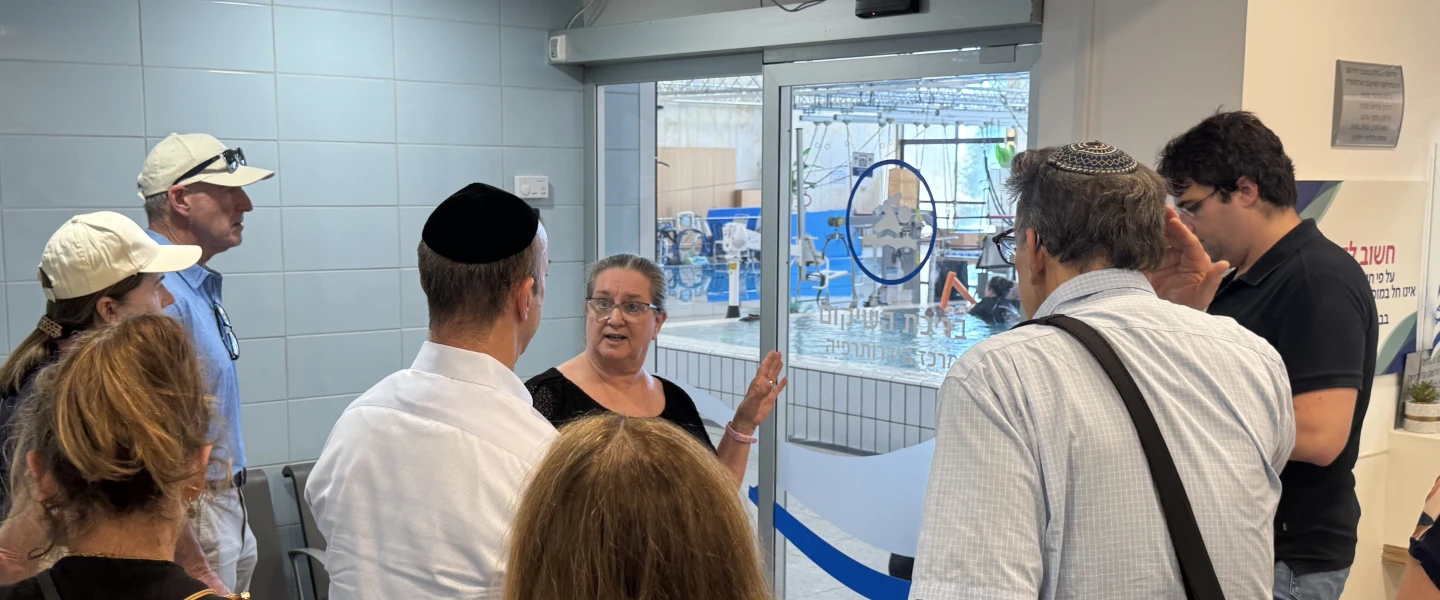
Sixty delegates attending the three-day JNS International Policy Summit on June 21-23 toured Sheba Medical Center in Tel Aviv, where they witnessed firsthand how Israeli medical innovation is helping wounded soldiers and civilians recover physically and emotionally while driving the development of cutting-edge healthcare technologies.
The delegation visited Sheba’s hydrotherapy department, the Immersive Rehabilitation Room and the ARC (Accelerate, Redesign, Collaborate) Center for Digital Innovation, where doctors and researchers showcased advances developed at what Newsweek ranks as the world’s seventh-best hospital.
Water as medicine
“For me, water is medicine,” said Dr. Caroline Barmatz, who has spent 30 years at Sheba and heads its Hydrotherapy Department.
Barmatz introduced the group to Sheba’s three hydrotherapy pools and an ice bath, which together treat more than 30,000 patients annually. The aquatic therapies are used for wounded soldiers, trauma survivors, premature babies and elderly patients. Since Oct. 7, 2023, the department has cared for more than 300 wounded soldiers and civilians.
Visitors watched patients undergoing treatment while one patient’s therapy dog waited attentively beside the pool.
“Therapy dogs are trained to look after their masters,” Barmatz said with a smile. “One time, a dog saw his master very relaxed and thought he drowned and he jumped in to the pool. The therapist needed to save both!”
She described how the department has adapted to the influx of wounded soldiers, including developing more physically demanding rehabilitation programs for highly fit patients.
“What happens to a person with a gunshot and glass wounds? How soon can we get him into the pool?” she asked, noting that one soldier had begun hydrotherapy just 18 days after surgery.
Barmatz demonstrated adjustable therapy pools equipped with treadmills that reduce the amount of body weight patients must bear during rehabilitation, as well as virtual reality systems that incorporate activities such as catching a ball or driving a car into therapy sessions.
She also pointed to an overhead obstacle course designed specifically for recovering soldiers.
“We built Ninja equipment because what we had wasn’t enough for these guys with such strong arms and legs!” she said.
The department’s ice baths, which expose patients to temperatures ranging from 12 to 3 degrees Celsius, have also become increasingly popular.
“Since Oct. 7, more soldiers want it—there is not enough research—we need more,” Barmatz said. Some soldiers, she added, seek out the ice baths “to feel they can defeat their fears. They want to spend five minutes at 3 degrees!”
Barmatz admitted she is not an avid swimmer herself. “I like to look at the water as medicine, not sport!”
Among those visibly impressed was Dr. Daryl Temkin, a psychologist who made aliyah from Los Angeles just over a year ago.
Having previously worked with stroke patients at Cedars-Sinai Medical Center in Los Angeles, Temkin said rehabilitation is “the story of hope and reinstilling hope.”
“They don’t have anything there like this,” he said.

Delegates also toured Sheba’s Immersive Rehabilitation Room, where rehabilitation psychologist Maya Ehrlich, the innovation coordinator at Sheba’s Integrated Rehabilitation Hospital, demonstrated how interactive projection technology helps patients regain cognitive and physical abilities.
The room transforms into environments such as grocery stores and banks, allowing patients to practice real-world tasks while improving memory, balance and coordination.
“We saw the potential for use in rehabilitation—it is interactive and fun and the software allows us to create our own scenarios,” Ehrlich said.
She noted that while the project was already under development before Oct. 7, the war accelerated its implementation.
“The effects of Oct. 7 and the subsequent war did help us push this project forward much faster,” she said. “We have lots of young soldiers injured in the war that benefit from this room as it is now starting to be part of their rehab.”
Angie Segal, media liaison for the South African Zionist Federation, said the immersive rehabilitation room left the greatest impression.
“More than any technology or medical breakthrough, it was the Immersive Rehabilitation room that I couldn’t stop thinking about,” she said. “After watching my own father struggle through desperately needed physical and cognitive rehabilitation a year ago, I found myself wondering how different his journey—and perhaps even his outcome—might have been if he had been treated in a place like this.”

Rehabilitation through innovation
The tour concluded at Sheba’s ARC Center for Digital Innovation, where delegates learned how clinicians are transforming frontline medical challenges into new technologies.
Dr. Karny Ilan, a surgical resident and CEO and co-founder of health-tech startup Feminai, demonstrated a wearable breast cancer screening patch that is expected to enter clinical trials soon. The device uses wearable sensors and artificial intelligence to detect physiological changes associated with breast tissue density and blood flow.ARV
Delegates praised the innovations they had seen throughout the day and left with a deeper appreciation of Israel’s medical ingenuity and resilience as the country continues recovering from nearly three years of war.
