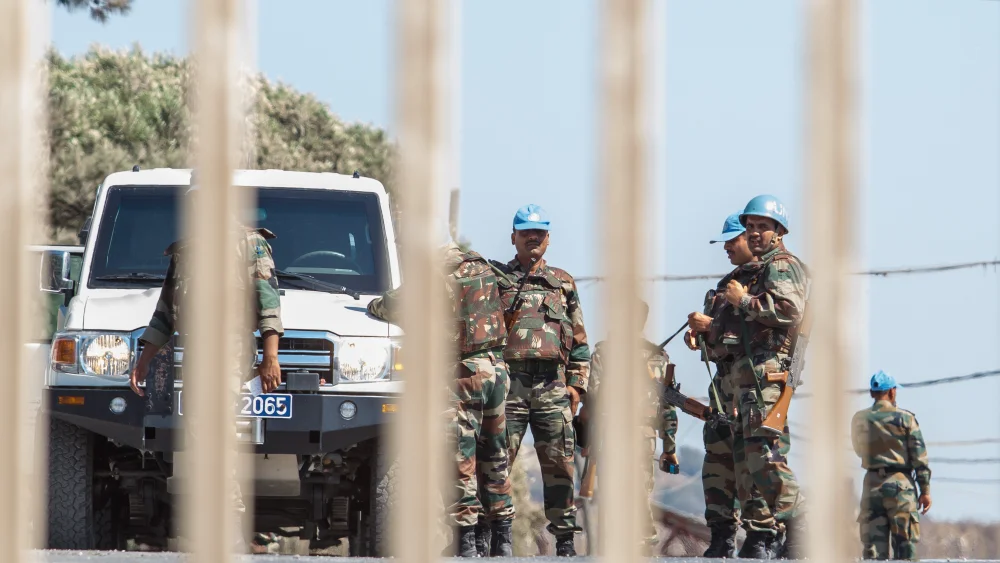
The United Nations Security Council voted unanimously on Thursday to extend the mandate of the U.N. Disengagement Observer Force, the global body’s peacekeeping force in the Golan Heights, for six months.
The resolution, which the United States and Russia drafted, drew support from all 15 members of the council. It pushes the mandate, which was set to expire next Tuesday, through the end of the calendar year.
The force, known as UNDOF, monitors the 1974 ceasefire and disengagement agreement. which Israel and Syria signed, after the latter attacked the Jewish state during the 1973 Yom Kippur War.
Syria attacked Israel in 1967 during the Six-Day War, during which Israel seized most of the Golan Heights, which Syria previously controlled, and later annexed it in a move that only the United States currently recognizes.
The U.N. force, which consists of more than 1,200 people from more than a dozen countries, patrols the buffer zone between the Israeli- and Syrian-controlled zones established under the 1974 agreement.
“Israel supported the extension of UNDOF’s mandate,” said Danny Daon, the Israeli ambassador to the United Nations. “We remain committed to maintaining stability along Israel’s northeastern border and ensuring the security of the residents of northern Israel.”
Tammy Bruce, deputy U.S. ambassador to the global body, said that there is an “important role” for the U.N. force in “upholding peace, security and stability along the Israel-Syria border.”
The move provided a rare opportunity for U.S.-Russian cooperation at the United Nations.
Dina Gilmutdinova, Moscow’s senior U.N. counselor, welcomed the extension and also called on Israel to “exercise restraint, avoiding any unilateral, illegitimate and provocative steps.”
Russia had long been a patron of Syria during the reign of the Assad family. Bashar Assad was deposed in late 2024 and now lives in exile in Russia.
Moscow often denounces Israel and the United States at the global body.
The new Syrian government of Ahmed Al-Sharaa has been harshly critical of Israel’s presence in Syria, which the Jewish state has maintained for security purposes after Assad’s fall and the rise of Al-Sharaa, who, until recently, was a wanted terrorist.
Ibrahim Olabi, Syrian envoy to the United Nations, accused Jerusalem of continuing “to violate every word” of the disengagement agreement.
Israel has said that it will occupy the buffer zone indefinitely to combat threats from southern Syria and to protect the Druze community in Syria’s southern Suweida governorate from tribal violence.
In April, the Israeli government approved a $334 million, five-year investment plan to expand development in the Golan, aiming to attract thousands of new Israeli families to the area.