Newsletter
Newsletter Support JNS

US said to move 20% of its refueling jets from Israeli airport

The remaining 80% will remain at Ben Gurion Airport to maintain rapid deployment capabilities.

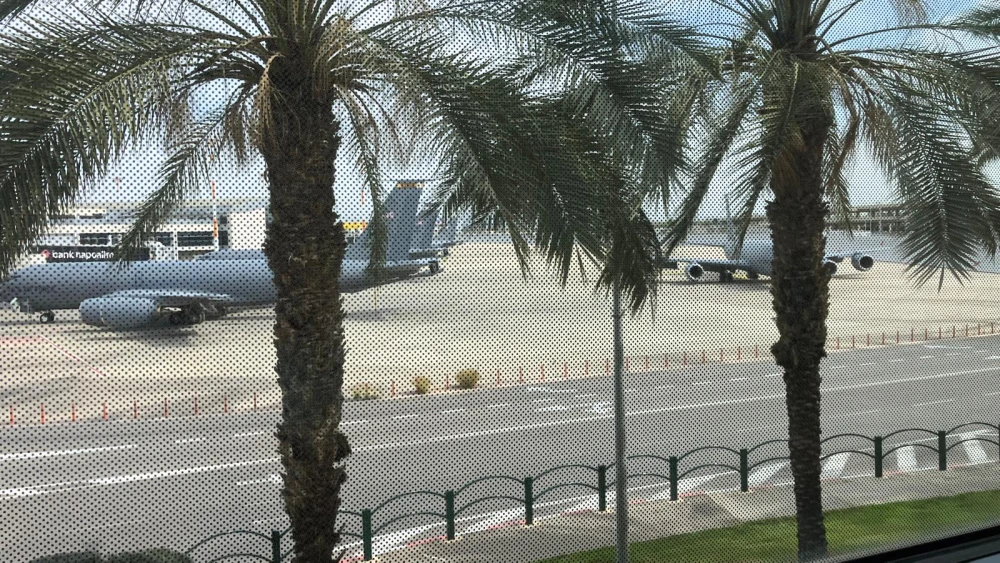
U.S. military aircraft at Ben-Gurion International Airport during the 2026 war with Iran. Photo by Etgar Lefkovits.

The United States is preparing to remove approximately 20% of its military aerial refueling and cargo planes from Israel’s Ben Gurion International Airport, Israeli media reported on Tuesday.

The anticipated decision made in the wake of the emerging deal to end the war with Iran will ease a bottleneck for civilian flights at Israel’s main international gateway.

About one-fifth of the estimated 72 U.S. military aircraft stationed at the airport will be moved, Israel’s Channel 12 News reported.

The majority of the aircraft are expected to be transferred to Israeli Air Force bases at this stage, while others will be moved to European bases.

The remaining 80% of the U.S. military fleet will remain on standby to maintain rapid deployment capabilities, according to the report.

The unprecedented deployment of scores of U.S. military aircraft to Israel’s main civilian airport, which began in February, will be withdrawn only in the event of a full agreement with the Islamic Republic.

The Israeli Defense Ministry declined requests for comment.

An Israeli Transportation Ministry official said last month that U.S. refueling and cargo aircraft stationed at the airport since the start of the war would return to bases in Europe or elsewhere within 72 hours of a ceasefire agreement.

The aircraft created a bottleneck at the airport outside of Tel Aviv after the April 8 truce took effect, as international carriers resumed flights amid a shortage of parking space.

Last month, the director of Israel’s Civil Aviation Authority warned that the airport was effectively being turned into a military base, undermining normal operations.

Etgar Lefkovits, an award-winning international journalist, is an Israel correspondent and a feature news writer for JNS. A native of Chicago, he has two decades of experience in journalism, having served as Jerusalem correspondent in one of the world’s most demanding positions. He is currently based in Tel Aviv.
A U.S. Department of Homeland Security spokesman told JNS that the administration “acted well within its statutory and constitutional authority” in Khalil’s case, “as it does with any alien who advocates for violence, glorifies and supports terrorists, harasses Jews and damages property.”
“The Strait of Hormuz is open to all ship traffic except for Iran,” the U.S. president wrote.
The amendment “would restrict our country’s ability to confront Hamas, Hezbollah and other terrorist organizations in the region who are sworn enemies of both the United States and Israel,” the House minority leader said.
“We are prepared for any scenario,” the prime minister assured.
Melissa Chaudhry, who is running in Washington state as a Democrat but has said she would switch to the Green Party, told JNS that she was “forced into a corner by an aggressive and dishonest political opponent.”
Eyal Ostrinsky told JNS that the 125-year-old Zionist institution is broadening its support for Jewish communities worldwide, while reaffirming its mission of settlement, forestry and national development.

