The Jews famously invented matzah when they couldn’t wait for their dough to rise as they were chased out of Egypt. Passover this year, which comes amid ongoing war with the Iranian regime and other factors that have disrupted global trade and product availability in the United States, has also required resourcefulness.
“The broader supply-chain environment has been challenging for many food companies, and we have stayed focused on planning ahead, working closely with partners and making sure consumers can find the products they rely on for the holiday,” Talia Sabag, marketing manager at Kayko Kosher Foods, the Manischewitz parent company, told JNS.
She noted that Passover in 2026, which begins April 1 at night and goes until April 9 at night, comes as “many people are carrying a real emotional weight, whether because they had hoped to be in Israel, have loved ones there or simply feel deeply connected.”
“In that context, food becomes more than food,’ she said. “It becomes comfort, continuity and a way to feel connected to tradition and to one another at home.”
The war has impacted Manischewitz as it has many other countries with “deep ties to the Jewish community and to Israel,” according to Sabag.

“These events have affected us profoundly on a human level,” she said. “Operationally, they have reinforced the importance of flexibility, planning and close coordination across the business, especially around a holiday as significant as Passover.”
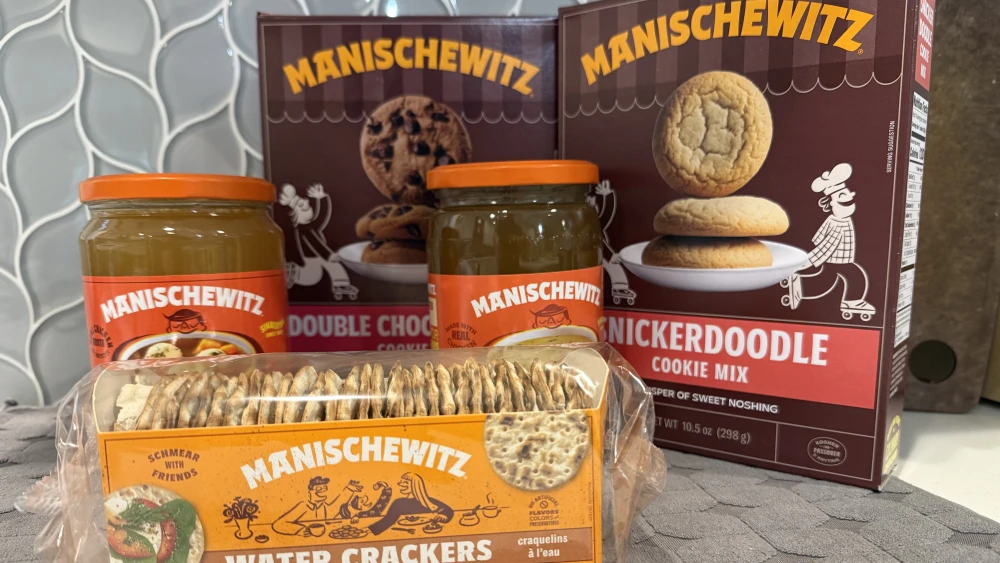
Manischewitz is debuting new products this Passover, the company said. “We have a sweet, we have an appetizer, and we’ve got a soup, and that really kind of brings together this concept of innovation that we’ve really been working on across the board,” Sabag told JNS.
A chicken matzah-ball soup and a clear chicken broth, both sold in glass jars and both of which can be heated on the stove top or in a microwave, are new Passover 2026 products and part of the company’s new “homemade soup line.”
“They reflect exactly what we wanted to bring to market this year: traditional comfort in a more convenient, ready-to-serve format,” Sabag told JNS.

Both are “produced and packaged in a sealed shelf-stable format, which allows them to remain stable until opened,” Sabag said. That format, which only requires refrigeration after being opened, is possible due to “the overall processing and packaging of the finished product.”
The matzah-ball soup used to be just matzah balls in clear broth, said Sabag. The new version includes vegetables and is “really inspired by the taste of Bubbe’s kitchen,” she said.
“The ingredients are clean and very whole,” she told JNS. “They’re only ingredients you recognize and that you would cook for yourself.
The only difference between their soup and a soup made at home, she said, is that “we did the work for you.”
Manischewitz also debuted three cookie mixes—chocolate chip, double chocolate and snickerdoodle. Each mix requires adding an egg and butter or margarine, and the company encourages using a mixer. They bake in the oven for about 15 minutes.
“We wanted to offer flavors that feel familiar and fun, while still making holiday baking easier for families,” Sabag told JNS. “They came from the longstanding beloved cake mixes that have been very popular.”

There are also new water crackers this year. “We saw an opportunity for something crisp, versatile and highly usable throughout the holiday, and they are actually made from matzah, whether with spreads, soups, appetizers or entertaining,” she said.
“It feels very natural for Passover, but with a more modern and flexible use occasion,” she said.
Sabag told JNS that Manischewitz intends its “innovations to contribute to the business, but our thinking is broader than that.”
“Passover is a unique holiday, and our role is to give consumers a portfolio that balances tradition, convenience, variety and relevance,” she said. “Some products are designed to be major volume drivers, and others are there because they complete the table and meet real consumer needs.”
The company is continuing to sell kosher-for-Passover items, for which it says there is strong demand, including frozen matzah balls, all-beef hot dogs and frozen gluten-free knishes.
“The core staples have always been incredibly important—matzah, matzah meal, broths and soup items, gefilte fish, macaroons and other pantry essentials,” Sabag told JNS. “Those are the products that generations of families continue to come back to.”

JNS asked if there have been any misses over the years that Manischewitz has wanted to sell for Passover but didn’t rise—or on Passover, not rise more than 18 minutes—to the occasion.
“With a brand as longstanding as ours, you learn that not every idea translates the same way from concept to shelf,” Sabag said. “Sometimes, the hurdle is technical, sometimes it is about timing or retail fit, and sometimes, you refine a product until it meets the quality and holiday expectations consumers have of Manischewitz.”
“We have a wide array of products that are convenient, easy, shelf stable, easily transportable and travel-friendly,” she told JNS.
And for those who are finding themselves having to make Passover at home on short notice because plans to visit Israel fell through? “Manischewitz is here for you,” Sabag said.