Newsletter
Newsletter Support JNS

California Assembly passes bill barring protesters from 100-foot buffers around houses of worship

David Bocarsly, of Jewish California, stated that the vote was a “powerful statement that California stands with every person of faith and their constitutional right to worship.”

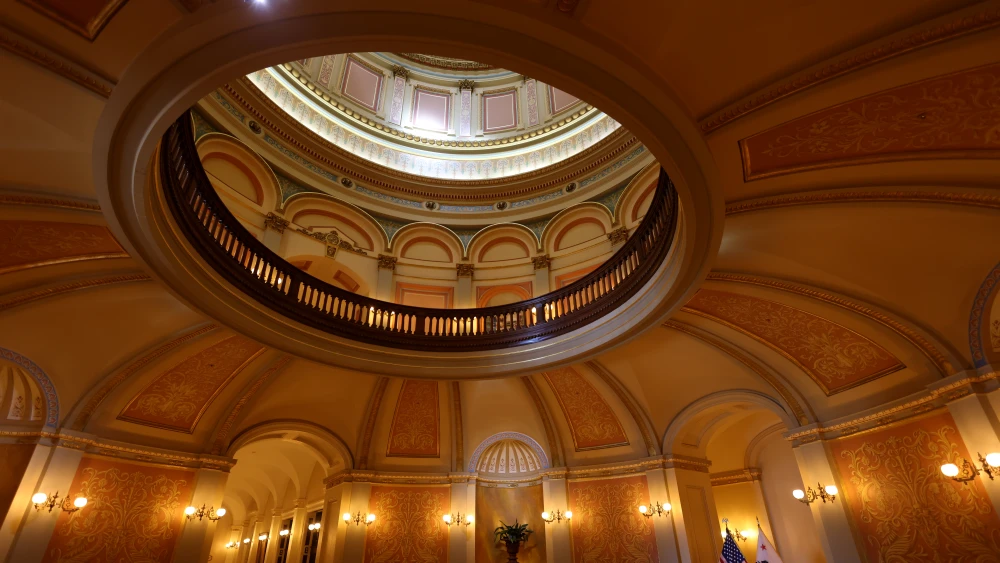
California State Capitol
The dome at the California State Capitol building in Sacramento, March 26, 2026. Credit: Gage Skidmore via Creative Commons.

The California State Assembly voted 61-2 on Tuesday to pass a bill that would create 100-foot, protest-free buffer zones around entrances and exits to houses of worship.

The bill now heads to the state Senate. On Tuesday, 17 Assembly members did not record a vote.

David Bocarsly, CEO of Jewish California, stated that the vote was a “powerful statement that California stands with every person of faith and their constitutional right to worship.”

“Jewish community members already navigate metal detectors and armed guards just to enter a synagogue,” he stated. “That is not normal, and it shouldn’t be.”

“We need de-escalation strategies” like the bill for “all faith communities that are facing rising animosity,” he added.
“You can’t call yourself independent when you’re being funded specifically by a government,” Hillel Neuer of UN Watch told JNS.
“No one’s pain is greater or more important than others,” Gov. Josh Shapiro told Politico. “But from a data perspective, there has been a dramatic spike in antisemitism that is unmatched elsewhere, and that’s a problem.”
“The Iranian military’s latest attempt to extort global maritime trade is proof that Economic Fury has left the regime desperate for cash,” the U.S. treasury secretary stated.
The state’s education department, rather than its coordinator under the 1964 Civil Rights Act, is also responsible for reporting annually on incidents of antisemitism.
Jewish watchdog CIDI recorded 281 cases last year and said anti-Zionism is increasingly used to mask antisemitism.
Lori Lowenthal Marcus, of the Deborah Project, told JNS that the settlement “requires policies of transparency, unbiased decision-making and concrete protections from antisemitic indoctrination and bullying.”