
In the days and weeks before the attempted attack at the White House Correspondents’ Dinner, there was no shortage of confrontation language in American public life. None of it pointed to a specific act. None of it needed to. When the attack came, the reactions arrived almost instantly, shaped less by the facts themselves than by the narratives already surrounding them.
Some framed the incident as the predictable result of rising extremism. Others minimized it, reframed it or folded it into broader conspiratorial claims. The act itself did not interrupt the surrounding political environment. It was absorbed into it.
That pattern is becoming harder to ignore.
Violence used to impose at least a temporary shared reality. Certain acts were destabilizing enough to interrupt the arguments around them. Even in deeply polarized environments, attacks on political leaders or civilians forced a pause. For a moment, the event itself shaped the reaction.
That pause is becoming less reliable.
Now the shock dissipates faster because the surrounding narrative environment is often already built before the violence occurs. People increasingly enter major public events with their interpretations already prepared. The act does not create the argument. It activates one.
You can see this most clearly in the normalization of confrontation language after the Hamas-led terrorist attacks in southern Israel on Oct. 7.
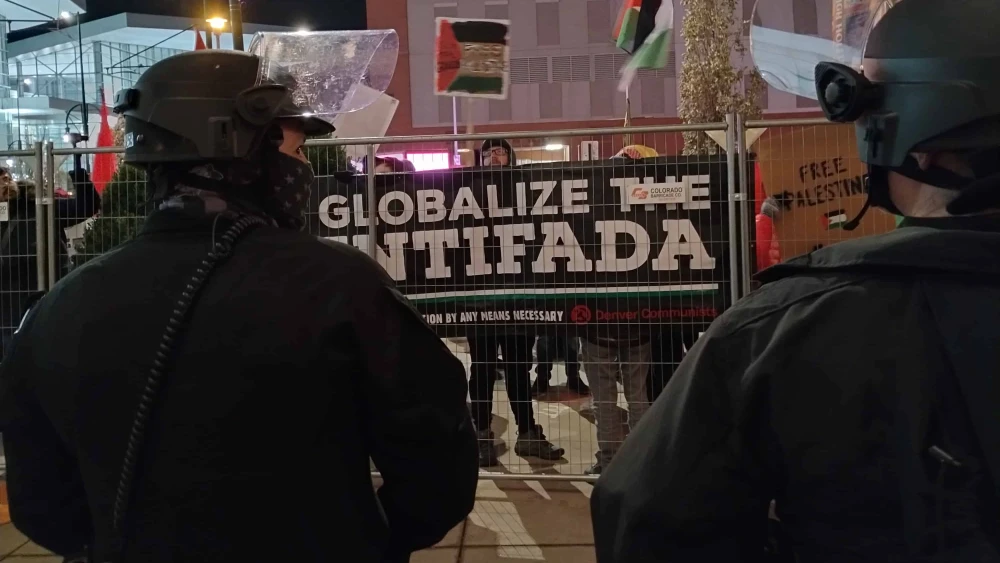
Take the phrase “globalize the intifada.” Historically, the term refers to uprisings that included suicide bombings, shootings, stabbings and assaults deliberately targeting civilians.
Since Oct. 7, the phrase has appeared regularly at demonstrations, on college campuses and across major Western cities, often reframed as a generalized expression of solidarity or resistance.
The issue is less whether a slogan directly instructs violence and more what repeated exposure does to the surrounding environment.
Over time, repeated exposure changes what sounds normal to say in public. Language once associated with violent confrontation becomes absorbed into ordinary political activism. Gradually, the boundaries start shifting. Terms that once felt extreme become easier to repeat openly and easier to defend once escalation occurs.
The same thing happens with the language of “resistance.”
At a distance, the term can sound abstract or even rhetorical. In practice, especially in emotionally charged public environments, the line between protest, intimidation and confrontation becomes far less clear. On campuses and in demonstrations, the language increasingly covers everything from political expression to openly hostile behavior toward Jews, depending on the setting and the audience.
You can see the effect in the physical environment itself. Jewish students were blocked from entering campus spaces. Protesters surrounded restaurants or businesses identified as Israeli or Jewish. Demonstrators chant confrontation slogans outside synagogues or through heavily Jewish neighborhoods while insisting the language is purely political. Each incident gets debated individually. Over time, the cumulative effect matters more.
That ambiguity gives escalation room to hide inside language that still sounds politically defensible.
The problem is no longer confined to explicitly extremist spaces. The language moves from fringe environments into campuses, protests, social-media feeds, and eventually, ordinary public life. Repetition alone begins to dull the shock around it.
That does not mean rhetoric automatically produces violence. Most people exposed to inflammatory language will never commit violence themselves. People radicalize for different reasons—personal, ideological, psychological. But the surrounding environment still matters because it shapes how violence is interpreted once it occurs.
The violence no longer feels disconnected from the surrounding atmosphere. It enters a public already prepared to process it.
There has now been more than one recent attempt on the life of a sitting or former U.S. president, just as there has been an unprecedented surge in targeted harassment against Jewish communities. Historically, major flashpoints imposed at least a temporary shared reality. Now, whether the target is an American political leader or a local synagogue, the fragmentation is immediate. One side sees confirmation of extremism; another sees manipulation or opportunism.
Once violence stops shocking us, societies begin losing one of the few remaining mechanisms that still impose restraint after escalation occurs. The public no longer merely disagrees about causes or solutions. Increasingly, even highly visible acts no longer produce a shared public reaction.
That fragmentation makes hostility easier to absorb and rationalize, and harder to reject collectively once violence finally appears.
The danger starts earlier than the violence itself.