
It turns out that there are some limits to the tolerance for antisemitism and hatred for Israel increasingly being demonstrated by the Democratic Party. When Maureen Galindo, a candidate in the race for the Democratic nomination for the 35th Congressional District in Texas, said that she planned on turning an ICE detention center into a prison for American Zionists, it was a bit too much for most Democrats. Galindo posted on Instagram that “if you are a Zionist,” then “you are a danger to humanity and belong in prison.”
Democratic House Minority Leader Rep. Hakeem Jeffries (D-N.Y.) said her comments “had no place in American politics, and certainly not in the Democratic Party.” Even left-wing congressional “Squad” ringleader Rep. Alexandria Ocasio-Cortez (D-N.Y.) denounced Galindo for spewing “bigoted garbage and antisemitism.”
Mainstreaming hate on the left
That was encouraging, as was the fact that Galindo ultimately lost her primary runoff to Deputy Sheriff Johnny Garcia, whom she accused of taking money from the pro-Israel AIPAC lobby. But it shouldn’t lead anyone to think that Jew-hatred is off-limits for mainstream Democrats. As the 2026 midterm elections come into focus, it’s clear that anti-Israel rhetoric is not merely commonplace among Democratic candidates. A willingness to demonize Israel and its supporters, discredit AIPAC as a malevolent influence on American politics and treat anti-Zionist smears that are indistinguishable from traditional antisemitism are no barrier to success or acceptance among Democrats. To the contrary, it is often a winning platform.
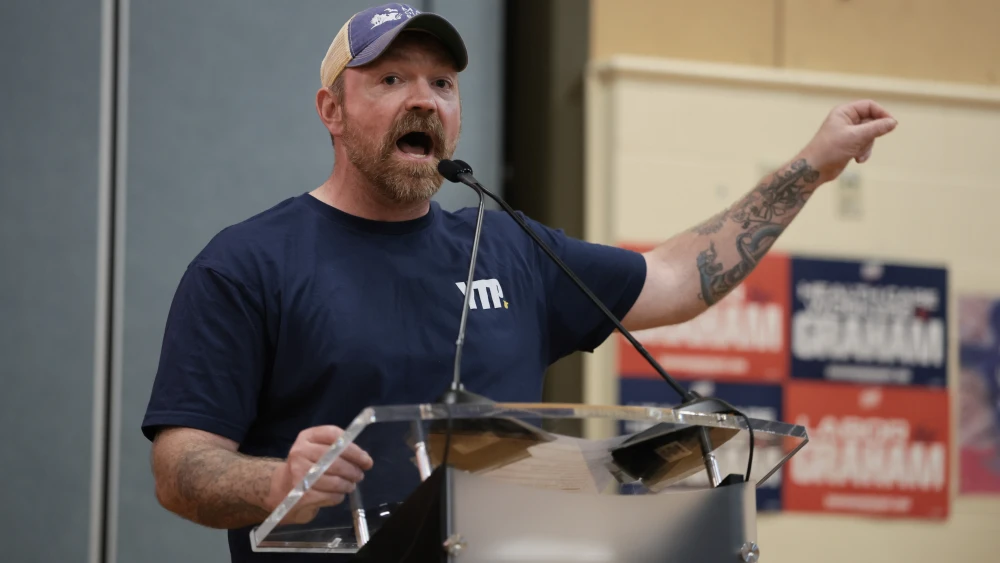
That’s not merely a function of the support garnered by extremists like Galindo, or first- and second-generation “Squad” members like Reps. Ilhan Omar (D-Minn.), Rashida Tlaib (D-Mich.) and Summer Lee (D-Pa.), all of whom are openly anti-Zionist. Nor is it limited to the popularity of someone like New York City Mayor Zohran Mamdani, whose entire career has centered on his hatred for the State of Israel and the embrace of anti-Jewish tropes. The willingness of national Democrats to tolerate the rise of antisemites who can help them win control of Congress, such as the Nazi-tattooed Maine Senate candidate Graham Platner or Michigan’s Abdul El-Sayed, speaks volumes about the party’s shifting center of gravity.
Reports about Jewish Democratic officeholders feeling themselves to be under constant attack from their own base are widespread. Rep. Josh Gottheimer (D-N.J.), whose pro-Israel views make him a throwback to a bygone era when such beliefs were normative among Democrats, complained in a New York Times op-ed: “My Party Has a Double Standard on Antisemitism.” But Sen. Chris Van Hollen (D-Md.), who has no shame in spreading libelous accusations about Israel committing “genocide” in Gaza, seemed to speak for most members of his party when he used the same forum to assert that they weren’t anti-Israel enough.
With Democrats seemingly poised to make significant gains in November, that’s a sobering thought for those who still hold onto memories of a bipartisan pro-Israel consensus that is clearly a vestige of the past.
But should we be equally worried about the future of the Republican Party with respect to Israel and the Jews?
Trouble on the right
That was the upshot of a New York Times/Sienna College poll published last week. Even if you discount the results because of the newspaper’s unabashed anti-Israel bias—highlighted by its recent publication of Nicholas Kristof’s bizarre and unsubstantiated blood libel about Israelis training dogs to rape Palestinian Arab prisoners—the results raise important questions about the prospects for continued Republican support for Israel and opposition to antisemitism.
Like every other poll about attitudes about President Donald Trump’s support for Israel, the war with Iran and the Jewish state’s conflict with Palestinian Arabs, the numbers show a stark partisan divide. Republicans back the president by huge margins, while Democrats are nearly unanimous in their contempt for Trump. The parties also differ on Israel, with the majority of Republicans backing the Jewish state, while even larger numbers of Democrats oppose it. But the main takeaway from the poll in the newspaper’s own coverage was the “generational divide” that it detected among Republicans with respect to Israel.
It wasn’t just that 60% of those identifying as Republicans wanted to see Trump’s successor seek a new approach to foreign policy. A majority of respondents aged 18 to 44 opposed the president’s decision to go to war against Iran. Of that age group, 54% also thought Trump was “too supportive” of Israel. And nearly two-thirds of them opposed providing additional “military and economic support for Israel,” though the slanted nature of the question (Israel only gets military aid, and almost all of that is spent in the United States) should be taken into consideration.
Among voters older than 45, the results are uniformly positive for Trump and for Israel. But just as ominous was the fact that 37% of Republicans of all ages said that they viewed antisemitic conspiracy theorist Tucker Carlson favorably, while only 29% viewed him unfavorably. That result may, at least in part, be a hangover from his time as a Fox News host, when he was a pro-Trump tribune of conservatism, and managed to keep his anti-Israel and anti-Jewish biases under wraps. Still, it demonstrates that while the antisemitic far-right may remain a minority among Republicans, it is not marginal.
In the post-Trump era—and January 2029 is only 32 months away—the situation may get a lot worse as those young voters play a larger role. Vice President JD Vance, whose public neutrality about Carlson’s antisemitism ought to be disqualifying, is still in the poll position to succeed Trump. If that is how things play out—and given U.S. Secretary of State Marco Rubio’s increasingly dominant role in the administration, assumptions about Vance’s 2028 prospects may be premature at best—the notion of the GOP being a lockstep pro-Israel party may become as much a vestige of the past as similar assertions about the Democrats.
Anti-Israel is political poison for GOP voters
The Times’ predictions about a future in which the mainstream of the Republican Party will, like Carlson, echo the anti-Israel and antisemitic rhetoric of the left are troubling. But for now, such a prospect is still more a matter of wishful thinking for its left-wing readers, who cheer the Democrats’ embrace of Platner and El-Sayed, and lap up the newspaper’s daily repetitions of the “genocide” smear, as well as its disingenuous and utterly unpersuasive justifications of its appalling canard about dogs being trained to rape people.
For the moment, the reality is that opposition to Trump’s pro-Israel stands is political poison for Republicans tempted to try to achieve the “strange new respect” that the left is willing to give to conservatives who embrace the new antisemitism.
The starkest illustration of this occurred last week in Kentucky’s 4th Congressional District when seven-term incumbent Rep. Thomas Massie was bested by a Trump-endorsed challenger by nearly 10 percentage points in the GOP primary. The extremist libertarian Massie spent the campaign claiming that he was being targeted by “Zionist billionaires.” While he was right that pro-Israel PACs poured record amounts into the campaign against him, he was able to counter those sums by raising massive sums of money from out-of-state sources who supported his willingness to engage in antisemitic slurs and Israel-bashing. He remained true to form even after losing, when he said that he had difficulty locating his opponent to concede “because it took a while to find Ed Gallrein in Tel Aviv.”
The results made clear that whatever may happen in the future, even in a district where a popular incumbent was the standard-bearer for the anti-Israel cause, it is a formula for defeat. It’s not only still Trump’s party. It’s also still a party where pro-Israel sentiments, along with support for efforts to oppose a genocidal Islamist regime like that of Iran, remain highly popular.
Indeed, as you look across the country at the results of Republican primaries, it’s obvious that whatever divisions exist within the GOP, the constituency for Israel-bashing is not the path to victory as it often is among Democrats. Antisemitism may be the coin of the realm when it comes to extremist podcasters like Carlson, far-right conspiracy theorist Candace Owens or the neo-Nazi “groyper” Nick Fuentes. But it has yet to make itself felt among Republican voters or officeholders. Indeed, once Massie is sent back to his off-the-grid cattle ranch to consume raw milk to his heart’s content, the GOP House caucus will be uniformly pro-Israel.
There simply is no current Republican equivalent of Platner or El-Sayed—or would-be members of the “Squad”—among those likely to be representing the GOP this fall. Candidates who might fit that description, such as Florida gubernatorial candidate James Fishback or Dan Bilzerian, who is mounting a primary challenge to Rep. Randy Fine (R-Fla.), are way behind in the polls. Their conspiracy-mongering about Jews and Israel seems to have put them in the wrong party.
Democrats embrace anti-Zionists
The situation is different among Democrats.
To take just one example of how Democratic primary voters are trending, the nominally pro-Israel Rep. Dan Goldman (D-N.Y.), whose anti-Trump credentials could not be better (he was one of the attorneys for the dubious effort to impeach the president in 2019), is seen as an almost-certain loser in his effort to hold his seat.
He is opposed by Brad Lander, the former Controller of New York City, whose tenure in that office was widely deemed a disaster. But Lander, who, like Goldman, is Jewish, is endorsed by Mamdani and is a rabid Israel-basher. He even recited a Quranic verse in an appearance at a mosque that attacked Christianity while also repeating the familiar blood libels about Israel committing “genocide” and “apartheid.”
Yet according to the latest polls, Landers leads the incumbent in the deep-blue district with a significant Jewish population by an astonishing 57% to 23% margin.
Across the nation, similar results can be seen. Indeed, the antisemitic Platner is coasting to his party’s Maine Senate nomination, because his lead in the polls scared Gov. Janet Mills (who had been recruited by the party establishment to oppose him) out of the race.
It’s possible to imagine a future in which younger GOP voters hold onto their antagonism for Israel and the Jews, as well as tolerance for antisemites, and wind up being the dominant force in a post-Trump party. Yet even Vance has to know that holding onto his friendship with Carlson will be a problem in the 2028 presidential primaries against an opponent who will be able to appeal to the GOP’s evangelical pro-Israel base.
On the other side of the aisle, pro-Israel candidates face a base that has been marinating in the intersectional ideology that falsely identifies Jews and the Jewish state as “white” oppressors. And they will be operating in an environment in which liberal media, like the Times, will not only be legitimizing Jew-hatred but openly celebrating it.
The persistent appeal of people like Carlson and other Jew-haters for many on the right means that a battle for the soul of the Republican Party will be waged in the coming years, and the outcome is far from certain. But the awful truth is that the same battle has already played out among Democrats in recent years. And condemnations of outliers like Galindo notwithstanding, it has already been lost.
Jonathan S. Tobin is editor-in-chief of JNS (Jewish News Syndicate). Follow him: @jonathans_tobin.