


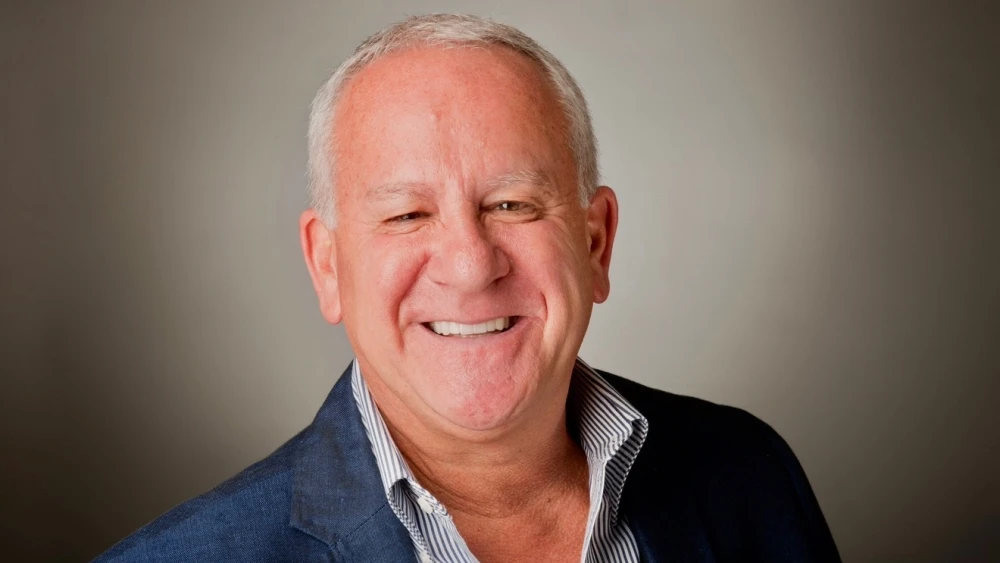
When Mark Berlin resigned from the Canadian Museum for Human Rights on Monday, the former lone Jewish trustee at the federal institution in Winnipeg saw it as the culmination of years of dwindling hope in both the museum and in the country.
“That hope is gone, gone,” Berlin, a legal scholar and human rights expert, told JNS. “I’m optimistic by nature. I will always fight, but I absolutely have lost hope and faith in certain institutions in this country, and the museum is one of them.”
Berlin left the museum in protest of a scheduled exhibit on the “nakba,” the term some use for the “catastrophe” of the founding of the modern Israeli state.
Berlin spoke to JNS from Ottawa, Canada, where he splits his time with his second home in Fort Lauderdale, Fla. He said he and his husband feel safer in Florida than they do in Canada amid rising Jew-hatred.
“The truth is that my husband and I, along with my sister and her husband and numerous cousins, feel far more comfortable in Fort Lauderdale, in southern Florida, than we do anywhere in Canada right now,” he said. “I think that’s an unmitigated indictment of Canadian society right now.”

Berlin told JNS that he raised concerns about the exhibit more than two and a half years before it was slated to open on June 27, 2026. He brought it up in nearly every board meeting since, he said.
“I said, ‘It’s an important story. It has to be told,’” he said that he told the museum’s then-vice president.
He asked if he could, as the only Jew on the board, “help bridge divides” and act as “an emissary from you to the Jewish community and vice versa.”
“I had that conversation,” he told JNS. “I was never, ever asked again to participate in any discussion on the exhibit.”
The exhibit, which seems to be about the displacement that occurred at the time of Israel’s 1948 War of Independence, actually spans a much longer period, according to Berlin.
“The exhibit is intentionally called ‘The Nakba: Then and Now,’” he said. “I haven’t seen it, but the one picture the museum posted on the website from 2025, from Gaza, lets me believe that they’re talking about 1948 to 2025 or 2026.”
That sort of framing is “a blasphemy,” he told JNS.
“It’s like saying ‘the Holocaust: Then and Now.’ I would not say what happened on Oct. 7 was a Holocaust. It was attempted genocide. It was a mass murder of Jews. But it wasn’t a Holocaust,” he said.
“How can you therefore say, if nakba is about a point in time, 1948, that there is an ongoing nakba?” he said. “To use that terminology, the intentional objective is to continue to demonize Jews and suggest that Israel is in a constant pattern of trying to displace Palestinians.”
“It’s not the case,” he told JNS. “Two million Arabs live in Israel. They’re not being displaced.”
It is not common for the museum’s board to involve itself in exhibitions, according to Berlin. But given the sensitivity of the subject and rising Jew-hatred in Canada, he saw this as a necessary exception.

“Knowing the heightened levels of antisemitism in the world, especially in Canada, and knowing the potential harm that could be caused by a prejudicial, biased, one-sided view of an episode in the museum, why would they proceed to wade into such controversy?” he told JNS.
“If you’re going to do this exhibit now, why do it in such a manner that could do nothing but cause harm to Jewish people?” he said.
Choosing to resign was not an easy decision for Berlin.
“It was with a heavy heart that I had to resign,” he told JNS. “I know that there would be a deficit of diverse opinions around the board table, which frankly will satisfy many of my board colleagues, who never wanted me to raise this.”
He added that his colleagues were frequently “disturbed” when he would raise Jewish concerns at board meetings.
“Some board colleagues would roll their eyes and say, ‘Here we go again. Mark’s raising this again,’” he said. “But I think a board has to have a diversity of opinion. It seems to me that some boards simply want unanimity and want peace and harmony and want everybody singing from the same songbook.”
“I’m not that guy,” he told JNS. “If I see injustice, I have to confront it.”
The situation has led Berlin to harbor a genuine fear for the future of Canada’s Jewish community. That failure to protect Jews stems from both the population and the government, he said.

“I strongly do not believe that the government is antisemitic,” he told JNS. “But I think the government has shown an increasing willingness to show an anti-Zionist bias.”
He noted that Canadian officials have publicly laid the blame on Israel for the recent conflicts in Lebanon and Gaza.
“The prime minister has never called Benjamin Netanyahu, but he regularly calls Arab leaders,” he said. “I don’t see bridges being built. I see divides being created.”
Because Berlin is not a U.S. citizen, he is legally permitted to remain in Florida for only about six months annually. Each time he returns to Canada, he wishes he could remain in the United States a bit longer.
“We came back to Canada with trepidation, with fears that we’d be confronted with antisemitic protests and demonstrations, which we have, and antisemitic acts, which we have seen,” he told JNS.
“I’m not saying America’s perfect, but I will tell you, in the five and a half or six months that we were there, we never witnessed one antisemitic attack,” he said. “We witnessed Jews proudly wearing their Magen Davids outward.”
He noted that near his Fort Lauderdale home, there was recently an art fair that displayed Jewish art and included Israeli artists.
“I’m telling you that those exhibitors could not be exhibiting their art anywhere in Canada today without great threats of harm to them,” he said. “Yet they’re able to do it without even a thought in Fort Lauderdale.”
Despite no longer being associated with the museum, Berlin said he will continue to speak out against Jew-hatred in Canada.
“The Jewish community of Canada is under siege at every quarter,” he told JNS. “In academia, in unions, in the arts and culture field, in the media.”
“Here is one more institution of government in Canada, one of our six national museums, again failing the Jewish community, leading to a rupture in the Jewish community, sidelining the Jewish community by only showing one side,” he said. “It erases Jewish history. To me, that’s not unintentional, and it’s very worrying.”


