


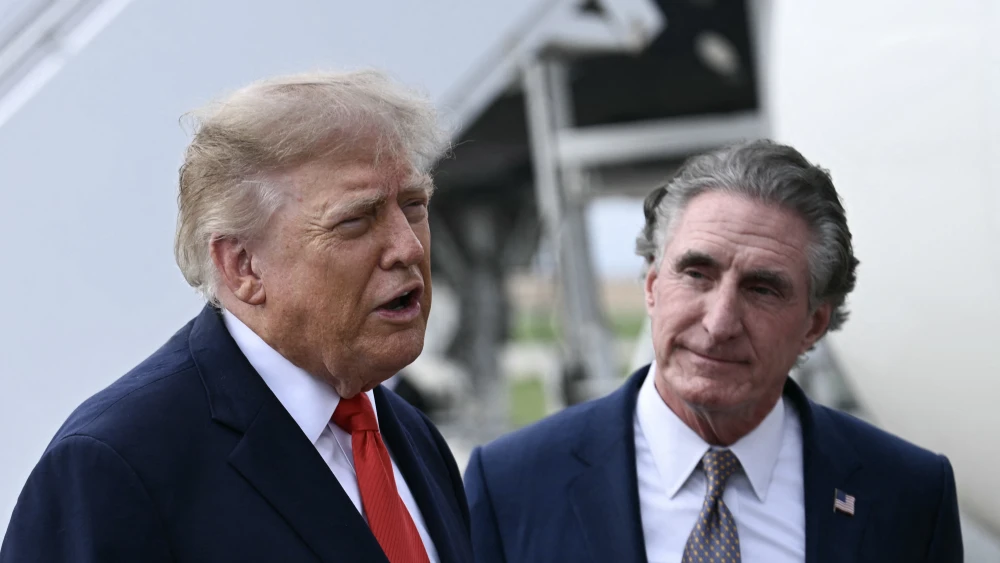
President Donald Trump said on Sunday that he discussed Iran during his latest telephone conversation with Israeli Prime Minister Benjamin Netanyahu, as he warned that the U.S. could carry out further military strikes if diplomatic efforts fail.
Asked on Sunday about Saturday’s conversation, Trump said, “A good call with Netanyahu. We talked about Iran,” according to Israel’s Channel 12.
Trump on Iran:
— Clash Report (@clashreport) November 1, 2026
I had a very good talk with Netanyahu.
We discussed Iran. pic.twitter.com/7ewwnGtMu0
Speaking at a campaign rally in Dubuque, Iowa, on Sunday, Trump said he was holding back from further military action to avoid additional loss of life.
“The only reason why I’m not finished with Iran is I want to be nice. I want to try and save all those lives if I can,” he said. “But at some point we’re going to have to give them the hammer.”
Trump said U.S. Special Envoy Steve Witkoff was working to reach an agreement with Tehran. “He’ll pull it off too,” the president said, adding that even if negotiations fail, “we’ll do it a little bit tougher way.”
He noted that much of the Islamic Republic’s military capabilities had already been destroyed.
President Trump says he is trying to give diplomacy with Iran a chance in order to save lives, but warned that the U.S. may eventually have to take stronger action.
— Open Source Intel (@Osint613) November 2, 2026
“I want to be nice. I want to try and save all those lives if I can,” Trump said, adding that “at some point,… pic.twitter.com/BdZU4vY4NY
On Monday, Iranian Foreign Ministry spokesman Esmaeil Baghaei said transferring uranium enriched to 60% to a third country was not on the table in talks with Washington.
“No such proposal is under consideration,” Baghaei said when asked about the possibility under an agreement, according to the state-affiliated ISNA news agency.
He insisted that Washington must lift its maritime blockade and meet Tehran’s demands before an agreement could be reached.
“Given the conduct of the United States, the negotiation process has become prolonged, and the United States must now decide on the path forward,” Baghaei said.
The spokesman also said a recent letter from U.S. Vice President JD Vance to Iranian Supreme National Security Council Secretary Mohsen Rezaei did not amount to a new diplomatic initiative.
“One cannot, on the one hand, discuss the Strait of Hormuz and, on the other, continue the blockade and expect Iran to accept such an approach,” he said.
Iranian Foreign Minister Abbas Araghchi told Al Jazeera in an interview on Saturday that Washington’s attempt to open broader dialogue was “a positive step,” but warned against using the outreach to sow divisions.
Iran’s Foreign Minister Abbas Araghchi:
— Clash Report (@clashreport) November 1, 2026
If Mr. Vance sent a message to Mr. Rezaei, he should be asked why.
If their intention was to create divisions, that would be another mistake added to their long series of mistakes. pic.twitter.com/EUgnrtH6OJ
“If Washington’s goal in sending this letter is to stir up discord, it would be yet another mistake to add to its previous ones,” Araghchi said.
Araghchi said Iran’s leadership was examining Vance’s letter, but that there were no plans at that stage to meet with U.S. officials. An Iranian delegation had traveled to Doha to discuss Tehran’s proposal for reopening the Strait of Hormuz.


