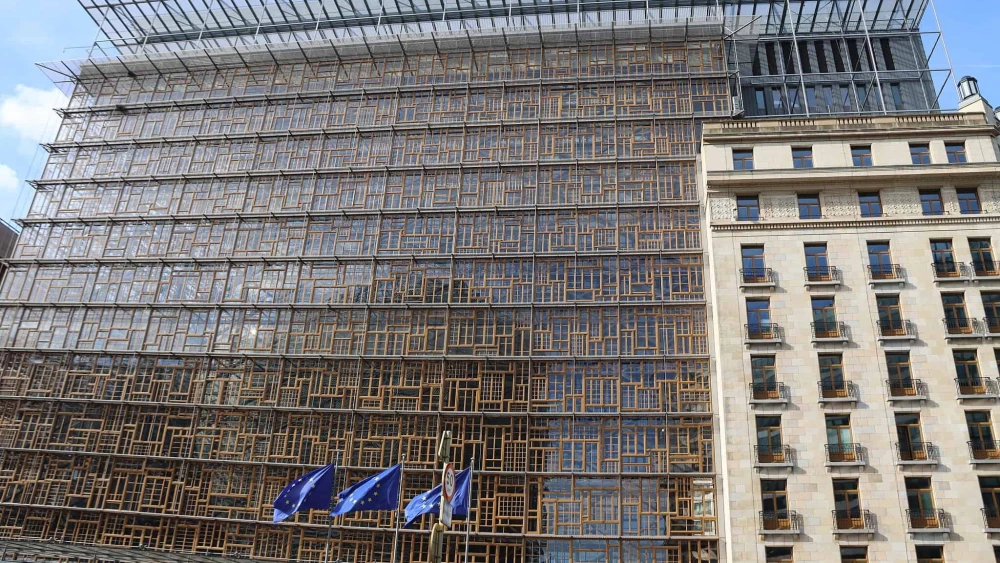
The Council of the European Union announced sanctions on Monday against the Islamic Revolutionary Guard Corps Navy’s Hormozgan Provincial Command and two Iranian officials for their roles in enforcing Tehran’s restrictions on maritime traffic through the Strait of Hormuz.
The council said the IRGC Navy has assumed control of traffic through the strategic waterway and “implemented a toll system whereby vessels are now required to provide identifying documentation, as well as cargo and destination information ultimately passed onto the Hormozgan Provincial Command.”
“Using this information, the Hormozgan Provincial Command screens vessels and determines which ones are allowed to transit through the strait, sometimes after paying tolls,” the council added.
Also sanctioned were Mohammad Akbarzadeh, the IRGC Navy’s deputy commander for political affairs and its spokesman, and Hamid Hosseini, a representative of Iran’s Oil, Gas and Petrochemical Products Exporters’ Union and a member of Iran’s Chamber of Commerce.
According to the EU Council, Akbarzadeh has threatened to use missiles and drones against vessels transiting the Strait of Hormuz, while Hosseini has publicly promoted Iran’s policy requiring ships to submit to inspections and pay transit fees for safe passage.
The sanctions follow a May 22 decision by the council to expand the EU’s Iran sanctions regime to target individuals and entities involved in actions that threaten freedom of navigation in the Middle East, particularly in the Strait of Hormuz.
The Strait of Hormuz, which normally carries about one-fifth of the world’s oil shipments, has been largely closed since Iran imposed restrictions following the outbreak of hostilities with the United States and Israel earlier this year. The disruption has driven up global energy and fertilizer prices and prompted U.S. efforts to prevent Iran from collecting transit fees or selectively allowing vessels to pass.
“Iran’s actions are unacceptable,” said Kaja Kallas, the EU’s high representative for foreign affairs and security policy. “This is the first time the EU has applied its new freedom of navigation regime and, when necessary, we will apply it again.”