


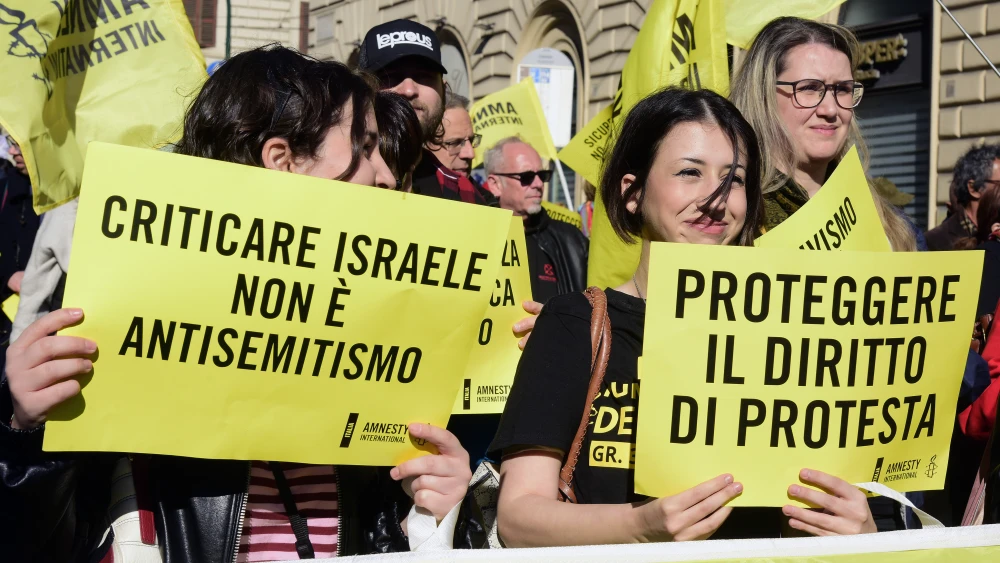
Hundreds of people gathered on Wednesday in Rome for a demonstration against a bill that seeks to ban antisemitic rallies in Italy. The protesters oppose the bill’s use of a definition for antisemitism that includes certain types of anti-Israel statements. Several smaller protests against the bill were planned to occur in cities across Italy.
The bill, which the Italian Senate approved and amended earlier this year, would extend the 1931 Law on Public Safety to events with “a serious potential risk due to the use of symbols, slogans, messages, and any other antisemitic acts pursuant to the working definition of antisemitism adopted by this law.”
The working definition, the bill states, is the International Holocaust Remembrance Alliance (IHRA) definition, which Italy adopted in 2020 but has not made legally binding. It lists examples of anti-Israel criticism that it says in certain contexts can be defined as antisemitic, including comparing the country’s policies to those of Nazi Germany, denying the Jewish people the right to self-determination and “applying double standards by requiring of it a behavior not expected or demanded of any other democratic nation,” as the definition states.
The opponents of the bill argue that it is too limiting of freedom of expression, and risks being abused to silence pro-Palestinian voices and events.
The IHRA definition means the bill “risks creating a serious restriction of the spaces of political, cultural and academic freedom, affecting the possibility of expressing critical positions towards Israel and its policies and its responsibilities towards the Palestinian people,” according to Amnesty Italy.
However, Davide Romano, the director of the Jewish Brigade Museum in Milan, questioned the motives of the bill’s opponents.
He told JNS he had questions for the protesters. “Where were you in the last three years when we Jews were attacked? Showing up only now against a law that aims to protect us shows that you are part of the problem,” he said.
In 2025, the watchdog group of the Jewish community of Italy recorded 963 incidents of antisemitism in Italy, a 400% increase compared to 2022, Romano noted. “We have never seen the protesters against the bill take to the streets with us, in any of the dozens of demonstrations we have organized,” he said, addressing the protesters.
One of the 250 groups that supported the protest in Rome on Wednesday is the National Association of Italian Partisans (ANPI), a prominent anti-Fascist group. A longtime ally of Italy’s organized Jewish community in the fight against neo-Fascism and discrimination, it lost the trust of many Jews by joining anti-Israel protests after Oct. 7, 2023.
The President of the Jewish Community of Milan, Walker Meghnagi, addressed ANPI’s involvement in Wednesday’s rally.
“It is with great sorrow that we witness a position taken that we consider a grave political and cultural error,” he wrote in a statement Tuesday. “ANPI represents the historical memory of the Resistance, a glorious history of women and men who fought, often at the cost of their lives, against Nazi-Fascist tyranny and the scourge of racial hatred. Seeing partisan acronyms alongside efforts to obstruct legislative instruments aimed at combating antisemitism is disconcerting and deeply wounding for our community.”
Trovo riprovevole che esponenti politici che fino a ieri andavano a braccetto con l'uomo di Hamas in Italia Mohammad Hannoun, pretendano oggi di stabilire cosa sia meglio o peggio per il mondo ebraico nella lotta all'antisemismo...https://t.co/9vKii8NNPT
— Ambassador Jonathan Peled (@JonathanPeled) September 8, 2026
Israel’s ambassador to Italy, Jonathan Peled, noted on X the involvement of the left-wing Five Star Movement in the protest in Rome, and particularly the proximity of one of its top representatives, MP Stefania Ascari, to an alleged Hamas operative, Mohammed Hannoun.
Hannoun was arrested in December on suspicion of funding Hamas from Italy. Ascari, who’s a member of the Parliamentary Anti-Mafia Commission, has participated in initiatives promoted by the network of associations linked to Hannoun, the author and pundit Massimiliano Coccia wrote last year in an op-ed for the Linkiesta website.
Peled recalled the op-ed, adding: “I find it reprehensible that political figures who until yesterday were arm-in-arm with Hamas’s man in Italy, Mohammad Hannoun, now presume to dictate what’s best or worse for the Jewish world in the fight against antisemitism.”


