Last Thursday, the United Nations Security Council and the rest of the global body sent an overwhelming message to Tehran.
Backed by a record 135 sponsors, the council passed a resolution 13-0 condemning the Iranian regime for its violent attacks against its Gulf neighbors during the first two weeks of the war between the Islamic Republic and the United States and Israel.
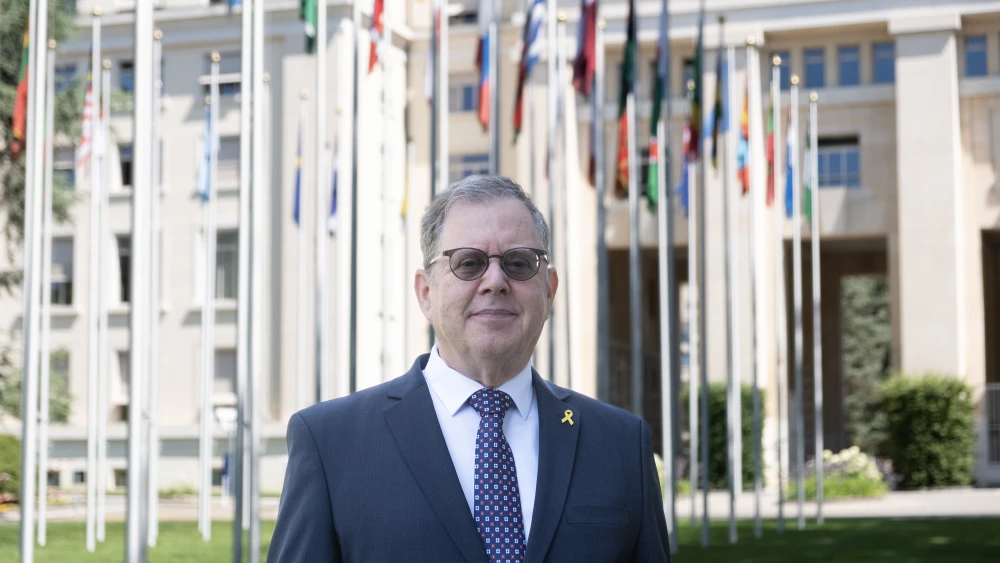
Daniel Meron, the Israeli ambassador to the United Nations in Geneva, told JNS that Tehran is receiving a different message in Switzerland than it is at U.N. headquarters in New York City.
“The Iranians are trying very hard to stay afloat here at the United Nations. They’re very present here, and they’re trying to continue to legitimize their behavior and their regime,” Meron said. “Unfortunately, they’re accepted here, inside the room, inside the plenary.”
Meron appeared incredulous as he described how Iran is treated “as if it’s any other country” rather than as “a representative of a brutal regime.”
None of the member states sitting on the U.N. Human Rights Council or other bodies “criticizes them harshly,” he told JNS.
“The language towards them is very weak, and the lead up towards this to where we are today has been pathetic,” Meron said. The United Nations has failed time after time in putting the finger on what needs to be, and that is to blame the Iranians for butchering their own people, for supporting terror, for promoting a nuclear program and all the bad things they do.”
“Instead, Israel has continued to be criticized here,” he said.
Nudged by council member Bahrain and the influential Gulf Cooperation Council members, the Security Council, which is based in New York, pushed back relatively quickly against Iran’s aggression.
Meron expressed frustration to JNS that it took nearly a month after the regime began its brutal protest crackdown in January for the Geneva-based Human Rights Council to even convene a special session on the matter, despite reports that the regime killed thousands, and possibly tens of thousands.
Even in that session, there was “no strong condemnation of the Iranians, no strong result, no strong resolution. It was pathetic,” Meron told JNS. “The U.N. is continuing to give the Iranians the platform to speak out.”
Three weeks ago, a senior Iranian official spoke at a Human Rights Council high-level summit.
“Nobody walked out of the room. He just said what he wanted to say, full of lies,” Meron said. “The U.N. mechanisms need to really put the finger on what is going on and to say this cannot go on.”
That includes a more proactive, aggressive approach, according to Meron, who cited a recent conference in Geneva, which U.N. Watch sponsored and which featured Iranian human rights defenders and activists.
“That’s what the U.N. should be about—to bring the voices of the people who are suffering under the regime there,” Meron said.
Instead, Iran is allowed to continue to “use the Israeli ticket to deflect criticism that was targeting them,” Meron said.
According to figures he saw recently, 187 U.N. General Assembly resolutions targeted Israel over the past decade and just 11 were against Iran. Last year alone, he said, there were 15 General Assembly resolutions against Israel and only one against Iran.
“They really are spearheading a lot of the criticism against Israel,” he said, of Iran. “They enjoy that criticism.”
The Israeli envoy aims to build on the criticism now being directed toward the Islamic Republic.
“We’re launching a campaign to show the difference in the attitude towards Israel and towards Iran,” he said. That includes comparing the “very stark” differences in language when it comes to talking about the two member states.
It’s “always about condemning Israel and demanding from Israel, but for the Iranians, they urge, they express concern, they call upon them, they encourage them,” Meron said.
Next week, the Human Rights Council will turn to its annual Agenda Item 7, which requires a review of Israel’s actions. It is the only country-specific, permanent agenda item for the council.
“That’s another stark example of the discrimination against the Jewish state, when there is one specific item dealing with Israel and all the other countries are dealt with under another item,” Meron told JNS. “It’s so unbelievable and repugnant, and that has to go away. So now with the Iranian issue, I’m going to use that to launch another attack on the way that the U.N. is discriminating against Israel.”