


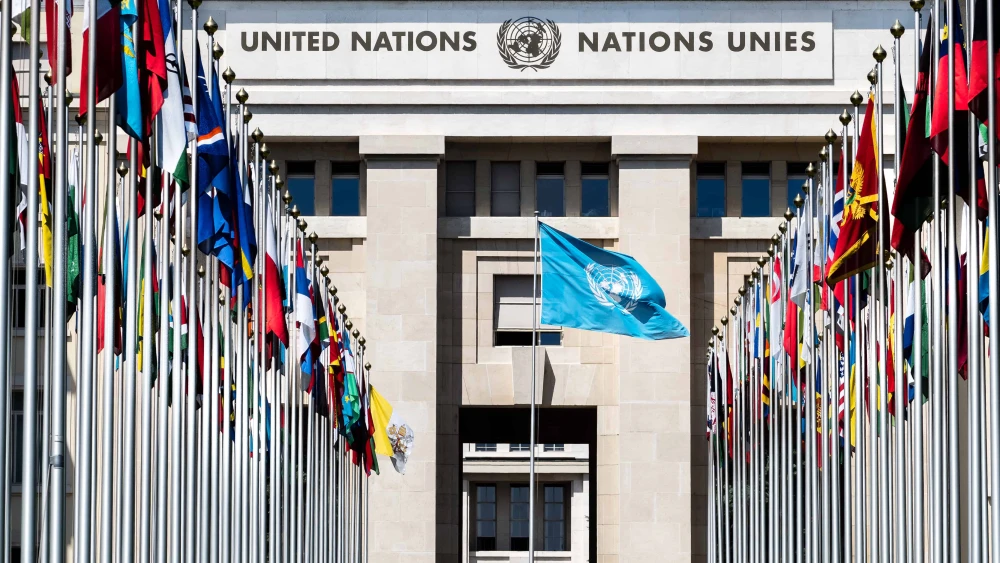
The United Nations Human Rights Council named Zeina Jallad, a Palestinian academic who justified the Hamas-led Oct. 7 terror attacks, on Tuesday to a six-year term as the global body’s special rapporteur on sanctions.
Jallad leads the Palestine Land Studies Center at the American University of Beirut, which was evacuated this week due to the threat of Iranian missile fire on U.S. educational institutions in the Middle East.
Her portfolio in the position, which Iran created, focuses on the negative impact of Western sanctions imposed on Tehran and other rights abusers.
Jallad’s appointment was unusual. Sidharto Suryodipuro, Indonesian ambassador to the global body in Geneva, who serves as president of the Human Rights Council, dismissed the vetting committee’s recommendation to select Jallad.
He cited her “practice-grounded perspective” and “pledge to approach the role with independence, transparency and a commitment to listen.”
Jallad does not appear to have expertise on sanctions. The expert whom the vetting committee chose does. Jallad also applied for the special rapporteur position on housing.
She serves as legal adviser to Michael Fakhri, U.N. special rapporteur on the right to food and a frequent critic of the Jewish state.
Jallad said last March “before talking about Oct. 7, let’s talk about Oct. 6,” blaming the United States and Europe for boycotting Hamas, which she said is the “elected government” in Gaza and a “political party.”
She also falsely said that “Hamas and its charter recognized Israel.”
Hamas’s original charter called explicitly for Israel’s destruction. A revised charter accepts a Palestinian state along the 1948 armistice lines but does not recognize Israel.
Jallad has called for “suspending Israel’s involvement in international organizations” as “a means to uphold justice.”
“The creation of Israel was the product of the wrongdoings of the West,” she has said.


