Yitzhak Shamir’s Likud Party won the Israeli elections on Nov. 1, 1988, , winning 40 seats against the Alignment Party (today’s Labor), led by Shimon Peres, with 39. Although the right-wing parties won a total of 65 seats compared to the left’s 55, Shamir preferred to re-establish a unity government with the Alignment.
One week later, on Nov. 8, 1988, George H.W. Bush was elected U.S. president, crushing his Democratic opponent Michael Dukakis in the Electoral College by 426 to 111.
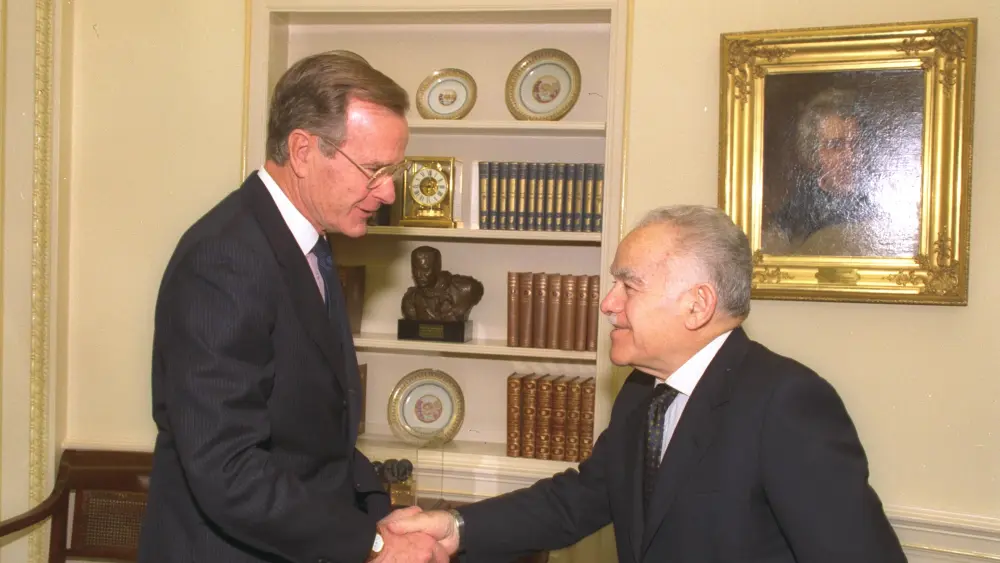
Under Shamir and Bush, Israel-U.S. relations were far from ideal. Following Bush’s death this month, three decades since those elections, Shamir’s longtime media consultant Avi Posner wrote a column reviewing the tense ties between the two figures.
“Already by their first conversation, Shamir was surprised when President Bush demanded he commit to not establish new settlements in Judea and Samaria. Shamir was unwilling to heed the demand, and attempted to evade it by responding that settlements would not constitute a problem down the road. President Bush interpreted this remark as a commitment on Shamir’s part, and he was very angry when the settlement enterprise in the territories continued,” wrote Posner.
One of the more dramatic events to occur during Shamir’s second tenure as prime minister was what is referred to in Israel as “the dirty trick,” in which Peres attempt to topple the government in which he served and remove Shamir from office. On March 15, 1990, the government was defeated following a no-confidence vote—the only incidence in Israel’s history in which this move has succeeded. However, Peres was unable to form a new government. Three months later, Shamir formed a new government—one that did not include the Alignment.
Close associates of Peres to this day point to Bush’s Secretary of State James Baker as one of the factors behind Peres’s move. Known for his critical approach to Israel, Baker issued tough demands for negotiations between Israel and the Palestinians. While Peres supported the demands, Shamir opposed them.
Another example of Baker’s harsh treatment of Israel was his decision to bar then-Foreign Minister Benjamin Netanyahu from entering the State Department’s offices.
It is interesting to note that when the Alignment was no longer in the government, relations between the two administrations calmed. Shamir met the U.S. demand for restraint during the 1991 Gulf War, even though this put him at odds with Defense Minister Moshe Arens.
By the end of that year, the Americans were pushing to hold what would be known as the Madrid Conference. While the conference did not help advance peace in the region, it did serve to sharpen tensions between Washington and Jerusalem. Shamir’s right-wing coalition partners resigned from the coalition in protest against his participation in the conference. Early elections were held in 1992 and resulted in the formation of a Labor government, headed by Yitzhak Rabin.
Abraham Diskin is a professor (emeritus) of Hebrew University of Jerusalem and a faculty member of the Interdisciplinary Center Herzliya.